|
a mystery lies at the heart of Jane Austen’s life: why was she sent away to school at seven? But at the heart of that mystery lies an unremarked failure of biographical inquiry. Sketches of two quite different houses have been accepted as Steventon rectory, her childhood home. With such a flaw at the center of Austen scholarship, how can we know the most basic facts about her home? How can we determine whether it was the “sufficiently commodious” house Jane Austen’s nephew, James Edward Austen-Leigh, described in his 1870 Memoir (23)—spacious enough for her parents, seven siblings, the family’s servants, and her father’s resident pupils? Or was it so cramped that the only girls, Jane and Cassandra, had to be sent away to accommodate all those boys?
The Austen daughters’ schooling has been the indigestible lump in the cheerful family story. It is only now that biographers have begun to cast a gimlet eye on the “hear no evil, see no evil” tradition of Austen biography laid down by her family, from her brother Henry’s tribute at her death through the reminiscences of her nieces and nephews. “It cannot be doubted that her early years were bright and happy, living, as she did, with indulgent parents, in a cheerful home,” James Edward wrote (39).
Among biographers, David Cecil represented this tradition at its most fervent in his 1978 A Portrait of Jane Austen. He wrote, “The Austen daughters, too, spent most of their childhood and youth at home under the care of their parents. This was lucky for them, as it was lucky for their brothers” (32). “Indeed,” he enthused, “home life at Steventon was affectionate, cheerful, untroubled” (34). Today’s biographers no longer gloss over the fact that Jane was cast out from the family home for almost five of her first eleven years.
To begin with, she spent the greater part of her infancy and early childhood boarded with a nurse in the village of Steventon. Rev. George and Cassandra Austen made a practice of sending their children to village women from the time their babies were weaned, at about three months, until about the age of two. At this point, when the children were walking, talking, and probably no longer in diapers, they were allowed to return. Jane’s Victorian nephew, James Edward, considered this practice “strange” but assured his readers that the parents paid daily visits to their children (39).
As harsh as such treatment may seem to a modern reader, it was evenhanded; all the Austen children seem to have been dealt with in that way. The particular harshness of Jane’s childhood lay in the early age at which she was sent away to school. No child but Jane was banished from the family as young as seven. Cassandra, who accompanied her on what would be a tragic venture, was ten, although by the time she was nine, she had already been away from home “a good deal” on visits to their cousin, Jane Cooper, in Bath (Le Faye 43; Lefroy 160).
The next youngest to be sent from the family were Frank and Charles, who embarked on their grueling training at the Royal Naval Academy in Portsmouth at twelve. In contrast, James and Henry did not leave for St. John’s College, Oxford until they were fourteen and seventeen respectively. Edward, whom George and Cassandra allowed to be adopted by wealthy relatives, Thomas and Catherine Knight, seems to have begun dividing his time between the two families when he was twelve and was formally adopted in 1783 at sixteen. George, suffering from an unspecified mental condition, was sent to live with caretakers while still a boy.
The school that the Austens chose to send their daughters to was run by a member of their extended family. Mrs. Austen’s sister, Jane, was married to Rev. Edward Cooper and it was his widowed sister, Ann Cawley, to whom they entrusted their daughters in 1783. The Coopers sent their daughter off to join her cousins at the school at Oxford. Jane Cooper was eleven, four years older than Jane Austen.
Did the family connection in some way counterbalance Jane’s scant seven years in the Austens’ minds? As it was to fall out, the family connection availed them nothing. The treatment the girls received at the hands of Mrs. Cawley brings to mind scenes from Charlotte Brontë’s Lowood. Between the spring when the girls arrived, and the following October, Mrs. Cawley moved her school from Oxford to Southampton, a port city where ships from around the world disgorged sailors—and disease. All three girls fell ill with what was probably typhus fever (Le Faye 45).
What happened next is incomprehensible. Mrs. Cawley did not notify the parents, but maintained a silence in the face of this grave situation. It was older, courageous Jane Cooper who managed to get word out.
The mothers rescued their daughters and swept them off to their homes. In Bath, Jane Cooper, Cassandra Austen’s sister, caught the disease herself and died on October 25 at the age of forty-seven. Seven-year-old Jane Austen was so ill that she nearly died and was convalescent for about a year.
Mrs. Austen was defensive about her decision to send newly recovered eight-year-old Jane away to a different school in the spring of 1785. One of Jane’s nieces, Anna Austen Lefroy, remembered Mrs. Austen telling her that “Jane was too young to make her going to school at all necessary, but it was her own doing; she would go with Cassandra: ‘if Cassandra’s head had been going to be cut off Jane would have her’s cut off too—’” (Lefroy 160).
Abbey School at Reading was run by a self-styled Mrs. La Tournelle, actually Sarah Hackitt, who had a cork leg and, in the words of one contemporary, “was only fit for giving out clothes for the wash, making tea, ordering dinner and, in fact, doing the work of a housekeeper” (Le Faye 48). It may be, however, that Austen’s accomplishments—French, some Italian, the ability to play the pianoforte well and a fine skill with the needle—were acquired from the teachers Mrs. La Tournelle employed, as Deirdre Le Faye suggests (48). It is also possible that she acquired them at home, from her parents, brothers, or from special teachers like John Claude Nattes, employed by her father to teach drawing and painting (Le Faye 47), and a “music Master” the Austens may have hired (Lefroy 183).
It was near her eleventh birthday in December, 1786, twenty months after she left for Reading, that Jane Austen was allowed to settle into the bosom of her family for good. She returned home still younger than the age at which any of her brothers was sent away.
Jane’s father had been taking in young male scholars to prepare them for university since 1773, two years before her birth. His deep interest in both the classics and the latest publications attest to the breadth of his interests. His library was extensive for a man who was never rich—500 volumes at the time of their move from Steventon in 1801. Biographers have commented on Mrs. Austen’s deep involvement in the school, running it like “a large family” (Tomalin 24). She fed her young male charges, attended to their clothes, nursed their scrapes and illnesses, cosseted and chivied them.
The Austens do not seem to have been cold, indifferent parents. Mr. Austen opened his library to his girls, encouraged Jane’s writing, and worked to find publishers for her early novels. He does not seem to have been one of those men who believed that women shouldn’t use their minds. Why then were the girls sent away to school for an education that was inferior to that which their parents could have provided?
The likely explanation of the girls’ expulsion from home, offered by present-day biographers, is a simple one: the Austens needed to free up space for paying scholars (Honan 30; Tomalin 33; Halperin 25). Rev. George Austen was often in debt and never flush. He paid £35 per term, per girl, and received about the same amount at that time for each student he taught. The math suggests that he was hoping for many more students than he had daughters.1
Leaving aside questions of the parents’ motives, the children’s needs and desires and the traditions of their time and place, this article attempts to approach the problems of the girls’ rough usage by coming at it from an empirical angle. Was space the real problem?
Two kinds of information are required to sketch the answer to this question: how big was Steventon rectory and how many people lived there? Such beguilingly simple questions! But like many issues Jane Austen’s biography raises, the answers prove elusive, despite or perhaps because of the reams of descriptions and memoirs left by her highly literate family.
The mystery of Steventon Rectory
Unlike her residences in Bath, Chawton, and Winchester, the house Jane Austen grew up in no longer stands and was razed in the 1820s before the advent of photography. Instead, three drawings that represent it have been bequeathed to us. But rather than helping our understanding, they only create confusion.
The drawings come from an impeccable source. They were done, so it has been agreed, by Anna Austen Lefroy, the oldest child of Jane’s oldest brother, James. Anna knew the house well. Born to James and Ann Matthew in 1793, she was two when her mother died and she was sent to live with her grandparents and aunts, Jane and Cassandra, at Steventon until James remarried in 1797.
Then in 1801 the traumatic removal of Jane’s family from the rectory made way for the arrival of Anna’s. James not only took over his retired father’s living, but his house and many of the family’s possessions as well. He moved in with his second wife, Mary Lloyd Austen, their son, James Edward, and with Anna, then eight (their second child, Caroline, was born there in 1805). It was Anna’s home until age twenty-one when she married Ben Lefroy and apparently took her pen and tablet around the neighborhood to record and bid farewell to the scenes of her youth.
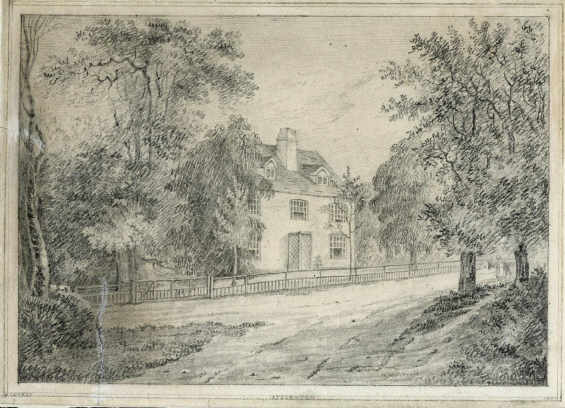
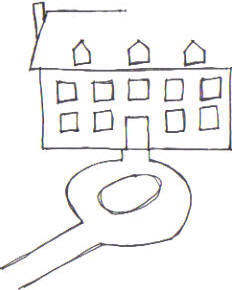
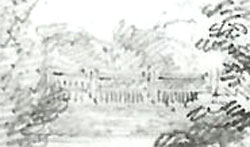
While Anna made one sketch of the back of the rectory which is labeled and dated 1814, she made sketches of the fronts of two houses. Some biographers have illustrated Austen’s childhood home with one of these front views, and some with the other. What baffles is that they haven’t explained their choice, or even noted that they have made one, much less defended it. Here are the sketches of the fronts of the two houses, with the proponents of each.
The Two Versions of Steventon Rectory
1) Anna Lefroy’s sketch of the front of the smaller house with a latticed entryway,
2) Schematic rendering of Anna Lefroy’s drawing of the front of the larger house.
The original of this sketch was not available for this article, but a later engraving based on it but with significant alterations, and used in the Memoir, is reproduced below (illustration #6). The original sketch can, however, be found in Tomalin (after 76) and Cecil (127) (misidentified as Chawton). The author’s rough sketch is meant to indicate the number and approximate position of the windows, attic dormers, door, chimney, and sweep as a means of comparison with the smaller house. The broken roof line reproduces the effects of obscuring trees in Lefroy’s drawing.
The back view
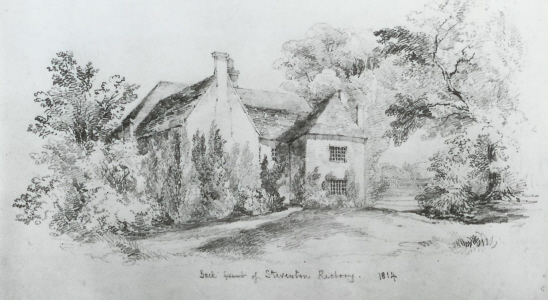
Let us begin our study of Anna’s drawings of the parsonage with the one about which there seems to be universal agreement. Austen’s biographers concur that Lefroy’s drawing labeled “Back [Front—(crossed out)] of Steventon Rectory,” and dated “1814” is exactly what it says it is.
3) The back view of Steventon rectory, courtesy of the Jane Austen Memorial Trust.
Steventon rectory faced north, and the back, or southern, façade reveals a house about twice as wide as deep, with two rear wings projecting from it forming a rough U-shape. Between the wings we can see a narrow portion of the back of the main structure where apparently a door gives onto a path that emerges and curves to the west (left).
Differences between the wings suggest their having been built at different times. That on the southwest (left) corner is significantly larger with a gabled roof; the wing on the southeast (right) is neither as deep nor as high and has a hipped roof. Neither wing is as tall as the original house, and the southeast wing appears to have an especially shallow attic. The attics in both wings appear to be quite low and raise the question whether they communicate with the attic of the main part of the house. Neither of the added attics appears to have windows.
A large chimney, partly hidden, rises from the front slope of the hipped roof; altogether there are five chimneys. The windows have small panes and it is hard to determine whether they are casement or sash although a slight curve on the bottom of the second story window in the southeast (right) wing suggests a bow window. On the east (right) side of the house a cleared area can be glimpsed, and beyond that, a fence.
Assessing the accuracy of Anna’s drawings
Is there any easy way to eliminate either of Lefroy’s drawings of the front of the house? Were her eye and hand reliable? She left many sketches behind by which to judge her, in addition to the three that have been associated with Steventon rectory. These include a view of cottages labeled “Steventon” (Cecil 22; Tomalin after 76), “Old Church at Deane” (Cecil 57), “Chawton Church” (Cecil 194) and Steventon (mislabeled Chawton) Manor House (Cecil 159).
Since so many of the buildings she sketched have been lost, comparisons between her renderings and the real thing are hard to find. But one interesting comparison is possible. Her drawing of Chawton Church, which can be found in Cecil (194) and online at http://www.janeaustensoci.freeuk.com/pages/biography.htm, agrees with a painting of it done about the same time (1809) by an anonymous artist and reproduced by both Cecil (unnumbered page after 128) and Nicolson (175). There is a striking and convincing resemblance and what differences there are might be explained by the painter’s and not Anna’s inadequacies.
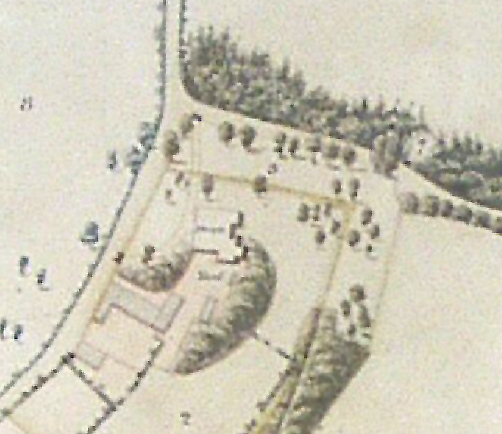
Support for Anna’s renderings of the rectory comes from two sources. The first is an 1821 plan of the Glebe land at Steventon. It shows the house, outbuildings, yard, fields and lane surrounding it.
4) 1821 Plan of the Glebe Land at Steventon, detail, courtesy of the Jane Austen Memorial Trust.
We see a house set back by about the distance of its width from a road which, perhaps about two more widths to the east, meets another lane that runs south (here, right) up a slope to Rev. Austen’s church, St. Nicholas.
Two additions to the southern (back) façade form the U Anna depicted, although it appears shallower. Small projections off the southwest (left) wing do not agree with Anna’s sketch perhaps because they were added later, she neglected to render them, her bushes hide them, or the map itself is in error. Outbuildings surround an open space marked “yard” to the west (left) of the house in the direction of the path Anna illustrated.
In further support for Anna’s sketch is a 1696 description of the house from the Diocesan Records, Winchester, Hampshire as “consisting of two Bays of building, outletted at the West end, and part of the South side over the Cellar” (Tucker 1983, 29). The other wing, the southeastern, presumably was added between 1696 and 1814.
In addition to Anna’s drawings are family reminiscences of Austen’s home. At the time James Edward was writing his Memoir in 1870, Anna (the artist), their sister Caroline Austen Craven, and Catherine Austen Hubback, Frank’s daughter, contributed their recollections. In a letter from Anna to James Edward, written probably in 1869, she recalled:
On the west side was a garden tool house. On the south a door communicated with the back yard—not far from the granary—another door opened into the larger garden, in the east wall, I think. I remember this sunny cucumber garden well—its frames, and also its abundance of pot-herbs, marigolds, etc.—Oh! me! we never saw the like again. (Le Faye 18).
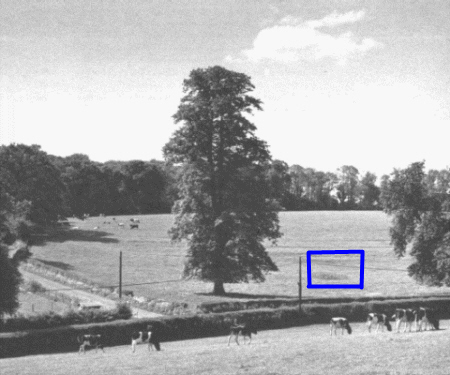
In a modern photograph of the now empty field in which stood Jane Austen’s childhood home, a pump enclosed by a low fence can be discerned (Nicolson 22-23). This is the sole remaining item dating from Austen’s time. It likely stood near or within the cucumber garden on the east side of the house.
5) Photograph of the site of Steventon Rectory (detail), showing a pump,
The front
Now we come to the two front views. They are similar, with doors and windows disposed along a central axis. Differences, however, abound:
The chimney
A huge chimney towers over both the back view of the house and the front view of the smaller house. It seems to have been a central chimney serving more than one fireplace. But in Anna’s sketch of the larger house, this commanding chimney has disappeared, unless simply obscured by her persistent foliage. Instead, a tall chimney stands on the far east (left) end of the roof. Not only does this chimney not appear in the back view, but its location suggests a matching chimney serving the other side of the house which is not present in the back view either.
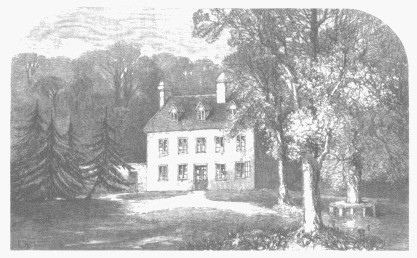
The subject of the chimney regrettably introduces yet another rendering of Steventon rectory that we are obliged to consider. Austen-Leigh’s Memoir is illustrated by a wood engraving that was made from Anna’s sketch of the larger house.4
6) Wood engraving of Steventon Rectory from James Edward Austen-Leigh’s Memoir (22).
It wasn’t a simple translation of a scene from one medium to another, however, because substantial changes were made. Where all was impressionistic haze in the sketch is now hard-edged assertiveness.
The chief difference between Anna’s drawing and the later woodcut of the larger house is the sudden addition of the central chimney. Not just any chimney, but an emphatic and imposing one that vehemently exaggerated the two renderings of a central chimney in the front view of the smaller house, and in the back view. In those views, Anna showed it centered, although possibly a hair to the west of exact center. But the phallic chimney in the woodcut is far off center to the west, midway between the middle and the west attic windows.
The fence
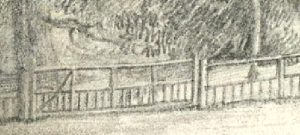
Amid contradictory views, failed correspondences and bewildering details, one piece of evidence stands refreshingly clear—the fence that in the sketch of the smaller house separates it from the road. It is a distinctive fence, divided into sections about six feet long. A horizontal rail runs equidistant between a top rail and the ground; below this middle rail stand evenly spaced pickets. On the east (left) side of the house it is broken by a gate (set in double posts) which has vertical pickets between the middle and top rails, as well. Beyond the gate is an open space which presumably is a drive.
In Anna’s drawing of the back view, the clearing is distinct. And beyond it—that very fence and gate. This drawing clearly shows the same distinguishing arrangement of pickets on the fence, and the gate with its double posts and pickets above the middle rail.
7) Detail of the fence and gate from Anna Lefroy’s sketch
8) Detail of the fence and gate from Anna Lefroy’s
Before the larger house is a drive culminating in a spacious sweep for carriages to turn around. No such drive leads to the smaller house which is closely bordered by the road. Although neither sketch perfectly accords with the glebe map of 1821, the sketch of the smaller house is the better fit. In that sketch, a road parallels the front of the house as does the drive that branches from the main road on the map. What the glebe map doesn’t show is a looping sweep.
Austen-Leigh firmly asserts the presence of a long carriage drive. “North of the house, the road from Deane to Popham Lane ran at a sufficient distance from the front to allow a carriage drive, through turf and trees” (Memoir 23).
Jane Austen herself would seem to clinch the matter. She wrote to Cassandra in November, 1800 about a great storm that felled trees on the property. “—I was sitting alone in the dining room, when an odd kind of crash startled me—in a moment afterwards it was repeated; I then went to the window, which I reached just in time to see the last of our two highly valued Elms descend into the Sweep!!!!!” (8-9 November 1800).
If the presence of the fence in the drawing of the back view, and in the drawing of the front of the smaller house, would seem to determine that the smaller house must indeed be the rectory, then the presence of the sweep in James Edward’s reminiscences and Austen’s own words would seem to settle the matter in favor of the larger house. One way to resolve this dilemma is to proceed into the house itself and discover the location of the dining room from which Austen saw the tree fall.
Inside the house
James Edward tells us that the sweep was in front of the house, but Austen herself says only that it was visible from the dining room window. Where was the dining room?
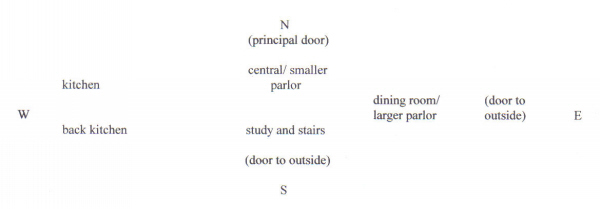
Downstairs
Austen’s niece, Catherine Austen Hubback, never saw the rectory, but left this description apparently gleaned from the reminiscences of her father, Frank, and others. “The Parsonage consisted of three rooms in front on the ground floor—the best parlour, the common parlour and the kitchen; behind these were Mr. Austen’s study, the back kitchen, and the stairs” (Le Faye 17).
Anna, who lived at Steventon until she was twenty-one, wrote,
The lower bow window [in back], looking so cheerfully into the sunny garden, up the middle grass walk bordered with strawberry beds, to the sundial, belonged to my Grand Father’s study; his own exclusive property, & safe from the bustle of all household cares. The Dining or common sitting room looked to the front, & was lighted by two casement windows; on the same side, the principal door of the house opened into a parlour of smaller size. Visitors, it may be presumed, were few and rare; but not a whit the less welcome would they have been to my Grand Mother on account of their finding her seated in this very entrance parlour, busily engaged with her needle, in making or repairing (Le Faye 18).
We probably know on which side of the house the kitchen lay. The 1697 description of the property notes that the original house had been “outletted at the West end, and part of the South side over the Cellar” (Tucker 1983, 29). A kitchen would probably have been built over a cellar for the convenient storage of foodstuffs. The southwest wing is also dominated by a broad fireplace and tall chimney, suggesting that it was used for cooking, roasting, and baking. A kitchen on that side of the house would also be near the outbuildings which we know included not only the granary, but a dairy, hen house, stables, and other farm buildings. The glebe map and Anna’s footpath both indicate that these buildings lay to the west of the house.
With these fixed points, it is possible to devise a room plan for the downstairs. This plan isn’t meant to indicate size, but to suggest the relationship of the rooms to each other.
9) The probable arrangement of the downstairs rooms at Steventon.
Jane Austen was sitting in the eastern room, the dining room, also called the parlor, when the violent storm felled the elm tree. This room, according to Anna, looked to the front and had two windows; these windows might both have been in the front, or one in the front (north) and one in the east side overlooking the garden. The sweep may have been in front of the house, as shown in the drawing of the larger house and the woodcut based on it. But it is also possible that the sweep may have been that cleared space to the east of the house that appears in Anna’s drawings of both the back and the front of the smaller house.
Upstairs
According to Catherine Austen Hubback, the rectory also contained “seven bedrooms, and three attics. The rooms were low-pitched, but not otherwise bad, and compared with the usual stile of such buildings, it might be considered a very good house” (Austen-Leigh, William, 17).
How large these bedrooms were is open to conjecture. Anna noted that the bedroom that Jane and Cassandra had always used was smaller than a room later given to them for an adjoining drawing room (Le Faye 69). Jane, visiting Bath in 1799, described to Cassandra a room in a sarcastic vein that undercuts the description of their bedroom at home, “we have two very nice sized rooms, with dirty Quilts & everything comfortable. I have the outward & larger apartment, as I ought to have; which is quite as large as our bed room at home, & my Mother’s is not materially less” (17 May 1799).
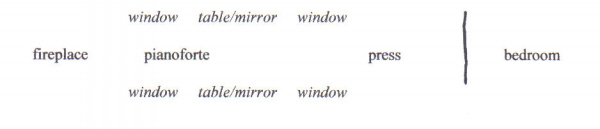
One pleasing side note to the investigation of the size of the rectory is discovering the apparent location of the bedroom that Jane and Cassandra shared. It appears to have been on the eastern side of the house. The source of this is Anna, who remembered that after their brothers had grown up and gone, and they were young women, “one of the Bed chambers, that5 over the Dining room, was plainly fitted up, & converted into a sort of Drawing room. . . . This room, the Dressing room, as they were pleased to call it, communicated with one of smaller size where my two Aunts slept” (Le Faye 69). She recalled that a press stood with its back to the wall that adjoined the bedroom, and opposite the fireplace. On one wall, two windows enclosed a looking-glass, beneath which was a table containing “2 Tonbridge-ware work boxes” (Le Faye 69).
This transformation probably took place in December 1798, just before Jane turned twenty-three when she wrote Cassandra, “We live entirely in the dressing-room now, which I like very much; I always feel so much more elegant in it than in the parlour” (1-2 December 1798).
Because we cannot know in which direction the rooms were laid out, we can’t determine which side the windows were on, and they are marked in italics for that reason. They were on one side or the other. As in the other sketch, only the relationships are indicated; size and proportion are unknown.
10) The probable arrangement of the dressing room and bedroom of Jane and Cassandra Austen at Steventon.
Theirs was not the only sitting room apparently converted from a bedroom, because Austen wrote that there were four sitting rooms in the house (14-16 January 1801). If one counts the two downstairs parlors and the sisters’ drawing room, it suggests that her parents may have made a room for themselves perhaps adjoining their bedroom which contained “such a bed” that they took it to Bath rather than fail to find its equal there (3-5 January 1801).
Two sitting/bedroom suites would account for four bedrooms. Austen notes a possible fifth when she wrote to Cassandra about the “best bed-room” (3-5 January 1801), which may have been reserved for company.
A closer accounting of bedrooms isn’t possible from an enumeration of beds. The only mention of their number is in 1801 when Jane wrote to Cassandra that they were taking six beds with them to Bath: their parents’, “our own two, the best for a spare one, & two for servants” (3-5 January 1801). Other beds, apparently, were being left for James’s family.
Having accounted for four or five bedrooms, we cannot be certain that Hubback was correct in her reference to seven. She never saw the house, and in one case her account is open to question. She noted that the rooms were low-pitched, yet Mr. Austen owned a book case that was eight feet by eight feet. A ceiling that is at least eight feet high doesn’t seem low-pitched, except, perhaps, to the daughter of an admiral who may have been accustomed to loftier ceilings.
The attics
Hubback was correct in that there were three attics; we can see them in the sketch Anna made of the back of the rectory. From this sketch it seems possible that the attics in the additions did not communicate with that in the front part of the house, although it is also possible that low doors were built through. Since Hubback mentioned only one stairway, it is possible that ladders were used to get from the second story up to the attics in the two wings. Because there are no windows in the attics over these wings, they may have been used for storage rather than sleeping. At Chawton the garrets were planned for “Storeplaces” and quarters for a manservant (20 November 1808).
Tomalin suggests that the resident pupils probably lived in the attics (23). But if so, then where did the servants live?
Which house?
It was one house or the other. Perhaps some new discovery will unassailably point the way to a certain choice; until then we have to use our best judgment. The arguments favor the smaller house and vary from empirical to impressionistic. The appearance of the same distinctive fence in front of the smaller house and in the back view has to be paramount. The chimney that dominates the smaller house and the back view is missing in the drawing of the larger house, although it may simply be hidden by an overhanging tree.
Also important is the tone of apology Jane’s descendents take in describing the rectory. Anna, writing of the dressing room remembered “its scanty furniture and cheaply papered walls” (Le Faye 69). James Edward, who lived in the house with his own family, noted that,
the rooms were finished with less elegance than would now be found in the most ordinary dwellings. No cornice marked the junction of wall and ceiling; while the beams which supported the upper floors projected into the rooms below in all their naked simplicity, covered only by a coat of paint or whitewash: accordingly, it has since been considered unworthy of being the Rectory house of a family living (23).
The smaller, humbler house required a cozy but ungracious latticed entryway to protect the occupants of the parlor directly within from wind, rain, and cold. In fact, if one strips away the second story and adds thatching, it bears a powerful resemblance to Anna’s sketch of the rustic cottages that made up the village of Steventon, with their protected doors, attic dormers and proximity to the road. James Edward himself makes this point, “It may be that the contrast between the parsonage house and the best class of cottages was not quite so extreme then as it would be now” (39). The sketch of the Steventon cottages can be found in Cecil (22) and Tomalin (after 76).
The main argument in favor of the larger house is the obvious one that James Edward chose it to illustrate the rectory in his Memoir, with the presumed agreement of his sisters, Caroline and Anna. All three grew up in the house and knew it better than any other of Jane’s descendants.
But finally, it is the fence that persuades that it was the smaller house. The fact that the same fence appears in Anna’s sketches of the back of the rectory and the front of the smaller house overrides everything else. It is hard to overlook such a precise match of an apparently unimportant detail. Furthermore, Anna drew it in person, when it was there before her eyes in 1814. Her memories, and those of Caroline and James Edward, were more than forty-five years old by the time the Memoir was written. Of her Aunt Jane, she admitted, “my reminiscences are few; surprisingly so, considering how much I saw of her in childhood, & how much intercourse we had in later years” (Lefroy 157). It seems sensible to go with the contemporary depiction: the sketch of the smaller house.
The identity of the larger house
How do we account for Anna’s sketch of the larger house? If it wasn’t Steventon rectory, do we just dismiss it as the “not-Steventon-rectory” drawing? The subjects of all the drawings she made have been identified and all seem to have been some place with which she was intimately familiar. Why not, then, the larger house?
Martha Lloyd, the widow of Rev. Noyes Lloyd rented Deane parsonage from Rev. Austen in 1789. Deane was within walking distance of the Steventon rectory, and the Lloyd daughters, Martha and Mary, became good friends of Cassandra and Jane. In 1792, the Lloyds moved to Ibthorpe, less than twenty miles away. After the death of his first wife and Anna’s mother, James married Mary Lloyd in January, 1797 and the Lloyds of Ibthorpe became Anna’s new family. Following the deaths of Rev. Austen and Mrs. Lloyd in 1805, Martha moved in with Mrs. Austen, Jane and Cassandra; eventually she married Frank Austen in 1828.
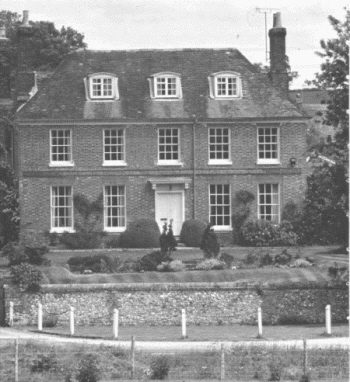
It is plausible that the larger house Anna sketched might have been that of her step-mother’s family, the Lloyds, and that the house was Ibthorpe.
11) Photograph of Ibthorpe House from Nicolson,
Ibthorpe still stands, and the photograph above shows that like the larger house that Anna drew, it has a hipped roof, three attic windows, five upstairs windows, and two on either side of the front door. It has no central chimney, but rather end chimneys, the left one of which Anna depicted. A spacious yard allows room for a sweep. Small details don’t correspond: the relation of the chimneys to the roof, the shape of the dormers and the recessed front door.
Let us imagine that this is the correct supposition: the larger house is Ibthorpe and the smaller, the rectory. Why then did the larger house find its way into Edward’s 1870 Memoir when he as well as Anna and Caroline well knew that it was the wrong house?
One hint comes from the difference between Anna’s original sketch of the larger house, and the woodcut that was based on it. One is modest and engulfed in foliage, the other is forceful and imposing. In the woodcut, the foliage had been pruned away to reveal a triumphant chimney—the same chimney that appeared in Anna’s sketch of the back of the house and the most prominent feature that they knew they would have to include.
Is it possible that the family offered this more imposing house knowing it was not the rectory? There is something in the psychology of Jane’s family and some subsequent biographers that required them to pretty up much of her life. In this vein, she had the happiest life in England’s happiest time—a reductive view challenged by more recent biographers.
The strongest proof of their willingness to alter reality to prettify her life comes from her very portrait. Cassandra painted a watercolor portrait of Jane that shows a strong face unrelieved by the trouble of a pleasant smile and her arms crossed almost truculently. The steel engraving of Jane in the Memoir, however, has been doctored and what was an interesting and almost challenging visage has become sweet, demure and characterless.
Anna considered Cassandra’s watercolor to be “hideously unlike” her aunt’s true appearance (Le Faye 75). But Cassandra was the family’s artist. She left behind portraits of the royals who were featured in Jane’s “History of England,” a painting of Jane seated outside in a billowing blue gown and a lovely portrait of her niece, Fanny Knight Knatchbull.
So the family altered Cassandra’s “hideously unlike” portrait and substituted their view of what Jane should have looked like. It is not hard to believe that a family that would do this to her face, would be more than willing to do it to her house. The two portraits may be found in almost all the biographies and online: The watercolor of Jane by Cassandra at: http://www.janeaustensoci.freeuk.com/pages/biography.htm. The steel engraving that appeared in the Memoir, at: http://www.jasna.org/persuasions/on-line/vol29no1/images/nigro-jane_austen_1870.jpg.†
Servants, sons and students
How many people lived in this small house? Three groups need to be counted, the Austens’ servants, sons and students.
Servants
To understand how many servants may have lived with the family at Steventon, it’s instructive to look at how many servants they kept after Mr. Austen resigned and the family lived in straitened circumstances.
The Austens kept a fairly constant ratio of one live-in servant per family member after they moved from Steventon to Bath. Only a handful of letters remain from the Bath period when Jane Austen fell silent. But on vacation in Lyme Regis in 1804, Jane and her parents (Cassandra was at Godmersham with the Knights) took off with four servants in tow: Molly, Jenny, a cook, and a manservant named James, whom she praised to Cassandra. “My Mother’s shoes were never so well blacked before, & our plate never looked so clean” (14 September 1804).
Rev. Austen died in Bath in 1805, and two years later, Mrs. Austen, Cassandra, and Jane moved with Martha Lloyd to Southampton. In 1807 Austen made mention of three maidservants: Molly, Jenny and Phebe (7-8 January 1807). The next letter acknowledges the assistance of a Mrs. Hall, in moving in, and the addition of a gardener, Choles (8-9 February 1807), who was with them until they fired him for drunkenness and replaced him with Thomas Carter (30 January 1809).
At Chawton, Austen’s home from 1809 until her death in 1817, at least two maidservants made their home with them: Sally, who seems to have stayed with them at least five years (29-30 November 1812; 23 January 1817), and Betsy (29 January 1813). In addition, they kept a cook and a new manservant, Browning (9 February 1813). Often during these years, Cassandra was at Godmersham and Jane began making extended visits to her brother Henry in London.
It is not surprising, knowing how many servants the Austens kept in their lean years, to learn that they employed many more at Steventon. In October, 1798, Jane and her parents returned from a visit to Godmersham and Jane wrote Cassandra, who stayed on, about the happenings at Steventon. Within the period of a little more than a month, for a family that now included only their parents and the two of them, Austen enumerated nine household servants: Nancy Hilliard, Molly, Dame Bushell (a washerwoman whom John Steeven’s wife was to replace) and Dame Staples who was acting as maidservant in the absence of any other (27-28 October 1798). In mid-November Nanny Hilliard’s illness necessitated the hiring of two charwomen and Nanny Littleworth dressed Jane’s hair (25 November 1798). Soon a new maid was hired who, in addition to cooking and sewing, was to be trained to work in the dairy (1-2 December 1798).
It is impossible to know which servants had quarters in the parsonage. Because Nanny Hilliard had her child with her while the family was away, it is possible that she did (27-28 October 1798), as well as Molly, Nanny Littleworth, and the new maid. It is likely that the women who did the washing and cleaning lived out and almost certain that John Bond, her father’s bailiff, and the male laborers who worked the farm and tended to the livestock did as well.
Even though some servants did not live in, they may regularly have spent nights at the parsonage when circumstances warranted. Mrs. Austen’s ill health, preparations for a visit or trip, days of washing and ironing clothes, preserving and canning food—all these events may have been reason for any of their women servants to stay over in beds and rooms that were maintained for them. These same quarters may have also housed temporary tutors: those music, painting, and dancing instructors who made their ways through villages at the time.
In 1798 as many as nine servants saw to the needs of four adults, three of whom were women who bore many household responsibilities themselves. However, when the house was filled with the Austen’s five sons (six until George was moved to his caretakers’ home) and Rev. Austen’s teenage students, many more servants would have been required and pupils’ tuitions would have helped pay for them. The cooking, cleaning, and laundering alone would have been daunting. When the younger children returned from their village nannies, some of the nannies, perhaps Hilliard and Littleworth, came with them as Jane’s poem to Frank attests (26 July 1809).
How many servants did the Austens employ at the time Jane was sent away to school in 1783? Enough to fill the attics.
Sons
With the attics filled by servants, how many people occupied the bedrooms?
One hint of the number that could squeeze into the rectory, albeit for a brief period, is given by Mrs. Austen when she enumerated the thirteen present for Christmas celebrations in 1786: herself and Rev. Austen; five of their children; Mr. Austen’s sister, Philadelphia Hancock; Hancock’s daughter, Eliza de Feuillide and her young son with his French maid, and the two motherless Cooper children (Le Faye 54). In addition, there would have been the Steventon servants.
Jane and Edward Cooper paid long visits to Steventon at other times as well, according to James Edward’s Memoir (27). They had lost their mother in 1783 and their father died in 1792, the year Jane Cooper was married from Steventon.
The Austen children were born over a span of fourteen years and James, the oldest, left for Oxford the year Charles, the youngest was born. James was born February 13, 1765 and left for Oxford at fourteen in 1779. George, born August 26, 1766, was established in his own household while still a child. Edward, born October 7, 1767, began to make extended visits to the Knights after 1779 at about the age of twelve and was adopted by them in 1783 at the age of sixteen. Henry, born June 8, 1771, did not leave home until 1788, when he went to Oxford at seventeen.
Cassandra, born January 9, 1773, had been making visits to her aunt and uncle, the Coopers, in Bath by the summer of 1782 when she was nine; she left for school with Jane in 1783 when she was ten. Frank, born April 23, 1774, left for the Royal Naval Academy in Portsmouth at twelve, in 1786. Jane, born December 16, 1775, went to school in 1783 at the age of seven, returned to recover from her illness for one year, and resumed school from 1785 to 1786. Charles, born June 23, 1779, left for the Portsmouth facility at twelve in 1791.
The following table shows which children were at home from the time Jane was born in 1775, through 1791 after which the only children left at home were the girls, Cassandra, eighteen, and Jane, fifteen.
Number of Austen Children at Home, 1775-1791
N--denotes the first two years spent with a nurse in the village; H--at home; C--with Coopers (counted as at home); K--visiting (counted as home) or A--adopted by the Knights; S--school. Because George was apparently settled away from home before Jane was born, he is not shown. The years Cassandra and Jane were at school are in bold type. The visiting Cooper cousins are not counted in the totals. To avoid confusion, once a child left for school, the symbol remains the same, even after the child reached adulthood.
Students
Between 1775, the year Jane Austen was born, and 1795 when she was nineteen, George Austen invited at least fourteen students into his home and had taught John Wallop for a few months in 1773 (Letters 564) and William Vanderstegen from 1773 through 1778 (Le Faye 23, 39). At least ten of them stayed four years or more. Some of them are mentioned in the Austens’ letters, some in a poem by Mrs. Austen, and others in Mr. Austen’s accounts at Hoare’s bank. But the inexactness of our knowledge of the precise terms students stayed with the Austens argues for lacunae in these records. Possibly more students made their home with the Austens than we know.
The students included in the table below are listed in order of their attendance. William Vanderstegen studied with Rev. Austen from 1773 to 1778 (Le Faye 23, 39), Fulwar Fowle from 1778 to 1781 (Letters 524), Gilbert East by 1779 to 1783 (Le Faye 39), Frank Stuart by 1779 to 1782) (Le Faye 39), George or Henry Deane (it is unclear which brother it was) by 1779 to 1786 (Le Faye 39), and Tom Fowle (later Cassandra’s fiancé who died on a trip to the West Indies in 1797) from 1779 to 1783 (Letters 525).
William Fowle attended from the early 1780s until at least 1786 (Le Faye 53, Letters 525), George Nibbs from about 1781 to 1783 (Letters 558), John Warren from sometime in the 1780s to probably 1786 when he matriculated at Oxford (Le Faye 53), Charles Fowle from sometime in the early or mid 1780s until the late 1780s (Letters 525, Le Faye 53), Richard Buller from 1790 to 1795 (Letters 503), William Goodenough about 1791 to 1795 (Le Faye 68), Deacon Morrell from 1791 to 1792 (Le Faye 262), and Francis Newnham from 1793 to 1795 (Le Faye 262) .
Paying Students Living in the Rectory, 1775-1795
A question mark preceding a name indicates that this date has been suggested but is not certain. Years Jane and Cassandra were in school are in bold; Jane was home recovering from typhus in 1784.
Now is the time to attempt to calculate the grand total of people living at the parsonage between 1775 when Jane Austen was born and 1795 when her father ceased teaching. The two Cooper children are not included in any of the totals but are represented so that their possible presence is not overlooked. The grand total includes four to eight live-in servants although it is possible that in the hectic days when ten or twelve children filled the small house, there were more.
Estimate of the Total Number of People Living in the Rectory, 1775-1795
In 1781 and 1782 the Austen household was bursting with as many as twelve young people. In the four years between 1779 and 1782, as many as sixteen to twenty-two people made their home in the rectory. The next year Edward was adopted and Cassandra and Jane sent off to school.
It is hard to draw any conclusion other than that the girls were sent away in 1783 to relieve crowding in the Austen home. That year Rev. Austen managed to attract between four and seven students, perhaps as many as he ever had at one time. It must have seemed that his academic enterprise was thriving.
But then came 1784 when Jane was home with fever and enrollment dropped precipitously. Her father never recovered the number of students he had before her illness. The irony was that in order to take in more students, her parents sent her away. Yet as a result of having sent her away, they saw their flourishing school falter and never recover.
Conclusion
By logic alone, we know that Jane Austen had an unhappy childhood. If her home life was happy, then she was exiled from it for three years; if her home life wasn’t happy, then it’s doubtful her childhood was either. By her own writing we know she often turned to thoughts of the unhappiness of a daughter exiled from home. It was also one of her earliest themes. Upon returning home just before her eleventh birthday, she took up her pen to write the witty confections that make up “Volume the First.”
“Henry and Eliza” is one of her earliest pieces. Dedicated to Jane Cooper, whose mother died of the fever the three girls caught at Mrs. Cawley’s school in Southampton in 1783, it was written between 1787 and 1790 (Austen 1), possibly 1788 (Le Faye 64). Jane Cooper, the oldest of the three suffering cousins at the school, was the one with the courage or guile to call for their rescue.
“Henry and Eliza” tells the story of a baby girl whose mother hid her in a Haycock because she dreaded her husband’s “just resentment at her not proving the Boy you wished” (Austen 39). Kicked out from her home for stealing from her father, the now young woman enjoys many improbable adventures typical of Austen’s juvenilia. Eventually, alone with two young charges, Eliza is imprisoned by an evil widow. With mock heroics, she leads herself and the two helpless children to freedom. After their escape, she “raised an Army, with which she entirely demolished the Dutchess’s Newgate, snug as it was, and by that act, gained the Blessings of thousands & the Applause of her own Heart” (39). But not before she had been reunited with her parents and “returned to that home from which she had been absent nearly four years” (39).
Because her books have given us great joy, we long to find joy in Jane Austen’s life. It is thin on the ground. We do her greater honor by looking unflinchingly at the facts of her life and trying to recreate it as it unfolded, rather than writing it as we wish it had been.
Notes
†The link to the image of the steel engraving of Austen in the original published essay was no longer valid. It has been replaced by a link to the same image on the JASNA website. – C. Moss, JASNA Web Site Manager
1. Of course, money was not the only thing the family gained by Rev. Austen’s enterprise. They benefited as well from the prestige of his profession, alliances with other families—some of whom were powerful and wealthy, friends for their sons, and potential husbands for their daughters. Cassandra, in fact, became engaged to Tom Fowle, who died before they could marry.
2. Tom Carpenter, Trustee, Jane Austen Memorial Trust, has also found it difficult to reconcile Lefroy’s two houses. When he generously forwarded the image of the front of the small house with the latticed entryway he labeled it the “side” of Steventon Rectory. He believes, he said in an email, that “it is in fact the (East facing) side view” and explained that when looking at the house in relation to the Glebe Map, “it is the only way I found to co-relate those images.”
3. Although Jenkins does not include a picture of the rectory, she describes an amalgam of the smaller house and the larger, ascribing to it both the “trellised porch” and “a wide, curving drive” in front (7). Tucker describes a half circle carriage drive, which suggests the larger house (Jane Austen 28).
4.
Le Faye suggests that the basis for the engraving was a sketch done by Anna’s daughter,
Julia Lefroy, to Anna’s specifications.
However, Anna criticized the final result, writing on the drawing, “The
Door should have more Glass, & less wood work - The Windows were Casements”
(Le Faye 253). Since the windows in the
engraving are, in fact, casements, it may well be that Julia’s drawing was not
used as the source of the engraving.
5. Anna’s use of “that” in: “one of the bedchambers, that over the Dining room” (Le Faye 69), suggests that there was only one bedroom over the dining room, which was the largest room in the house. If her choice of words reflected reality, then seven bedrooms would have been virtually impossible. It would also mean that the room made up for Jane and Cassandra’s drawing room did not lie in line with the bedroom, but at right angles to it.
Works Cited
Austen, Jane. “Henry and Eliza.” Volume the Third. Minor Works. Ed. R. W. Chapman. 3rd ed. Oxford: OUP, 1986. _____. Jane Austen’s Letters. Ed. Deirdre Le Faye. Oxford: OUP, 1995. Austen-Leigh, James Edward. A Memoir of Jane Austen. Ed. Kathryn Sutherland. Oxford: OUP, 2002. Austen-Leigh, William and Richard Arthur Austen-Leigh. A Family Record. Rev. Deirdre Le Faye. Boston: G. K. Hall & Co., 1989. [Cited as Le Faye] Black, Maggie and Deirdre Le Faye. The Jane Austen Cookbook. Chicago: C Review P, 1995. Cecil, David. A Portrait of Jane Austen. London: Constable, 1978. Halpern, John. The Life of Jane Austen. Baltimore: Johns Hopkins UP, 1984. Honan, Park. Jane Austen, Her Life. New York: St. Martin’s Press, 1987. The Jane Austen Society of the United Kingdom website: http://www.Janeaustensoci.freeuk.com/ Jenkins, Elizabeth. Jane Austen. London: Sphere Books, Ltd., 1938, 1972. Laski, Marghanita. Jane Austen. London: Thames and Hudson, 1969, 1975. [Le Faye, Deirdre.] Austen-Leigh, William and Richard Arthur Austen-Leigh. A Family Record. Rev. Deirdre Le Faye. Boston: G. K. Hall & Co., 1989. Lefroy, Anna. Copy of part of a letter to JEAL, April 16 [1869?] Ed. Kathryn Sutherland. Oxford: OUP, 2002. 183. _____. “Recollections of Aunt Jane.” 1864. Ed. Kathryn Sutherland. Oxford: OUP, 2002. 153-62. Nicolson, Nigel. The World of Jane Austen. London: Phoenix Illustrated, Orion Publishing Group, 1997. Tomalin, Claire. Jane Austen, a Life. New York: Alfred A. Knopf, 1997. Tucker, George Holbert. Jane Austen the Woman. New York: St. Martin’s Griffin, 1995. _____. A Goodly Heritage. A History of Jane Austen’s Family. Manchester: Carcanet New Press, 1983. Watkins, Susan. Jane Austen’s Town and Country Style. New York: Rizzoli, 1990. |