
The Austen Table:
A Culinary Celebration
Celebrate Jane Austen on her birthday, December 16—or any day—with a festive meal inspired by Austen family recipes and Regency-era favorites.
Food historian Dan Macey has curated a selection of dishes adapted for today's cook to help you honor Jane and recreate the dishes she may have enjoyed herself.

How Do We Know What Jane Austen Ate?
By Dan Macey
Have you wondered what Jane Austen might have eaten when she sat down at the table? Clues from her letters, family recipes and reminiscences—along with what we know about Georgian- and Regency-era cuisine and culinary practices—provide a glimpse into the meals that were part of her daily life and special gatherings.
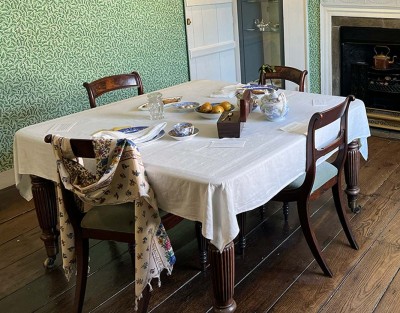
The dining table in Jane Austen's House (Chawton Cottage) set for a breakfast prepared by Jane. (Photo: JASNA)
We also know from Jane’s letters that she was not particularly interested in the task of cooking. At Chawton Cottage, where she lived with her mother, her sister, and their longtime friend Martha Lloyd, she was responsible for breakfast—often only tea and toast—and was in charge of the household stores of tea, sugar, and wine. Mrs. Austen focused on gardening, and Cassandra and Martha managed the household and kitchen. This arrangement worked out well for Jane because it gave her time to focus on her writing.
“Jane Austen was a devoted daughter, sister, and aunt, as well as being a great writer; but she was not brilliant at everything and it has to be admitted that she was not particularly domesticated. She was skillful with her needle . . . but housekeeping and cookery were not her forte,” notes Austen scholar Deirdre Le Faye (Martha Lloyd's Household Book, p. viii). In a September 1816 letter to Cassandra, after a period in which Jane oversaw the household in her sister absence, she wrote, “Composition seems to me Impossible, with a head full of Joints of Mutton & doses of rhubarb.”
Though cookery may not have been of great interest, Jane did enjoy good food. Her letters often referenced meals she enjoyed, missed, or anticipated eating, as well as some of her favorite foods, including toasted cheese, sponge cake, and “good apple pies.” Beverages such as mead (and the honey required to produce it) and various types of wine were also mentioned a number of times. While visiting brother Edward’s family at his Godmersham Park estate in June 1808, she wrote, “I shall eat Ice [cream] & drink French wine, & be above Vulgar Economy,” referring to the luxuries she enjoyed at her brother’s table, where the food was on par with that served in the great houses of the time.
Food historian and Austen scholar Julienne Gehrer characterizes Jane's dinner table and Martha's recipes as the “middling-sort,” with the dinner table typically set “economically with just three to five dishes” (Martha Lloyd's Household Book, p. 60). An example of this can be found in a December 1798 letter to Cassandra: “Mr. Lyford was here yesterday; he came while we were at dinner, and partook of our elegant entertainment. I was not ashamed at asking him to sit down to table, for we had some pease-soup, a sparerib, and a pudding.”
Luckily, in addition to Jane’s letters, we have two primary recipe sources that point us directly to the foods she ate and how they were prepared: Martha Lloyd’s Household Book and the Knight Family Cookbook.
Martha Lloyd’s Household Book
Martha Lloyd first met Jane Austen in 1789 when Jane was 13 and Martha about 23. She became close friends with Jane and Cassandra and in 1806, after her mother died, joined the Austen women’s household while they were living in Southampton with Frank Austen and his wife, Mary. From there, she moved with Mrs. Austen, Jane, and Cassandra to Chawton Cottage in 1809, where she continued to live after Jane's death until she married the widowed Frank Austen in 1828 at the age of 62—making her an authority on day-to-day life in the Austen family.
Martha brought with her the beginnings of her “household book,” a collection of recipes and home remedies that she continued to compile for 30 years. Maintaining a handwritten household book was a common practice at the time. The books included recipes garnered from family, friends, and popular cookbooks of the day, and Martha’s recipes reflect the “everyday cooking” in the Austen household. Fun fact: Martha Lloyd’s household book includes "A Receipt for a Pudding"—a recipe for bread pudding written in verse that is thought to have been composed for her book by Mrs. Austen.
Martha’s household book was passed down through the Austen family and is now at Jane Austen’s House. In 2021, the Bodleian Library at the University of Oxford published a facsimile edition—Martha Lloyd’s Household Book: The Original Manuscript from Jane Austen's Kitchen, by Julienne Gehrer—complete with a transcription of the Georgian-era cursive writing, detailed annotations, an extensive biography of Martha Lloyd, a first-time publication of one of her letters, in-depth historical context for household books, connections to Austen’s fiction, and more.
The Knight Family Cookbook
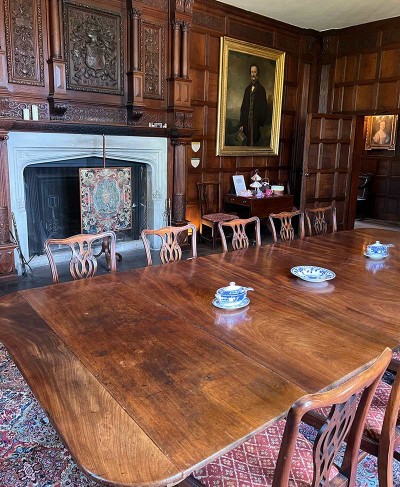
Chawton House Dining Room (Photo: JASNA)
The Knight Family Cookbook is a collection of recipes compiled around 1793 on behalf of Thomas Knight II (1735-94), Rev. George Austen’s wealthy second cousin who gave him the living at Steventon. Thomas and his wife also took an interest in Jane’s brother Edward when he was a boy and eventually made him heir to their estates in Kent and Chawton.
The cookbook is part of the collection in the Chawton House library and bears the inscription: “This book I brought from Chawton and gave to my sister Mrs. J. Knight, on whose death it was returned – TK 1793.”
According to Julienne Gehrer, “The content ranges from simple dishes to elaborate preparations—many with a fashionable French flair” (Dining with Jane Austen, p. 10). She has also noted that the Knight family’s cookbook is “pristine, giving the impression it came nowhere near the kitchen” (Dining with Jane Austen, 10). It was common practice at the time for the lady of the house to hand-copy recipes from such a book and give the copy to her housekeeper or cook to use in the kitchen. In contrast, Martha Lloyd’s household book is peppered with stains and dogeared—a sure sign that it was sitting in the kitchen while meals were being prepared.
A facsimile edition—The Knight Family Cookbook—was published in 2014 by Chawton House Press.
Related Listening and Reading
- "Jane Austen and Food: A Visit with Julienne Gehrer." Austen Chat podcast, Episode 8, Jane Austen Society of North America, February 1, 2024. Food historian Julienne Gehrer provides glimpses into Jane Austen's daily life, the foods she ate, and Georgian-era cuisine and culinary practices. Stream the episode on your favorite podcast app and on our website, or read the transcript here on our website.
- For a look at what Austen's characters were eating and drinking in her novels: "Dining at the Great House: Food and Drink in the Time of Jane Austen." Eileen Sutherland, Persuasions No. 12, 1990.
Dan Macey has worked as a food stylist for more than 25 years, bringing food images to life for advertising, packaging, and editorial purposes. He also writes about food and food history and is on the board of the Historic Foodways Society of the Delaware Valley. Dan regularly speaks on food history topics and prepared three foodways videos for the JASNA Virtual AGM in 2020. More recently, he presented Scents and Sensibilities: The Fragrances, Aromas, and Smells of Austen’s Regency World at the 2025 AGM in Baltimore. Dan enjoys recreating period meals and prepared an authentic Regency banquet to benefit the Chawton House Library. His food writing and styling were featured recently in The Gilded Age Cookbook and The Gilded Age Christmas Cookbook, by Becky Diamond. He is a life member of JASNA and active in the Eastern Pennsylvania Region.
WORKS CITED
- Gehrer, Julienne. Dining with Jane Austen. The Ash Grove Press, Inc, 2021.
- _________. Martha Lloyd’s Household Book: The Original Manuscript from Jane Austen’s Kitchen. Oxford: Bodleian Library, 2021.
Host a 3-Course Meal ›
Pick a recipe or two from each category and celebrate Jane Austen with a special luncheon, dinner, t…
Celebrate with a Tea ›
Mark Jane Austen's birthday with a special tea! Get inspired with recipes for the perfect cup of tea…
Make White Soup for a Ball ›
In Pride and Prejudice, Mr. Bingley sensibly notes that he will wait to make plans for his ball unti…
