Fainting can save your life or kill you, and people faint often in books, movies, and other media as well as in real life. Jane Austen provides readers with advice on the subject from the dying Sophia in Love and Freindship, written when Austen was a teenager.
“[T]ake warning from my unhappy End. . . . [B]eware of fainting-fits. . . . Though at the time they may be refreshing & Agreable yet beleive me they will in the end . . . prove destructive to your Constitution. . . . A frenzy fit is not one quarter so pernicious; it is an exercise to the Body & if not too violent, is I dare say conducive to Health in its consequences—Run mad as often as you chuse; but do not faint—.” (MW 102)
We can’t help but laugh at the exaggerated behavior Sophia recommends in this exuberant juvenile work, but her story ends with fatal consequences and a strong warning associated with fainting. In literature and other media, fainting stands in for a wide range of emotional states and provides social cues to readers and viewers—cues that depend on the genre and the time. The Cult of Sensibility brought with it a craze for fainting, and every properly outfitted Regency reticule contained smelling salts so that women would be prepared for these unpredictable yet frequent and expected events. But as young Sophia warns, fainting can be dangerous and even deadly. Is that warning to “Run mad as often as you chuse; but do not faint” good advice? Perhaps a judicious indulgence in frenzy has been sadly overlooked.
The definition of fainting can be hard to pin down, as it both changes over time and yet stays the same. While the description of what fainting looks like has remained remarkably stable since the ancient Greeks wrote about it, the many medical, physical, and emotional states that have been called faints have varied significantly over time. Fainting is described in medical texts for the diagnosis and treatment of sufferers, but fainting described in literature is often used to signal specific ideas or associations to the reader. Jane Austen mentions fainting or faint-adjacent terms in her writing as early as her juvenilia. Love and Freindship tells us that we can choose between fainting and frenzy. What criteria should we use in making such an important decision?
The faint
The modern medical definition of fainting or syncope is the phenomenon of loss of consciousness associated with loss of postural tone (i.e., falling or collapsing). It is caused by global impairment of blood flow to the brain, resulting from a variety of conditions, but by far the most common causes of syncope are vasovagal spells, also known as simple faints. These episodes occur in all age groups, are equally common in men and women, and can be more frequent in some families. There is often a typical prodrome of symptoms preceding the faint, including lightheadedness, nausea, sweating, salivation, pallor, and dimming of vision. The faint typically (but not always) begins in the upright position, standing or seated. The individual loses consciousness and postural tone and falls; the eyes are usually open, and the person is pale and clammy. Consciousness is typically rapidly recovered when the patient is horizontal, and recovery of consciousness and cognitive orientation are typically simultaneous. Treatment today is directed at the cause of the fainting.
Many conditions can mimic fainting but are not actual faints. There is a well-known species of goats whose muscles freeze up when they are startled so that they topple over, but they remain conscious (“Myotonic”). This is not fainting since it does not involve loss of consciousness. Epilepsy can look like fainting, but it is a very different condition: it does not involve loss of consciousness or loss of postural tone. Persons having epileptic attacks often retain motor activities and consciousness, though these may be altered. Today’s modern medical technology allows for more confident diagnosis and differentiation of similarly appearing conditions than were previously available. We don’t have to spend nearly as much time wondering today, as people had to during bygone eras, whether something was a swoon, a trance, a raptus, a frenzy, a faint, or a temporary death.
The word syncope is derived from the Greek prefix syn (together) and the verb kopto (to cut), suggesting a linear thread that has been severed or separated. We can read this linear thread as consciousness, as individual awareness residing in the body. When that consciousness is cut or severed or separated from the body—when a person is unconscious—this is a different state of being that has historically required much deep thought and often remarkable mental gymnastics to explain. Despite fainting’s many and evolving medical explanations over the course of time, its use as a literary device is long-standing. What fainting represents in literature changes with the times as well.
Long before Jane Austen’s characters took turns fainting on a sofa, ancient and early Christian writings had a history of deep interest in swoons and associated trance states. Plato’s Socrates spent long spells unmoving and unresponsive to his surroundings, yet alive and recoverable. The biblical raptus was envisioned as a swoon or trance, an unmoving and unresponsive state caused by intense emotion—sort of an out-of-body experience, often described in terms of separation of the body and soul.
As long ago as the fourth century BCE, Hippocrates described sudden death occurring in fainting victims. Galen defined syncope in the second century CE as “an acute collapse of capacity,” and described its causes as including much excretion of blood, vehement moving, great pain, breathing stinking air, fear, dread, perturbations of the mind, and excessive washing (Papavramidou and Tziakas). He described symptoms that readers in Jane Austen’s day and today would recognize. This definition anticipated the medieval and Renaissance arguments about the nature and meaning of personal, individual consciousness. Frequently in medieval writing, we find swoons used as narrative or emotive devices: In The Divine Comedy, Dante swoons at transitions between cantos as well as at times of heightened emotion.
According to the Oxford English Dictionary, the word consciousness was first used to describe a distinctive faculty of self-awareness in 1678. But the struggle to decide what unconsciousness is—lack of awareness when the heart continues to beat—has lasted for centuries. Unconsciousness is actually a pretty terrifying concept: the essence that makes you who you are is gone for a while, yet your body still lives, seemingly without it. Will it come back? Where has it gone? And why? It is no wonder that everyone, from medical practitioners to the general populace to writers, has been deeply interested in fainting and what it means.
The emotionally triggered faint that is often a plot point in eighteenth-century fiction is called vasovagal syncope. It happens to approximately one-third of humans during their lives, for the same reasons we have seen in historical records—usually situations that invoke the “fight or flight” response. When sensing a threat, a flood of adrenaline and other stress hormones acts to cause rapid breathing, raise blood pressure, increase heart rate, and give a burst of energy to combat the threat. But some humans (and other animals) invoke another mechanism in this pathway—fainting, as described above. That same cascade of high emotional stress and adrenaline surge can cause a reversal of the body’s typical response. Instead of rapid breathing, breathing is slowed; instead of raised blood pressure and heart rate, both are drastically lowered; when the body senses the low blood pressure and slow heart, it turns off—or faints.
Alarm-triggered bradycardia (or an abnormally slow heart rate) is a common response. The surge of stress hormones can also cause a sudden injury to the heart muscle that leads to abrupt failure, resulting in death. Takotsubo cardiomyopathy (popularly known as “broken heart syndrome”) is the abrupt development of a bulbous change in the ventricle of the human heart in response to intense emotions, and it can be fatal. There are sharp increases in human cardiac deaths after such experiences as natural disasters, frightening emotional stresses like air raids, and even high-stakes sporting events. The emotional flood can kill.
Remedies
In Jane Austen’s day, medical care could be obtained in a variety of ways. Calling for the doctor was expensive and dependent on being in a community where there actually was one. (What constituted a doctor, and how someone became such, is another topic altogether!) An alternative was to seek the advice of an apothecary, who was like a druggist or pharmacist and could have been found more readily, especially in rural locations. Most people took medical care into their own hands and used remedies transmitted by more informal means—traditional or local advice and books.
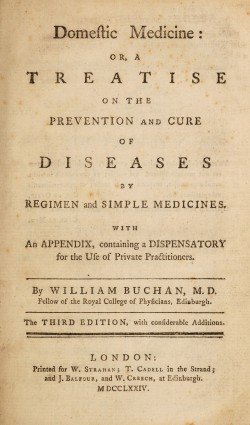
In Jane Austen’s day, Dr. William Buchan’s Domestic Medicine was the backbone of medical texts for the reading population. It was published in 1769, just six years before Jane Austen was born, and was an immediate best-seller—eighty thousand copies’ worth. It sold for just six shillings, went through nineteen English editions during Buchan’s lifetime, and was translated into all the European languages. The Empress of Russia liked her copy so well she sent Dr. Buchan a gold medal with a letter of commendation. We can see from the book’s subtitle its many intended uses:
A Treatise on the Prevention and Cure of Diseases, by Regimen and Simple Medicines; Containing Observations on Vaccine Inoculation, with Instructions for Performing the Operation, Published by the authority of the Royal Jennerian Society; An Essay Enabling Ruptured Persons to Manage themselves, and an Engraving of Cole’s Self-Adjusting Trusses; Copious Instructions for those afflicted with Syphilitic Disorders; A Complete Family Herbal; A List of Simples, and of such medicinal Preparations as ought to be kept in readiness for Private Practice of Family Use; the Method of Preparing and Compounding such Medicines as are recommended in the Work; Remarks on the Doses, Uses, and Manner of Applying the Different Medicines. To which are added, numerous Anatomical, Botanical, and Chemical Engravings.
Buchan wanted readers to know that his book was the place everyone could go for do-it-yourself medical knowledge. And they did.
Dr. Buchan had much to say on the topic of fainting, and he provided the standard of understanding in Jane Austen’s time. He assured readers that fainting fits and swoons are “seldom dangerous when duly attended to; but when wholly neglected, or improperly treated, they often prove hurtful, and sometimes fatal” (334). In people of weak nerves or delicate constitutions, swoons, he said, are caused by “sudden transitions from cold to heat; breathing air that is deprived of its spring and elasticity; great fatigue; excessive weakness; loss of blood; long fasting; fear, grief, and other violent passions or affectations of the mind” (335). Treatments varied depending on the cause of the faint, so knowing why somebody fainted would tell you how to treat them. Dr. Buchan’s book provided sections on the many and various faints people could suffer, and the specific treatments to apply to the fainter for each.
Buchan explained that the sufferer of a transition-from-cold-to-hot faint needed to have ligatures applied above the knees and elbows, to have the hands and face sprinkled with vinegar, to inhale vinegar, and to have two spoonsful of a vinegar–water mixture put in the mouth to swallow. If this process didn’t help, the fainter needed to be bled and then given a clyster (an enema). Another cause of fainting was breathing air that that had lost its “elasticity” or “spring” from being breathed too frequently. These faints could happen in crowded assemblies, especially in hot weather, and were considered a “temporary death, and to the weak . . . fatal” (336). This kind of faint required the victim to be carried into open air, to have the temples rubbed with brandy or vinegar, to have volatile spirits or salts held to the nose, to lie on the back with head low, and to be given wine or other spirits to drink. A person who had had hysterics leading up to a faint would additionally need castor or asafoetida (devil’s dung) applied to the nose. Fainting from fear, grief, or violent passion would likely require cleansing the bowels with enemas. Fainting fits in strong and healthy persons, who “abound with blood,” were more typically caused by violent exercise, drinking freely of warm or strong liquors, or intense application to study (457). These faints would often need bleeding, and one should not be afraid to use “sharp clysters” (458).
The treatments for faints of different causes each had their own recipes, and knowing what caused a faint would allow nearby supporters to provide the appropriate succor to the victim. Unfortunately for all involved, if the faints did not quickly resolve, many treatment recipes required administration of enemas and/or bleeding, which could be problematic at a public assembly or other social situation. The most worrisome thing about fainting, according to Dr. Buchan, was that if not properly treated, every fainting fit left the person in “dejection and weakness,” with the “movement of their secretions suspended.” This caused “polypuses” to form in the heart, with fatal consequences (460). Polypuses were large, rounded masses deforming the heart, presumably thrombi or clots, that blocked the circulation and caused sudden death. Medical practitioners around Jane Austen’s time described them as “concretions that upon dissection have been found in the heart . . . of persons killed by sudden frights, as also in those that have been quickly dispatcht by . . . a Cardiacal Syncope . . . where the coagulative Spirit like lightning strikes through the whole mass of blood . . . and fixes it and makes it unapt for the generation of fresh spirits” (Gould 542–44). The “polypuses” found in the hearts of Dr. Buchan’s and Dr. Gould’s patients who died from emotional stress or fainting sound intriguingly like what we now know as Takotsubo cardiomyopathy or broken heart syndrome.
So, while fainting was believed to be a frequent and expected outcome of certain situations, the treatments were often noxious. Fainting was also perceived to be potentially dangerous and possibly deadly. It would thus be in fainters’ best interests to recover quickly.
Fainting in Jane Austen
How does fainting appear in narrative? Literature uses fainting as a bodily response to convey an internal emotional or physical state. It cues the audience to understand something about the fainter’s experience. But what we are cued to understand is highly dependent on the era and its contemporaneous tropes—ranging from the “weakness faint” or “anemia faint” of vampire fiction to the “monster faint” of gothic narrative.
Fainting is often described or anticipated in Jane Austen’s novels, but does anyone actually faint? The threat of fainting in Austen’s works happens far more commonly than the event itself. A word frequency search amongst Austen’s six novels looking for the words faint, fainted, fainter, fainting, faintness, faints, swoon, unconscious, and lost . . . senses shows 39 occurrences; only 11 of these refer to real fainting, and only one describes an actual faint (De Rose). More often, these words are used as adjectives: there are several faint blushes and faint smiles, a faint invitation, a faint enquiry, and so on. Fainting, however, is often a preoccupation.
In Austen’s novels, there are intriguing occurrences of the faint words. When Sir Thomas returns from Antigua, Fanny in Mansfield Park “was nearly fainting: all her former habitual dread of her uncle was returning”; “she was almost ready to faint at the sight of” her uncle after their conversation about Mr. Crawford’s proposal; and, when Mr. Crawford comes to visit her in Portsmouth, “she fancied herself on the point of fainting away” (176, 321, 399, my italics in these and subsequent quotations from Austen). These near faints are signs of her internal turmoil. In fact, she never loses consciousness or gives any physical sign that she’s liable to.
Marianne in Sense and Sensibility has many such near-misses: at the party to which they go with Lady Middleton, “Elinor, expecting every moment to see [Marianne] faint must screen her; after Willoughby’s betrayal, Marianne has made herself “faint and giddy from a long want of proper rest and food” and feels a “general nervous faintness (177,185). Marianne is the only character who is described with the word unconscious in the sense of unawareness of self and environment, but this instance occurs when she is sick with a febrile illness, so it doesn’t count as an emotional faint. Not everything that looks like a faint is real emotional fainting. Further, Sense and Sensibility gives us our only instance of the word swoon outside the juvenilia: Elinor, not surprisingly, “felt in no danger of an hysterical fit, or a swoon” when Lucy reveals her secret engagement to the man Elinor loves (129). Lucy has a near miss when Fanny Dashwood “‘scolded like any fury, and soon drove her into a fainting fit,’” after which “‘she could hardly walk’” (259). If she is ambulatory, it is unlikely that Lucy has truly fainted, so this episode is better described as a hysterical fit such as Elinor has previously proved herself safe from (and which Fanny Dashwood also performs during the same scene).
We get hysterics rather than fainting again in Persuasion when Louisa Musgrove has her fall from the Cobb. Mary screams and has hysterics, and Henrietta “lost her senses too” (110). Henrietta is supported by concerned bystanders but, with their help, can move away from the scene. (Remember the fainting goats!) Collapsing onto other people, having hysterics, or both together, while remaining conscious, is not the same thing as fainting. In Love and Freindship Laura makes this explicit when, rather than fainting as Sophia does, she “‘screamed and instantly ran mad—. We remained thus mutually deprived of our Senses some minutes’” (99). Obviously, Louisa’s loss of consciousness is a concussive head injury, rather than, as Laura describes Sophia’s, an emotional faint.
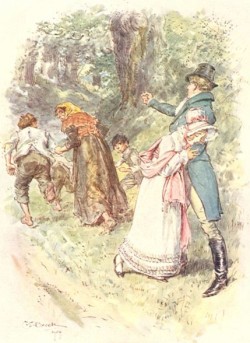
“The terror . . . was then their own portion,” by C. E. Brock (1909).
Courtesy of Mollands.net.
In Emma, Harriet is most liable to faint. “‘I thought I should have fainted,’” Harriet reveals, on unexpectedly seeing Mr. Martin in Ford’s (178), a near-miss before the only actual faint of the novels. After Harriet’s almost-assault by the strangers (and after she manages to make it all the way from the lane to Hartfield safely with Frank Churchill’s help), “Harriet immediately sinking into a chair fainted away.” The narrator celebrates the moment: “ A young lady who faints, must be recovered; questions must be answered, and surprises be explained” (333).
Jane Austen’s use of fainting-related words describes near-fainting for Marianne, Harriet, and Fanny; hysterical fits for Lucy and Henrietta; Louisa’s getting knocked out; and Marianne’s having a fever. But it is only Harriet who truly faints, and that after the somewhat violent incident with the strangers. None of our strong protagonists—Elinor, Eliazbeth, Emma, Catherine, or Anne—faints or threatens to faint. Fanny has several near faints, but she is under significant duress in those situations. And, interestingly, all the scenes where Austen uses the faint words in relation to Fanny describe her internal mental state. They are not voiced to others or acted out by Fanny herself. Many other characters have episodes of strong emotions—some, including Mrs. Bennet, have hysterics—but they aren’t captured in the faint–word search. Austen chooses different wording to describe these states and outbursts.
Fainting in fiction is complicated. It can be a stand-in for a character’s emotional landscape, and what it tells us about the character depends on the type of faint as well as on the tropes of the time. It can be a representation of an actual biological response in reaction to threats and emotional upheaval. Fainting can be life-saving, or it can be deadly. If you faint, you may find yourself subject to ridicule, laughter, concern, enemas, noxious fumes, or death. And while Jane Austen’s Love and Freindship depicts a lot of fainting—100% of the uses of the word in this early work refer to actual physical faints—it also depicts one fatal outcome.
Running mad is another topic—also a popular pastime in literature! Thomas Malory’s Tristram runs mad for a while after a bout of intense emotion. Perhaps inspired by his example, Lancelot goes spectacularly mad (with associated forest nudity) and requires restoration by the Holy Grail. Some of Frances Burney’s heroines also run mad. There is a great deal of running mad in Love and Freindship, and Lucy, Henrietta, Mrs. Bennet, and others of Jane Austen’s creations in the novels often indulge in hysterics to varying degrees. But while the frenzies in these and Jane’s juvenile work may be funny, embarrassing, prolonged, or distressing to others, they are not fatal.
Young Jane’s narrator exhorts readers to choose running mad over fainting for the very reason that fainting can be so dangerous. Given what emotional surges can do to the heart, Jane Austen’s readers can appreciate her concern for them in her exhortations to value sense over sensibility, to modulate and moderate one’s emotions, and at times to partake of a little madness!
