Austen’s writings have at various times and in various places been considered as depicting a diminutive world of elite living, far from economic or political turbulence. Winston Churchill was one such reader. When sick with pneumonia in 1943, he turned to Austen for comfort. In his war memoirs, he explained Austen’s appeal at that time: “What calm lives they had those people. No worries about the French Revolution or the crashing struggle of the Napoleonic Wars. Only manners controlling natural passion so far as they could, together with cultured explanations of any mischances” (Churchill 425). Other readers have commented on her limited experience, sometimes assuming from the evidence of the novels themselves that Austen had read little and knew little of the world at large.
In some ways, Austen’s experience of the outside world was indeed limited. She received less than three years of formal schooling, and she never traveled outside England. She never even got farther north in England than Staffordshire, but she did experience living in many of her relatives’ homes in the south of England. Her travel was in that sense quite limited. In a letter to Cassandra, written while in residence at her brother Edward’s Godmersham estate, she expresses frustration at her lack of agency in determining where she would go next, let alone how or when she would travel:
Edward will be going about the same time to Alton, where he has business with Mr. Trimmer, and where he means his son should join him; and I shall probably be his companion to that place, and get on afterwards somehow or other. I should have preferred a rather longer stay here certainly, but there is no prospect of any later conveyance for me, as he does not mean to accompany Edward on his return to Winchester, from a very natural unwillingness to leave Elizabeth at that time. I shall at any rate be glad not to be obliged to be an incumbrance on those who have brought me here, for, as James has no horse, I must feel in their carriage that I am taking his place. (15–17 June 1808)
She obviously found this lack of mobility confining.
Austen’s worldwide popularity can seem hard to reconcile with the geographical narrowness of her own life. Austen herself would surely have been astonished by such international fame. Part of this impression stems from her self-deprecative comments in her letters. In the hope of encouraging the literary pursuits of her nephew, Austen described her own novels with an analogy to the art of painting miniatures on ivory. She described her craft in opposition to his on 16 December 1816: “What should I do with your strong, manly, spirited Sketches, full of variety & Glow?—How could I possibly join them on to the little bit (two Inches wide) of Ivory on which I work with so fine a Brush, as produces little effect after much labour?” Some critics have seized on this image to praise her genius; others, especially male or Victorian readers, her virtue (a modest woman working modestly within her modest sphere).
Austen’s life was indeed limited by many factors beyond her control: she had neither the finances nor the freedom to travel much herself, and for many years of her life, she lacked the basic stability and privacy that she required for writing. Even after she and her sister were finally given a stable place to live in Chawton Cottage, they were often taken advantage of for their utility as babysitters. Maiden aunts were assumed to have no great plans of their own, and without any means of transportation at her disposal, Austen went where she was told, when she was told. It is an error, however, to assume that her intellectual life was equally limited. Austen was, in fact, a world traveler—vicariously, at least.
Austen’s life afforded her far more access to the wider political, intellectual, and cultural world than either of these accounts allows, as recent historicist and postcolonial scholarship has shown. The myth of her limitation persists less among Austen scholars, then, than among general readers, for whom her global reach can still seem puzzling given so circumscribed a life. Our digital humanities project, Jane Austen’s Desk (hereafter JAD), takes up this modern view of Austen’s breadth of understanding and gives it visual and virtual form, making tangible just how broad Austen’s actual knowledge of the world was. With this project, we hope to rebut the notion of her intellectual narrowness, along with other myths surrounding her authorship.
An antidote to narrowness
If Austen herself was limited by geography and circumstance, so too are many of the readers and scholars who love her most. Popular fandom spaces, for all their energy and creativity, can lack scholarly depth, while academic treatments of Austen can feel inaccessible to the very readers whose enthusiasm keeps her so vital. Geography and cost compound the problem: much of the Austen-related programming aimed at general readers is either expensive, as in the case of JASNA’s annual meetings and sponsored travel tours; or geographically limited, like our own annual symposium, the Jane Austen Summer Program, first located in North Carolina and now in Pennsylvania. A website offers no such restrictions. As Bridget Draxler and Danielle Spratt argue in Engaging the Age of Jane Austen, Austen’s works are unusually well suited to reaching broader public audiences and fostering more engaged readers and citizens, particularly when accompanied by digital tools (10–11). We agree with Matthew Kirschenbaum’s observation that digital humanities work is fundamentally a social undertaking (56). In the same vein, Draxler and Spratt suggest that digital platforms offer more egalitarian and inclusive spaces for a wide range of academic practices and audiences (171).
An easily accessible, attractive digital space dedicated to a widely beloved author has the best chance of reaching the widest audience, including younger readers for whom Austen may no longer be a high school staple, and of engaging those audiences with the transatlantic history and literary culture of the late eighteenth and early nineteenth centuries. In some ways, a public-facing digital project is a natural way to demonstrate the utility of humanities research to public audiences. Commitment to the public humanities asks scholars to resist jargon or insider language and to open conversations to a broader readership. Austen’s “academic” readers and her “popular” ones have more to offer each other than the traditional divide between them suggests. Jane Austen’s Desk is built on the premise that scholarship can only benefit from community engagement, and vice versa.
So what is JAD, exactly? It is a public humanities website that invites fans, scholars, and general readers from around the world into an imaginative rendering of Jane Austen’s imaginative writing environment as it might have looked on 30 March 1813, when Austen had just published Pride and Prejudice and was at work composing Mansfield Park. Anchored by some of Austen’s most iconic material possessions—among them, her twelve-sided writing table, now housed at Jane Austen’s House, and her portable writing desk, now in the collection of the British Library—JAD serves as a hub for an expanding, interdisciplinary collection of historical, literary, musical, and cultural materials, presented in as interactive and multimedia a manner as possible.
JAD has been supported by two grants from the National Endowment for the Humanities and is one of several projects produced by the Jane Austen Collaborative, Inc., a public humanities nonprofit. The team behind the project consists of academics, librarians, artists, musicians, and students. At every stage of development, we have been mindful of the range of perspectives and interests we collectively bring to Austen, and we have aimed to capture that range in the website’s look and content. Test users from the public and fans who attend Jane Austen-related events have provided feedback at all stages of the design. We want the website to mirror Austen’s global reach and are committed to the idea that the tools of digital humanities, including interactivity, multimedia, and open access, can deepen engagement with Austen’s world for scholars and fans alike, in ways that print alone cannot. This article introduces Version 1.5 of the site, tracing the thinking behind its design and the directions in which JAD is growing. Our work is guided by the proposition that a digital version of Austen’s writing world invites users into her process, allowing them to watch the work happen and not just read its results.
Sitting in Austen’s (virtual) chair
JAD’s accessibility is exciting not just because it bridges existing audiences and reaches new ones, but also because it extends and reimagines the scholarly impact of materials showcased at physical symposia, museums, or archives. Through generous partnership with many beloved Austen institutions, JAD’s Version 1.5 integrates materials across multiple continents, including photogrammetric models of Austen’s jewelry housed at Jane Austen’s House in Chawton, high-resolution scans of documents held at Chawton House and the Hampshire and Southampton Records Offices, rare books available in only a handful of university libraries, and a 1790 Chart of the World sourced from the National Library of Scotland. Digital space and media make it possible to integrate sources hosted by a variety of institutions and enable scholars to compare notes in ways that can help remedy disciplinary (and geographical) silo effects. JAD avails itself of that potential while simultaneously opening opportunities for original research.
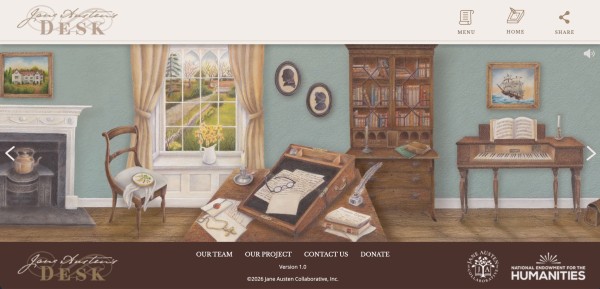
The project’s first-person point of view, which places the user in Austen’s writing environment, is designed to erode the traditional exhibit model and give users autonomy to explore and learn. Users can examine Austen’s topaz cross even as they listen to an audio clip discussing the significance of William Price’s gift to his sister in Mansfield Park, or they can peruse a high-resolution scan of Austen’s 1813 letter detailing her current reading list alongside full-length facsimiles of first editions of those exact titles. JAD’s multimedia content and interactivity are not simply characteristics of its digital form but rather core arguments about what digital humanities can do for literary and historical study.
As creators, we placed much thought and research into how to present the user’s experience, as well as how to represent Austen’s world imaginatively. Our collaborator and graphic artist Harriet Wu hand-drew most of the illustrations that anchor JAD, making use of a Regency-inspired palette, while avoiding the pastel, over-feminized coloration of many sites devoted to Austen. Not only do we want a global audience to gain access to our site; we also want individual users to feel confident in the site, regardless of age, gender, or scholarly status. Austen’s global reach is limited in none of these ways. For similar reasons, we also decided against a more avatar-based representation that might have included a manipulable hand—to hold a quill, write notes, select books, etc. Once a human body is introduced, choices (including skin tone and clothing) inevitably limit the imagination. Instead, we decided to adopt a playful and more magical approach, where writing mysteriously appears on papers and inanimate objects respond to the user’s presence.
Catching Austen in acts of greatness
Virginia Woolf famously wrote that “among great authors, Jane Austen is the most difficult to catch in the act of greatness.” The difficulty Woolf describes is likely coeval with the myth of Austen’s limitations. The surface simplicity of Austen’s prose, similarities among her plots, and the realism of her portrayal of characters and their idiolects can belie the complexity of her art. JAD attempts to portray in a visual format the breadth of Austen’s knowledge of the real world and to bring to life many of the resources and experiences that inspired her imagination. We hope thereby to provide users with more tools to “catch” and explain Austen’s “greatness.”
The features and content of Version 1.5 underscore her composition process by focusing on the spring of 1813, when Austen had just published Pride and Prejudice and was composing Mansfield Park. We center this season because it captures Austen in mid-transition—fresh off the success of a comic novel and drafting her most politically charged one. Giving a snapshot of this moment allows users to watch her artistic and political sensibilities develop side by side. March 1813 is also rich in global historical context, as it coincides with the Regency of the future George IV and the Napoleonic wars. Centering Mansfield Park enables us to engage with important contemporary issues, particularly issues surrounding female authorship and mobility, the transatlantic slave trade and the Austen family’s disputed role in it, and the family involvement in the War of 1812. That Austen was writing against the backdrop of these significant events and while in conversation with her community exposes the myth (partially perpetuated by her own family) of Austen’s isolation from the events of the war and political happenings in general.
The weeks prior to the publication of Pride and Prejudice were busy for the Austen family. On 27 December 1812, Austen’s brother Francis, Captain of HMS Elephant, had captured the American privateer Swordfish off the Azores; the newspapers were full of this news after he posted a letter about it in the London Gazette on 16 January. At the end of January, her other naval brother, Charles, returned from London to HMS Namur with his wife, Fanny, and two of their three daughters. Meanwhile, as the first reviews of Pride and Prejudice, published on 27 January 1813, appeared in The British Critic and The Critical Review, Austen and her family debated whether to reveal her authorship. It was a moment of overlapping concerns and activities. Austen would have found it challenging to find a quiet space for her writing between the bustle of family events and her responsibilities as an aunt; for example, she played hostess to three of her Knight nephews and three of their cousins on their way back to Winchester College (16 February 1813). Early 1813 is a period that highlights Austen’s robust and complicated family life, as well as her global network.
Amid all this hubbub, Austen was rapidly revising Mansfield Park, a novel whose thematic and geographic scope is the broadest of any in her works, and which stands in stark contrast to the “light & bright & sparkling” (4 February 1813) novel that preceded it. The scope of Fanny Price’s world is surprisingly vast, given the insular social life of the Bertram family. The works and places referred to in Mansfield Park, many of which Austen researched during this time, are the most far-flung of any of Austen’s novels: Mansfield Park contains information on hedgerows and soil quality, distant constellations, Antiguan slavery, Humphry Repton’s landscape gardening, and British embassies to China. It features Austen’s wealthiest single character and the most impoverished and abusive of her heroines’ families. This novel includes adultery, along with reflections on the nature of ordination, and it is a frequent example in discussions of postcolonial discourse regarding slavery. Perhaps most notably, Mansfield Park has long been at the center of postcolonial debates surrounding Jane Austen and her novels. Ever since Edward Said accused Austen and her contemporaries of passive complicity in the slave trade, the heroine Fanny’s attempt to ask about Sir Thomas’s Antiguan estates has been interpreted minutely and in contradictory ways.
The combination of Mansfield Park’s content and Austen’s biography (which includes her globetrotting brothers, her family’s connections to Caribbean plantations and participation in the discourse of abolition, and her extensive correspondence and wide reading) offers material for examining postcolonialism and transatlanticism more broadly—again underscoring that Austen was not a provincial country author but a writer with a deeply engaged and nuanced political, philosophical, and literary consciousness.
An overview of JAD contents
JAD’s key features and content areas, then, are windows onto these larger questions and themes, as well as to her global network. Currently, Version 1.5 includes the following content areas:
1. Digital editions of Pride and Prejudice and Mansfield Park.
2. Digitized texts of several of the works that Austen was reading and referencing in the winter and spring of 1813, including Thomas Clarkson’sThe History of the Rise, Progress, and Accomplishment of the Abolition of the African Slave-Trade by the British Parliament.
3. Catalogs from Regency-era circulating libraries to which Austen had access.
4. Images of newspapers like theHampshire Telegraph and the Morning Chronicle, with details on specific articles relevant to Austen.
5. A photogrammetric rendering of Jane’s and Cassandra’s topaz crosses (along with explanatory audio by Lizzie Dunford, curator at Jane Austen’s House).
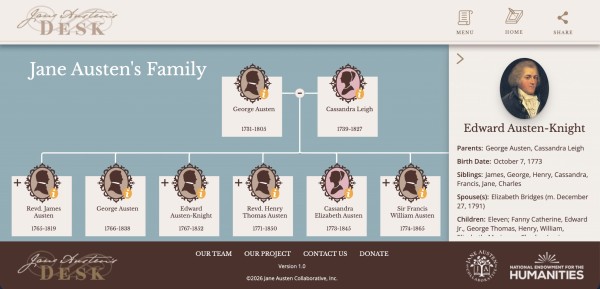
6. An expandable family tree providing biographical information about Austen’s parents and siblings.
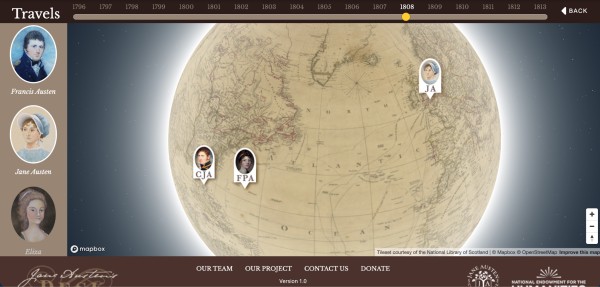
7. An interactive globe tracing the Atlantic and West Indies travels of family members Charles Austen and his wife, Fanny Palmer Austen, as well as of Francis Austen and of Austen’s cousin and sister-in-law, Eliza de Feuillide.
8. “StoryMaps” recounting some of the international adventures of Austen’s brothers and cousins (compiled by our collaborator, Sheila Johnson Kindred).
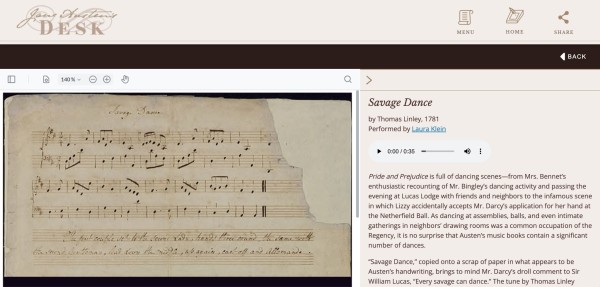
9. Musical scores that Austen knew and sometimes copied by hand, along with information on the origin of the pieces and their relevance to her novels, as well as recordings on historically appropriate instruments (recorded by our collaborator Laura Klein).
One of our objectives is simply to make scarce material accessible for the public. The topaz crosses that Charles Austen purchased for his sisters with his naval prize money in 1801 are housed at Jane Austen’s House in Chawton; short of visiting in person, most readers would never encounter them except in two-dimensional photographs. The music Austen copied out in her own hand survives in family music books held at the University of Southampton; they are brought to life on JAD through Laura Klein’s bespoke and careful performances. The newspapers we provide—including the Hampshire Telegraph, the Morning Chronicle, and the Sussex Advertiser from the winter and spring of 1813—are available in scattered form through subscription databases like the British Newspaper Archive and Gale’s British Library Newspapers, behind paywalls that many readers, and even many scholars at under-resourced institutions, cannot access.
Yet JAD is much more than an archive of rare materials. In creating JAD, we wanted to represent the sheer scope of Austen’s world in a way that invites exploration rather than induces paralysis. We believe that these features, which lean on visual and user interaction, are not simply ways of presenting existing material but also form interpretive interventions, such as the possibility of debunking the myths of narrowness that surround Austen’s artistry. Austen herself was extremely good at actively engaging her readers; in a sense, we are also mimicking one of her central artistic goals through the interactive opportunities on JAD. Pairing Clarkson’s abolitionist history with the novels argues for reading Austen’s fiction against the live political debates of her moment, not in isolation from them. The interactive globe tracing the Atlantic and West Indies travels of the Austen family makes visible economic and colonial entanglements that a print edition would leave invisible. The very structures of the family tree and StoryMaps make the case that exploring Austen’s world should feel like discovery rather than footnote-reading. These content areas make it difficult to think of Austen’s intellectual life and experience as limited.
One of the central challenges of a digital humanities project like JAD is scale. Austen’s intellectual, social, and cultural world was vast, as is the body of material documenting it. The abundance of information invites precisely the kind of organizing, layering, and cross-referencing that digital space makes possible in ways print cannot. Three features of JAD’s Version 1.5 take up this challenge directly: the interactive family tree, the bookshelf, and the circulating library catalog. The family tree addresses this problem of quantity and scope by blending media types in an interactive interface. The information itself is drawn largely from Deirdre Le Faye’s A Chronology of Jane Austen and Her Family, as well as from archival holdings at Chawton House, the Hampshire Records Office, and the Southampton Archives. It spans three generations, beginning with Austen’s parents, and is designed to be navigated interactively rather than read sequentially, with side panels that open onto biographical information, portraits, and primary documents. Among these rare documents are a Memorandum of Charles Austen’s Naval Service, Edward (né Austen) Knight’s legal document recording his inheritance of Godmersham Park, and a 3-D model of the portable writing desk Austen’s father gave her as a gift (courtesy of the British Library).
The bookshelf features nearly as many media types as the family tree but foregrounds full editions of texts rather than historical information. The texts themselves, gathered with our collaborator Susan Allen Ford, are among those that Austen was reading and referencing in the winter and spring of 1813, including Pasley’s Essay on the Military Policy and Institutions of the British Empire, Clarkson’s History of the . . . Abolition of the African Slave-Trade, and an account of Lord Macartney’s Embassy to China. We chose these books because they appear in her correspondence from that period and because their subjects resonate with the concerns of Mansfield Park. That the titles range across military history, abolition, science, comic poetry, and travel writing is itself an argument for the expansiveness of Austen’s world: her reading was wide, current, and engaged with the political, moral, and cultural questions of her moment.
The circulating library catalogs add more evidence of the breadth of material informing Austen’s thinking. JAD includes high-resolution scans of the catalogs of the Alton Book Society—the library likely referred in her letters as simply “the Society”—held at the Hampshire Records Office. The catalogs, which belonged to her neighbor Colonel Jervoise and include several titles we know Austen read, are revealing in their own right: in the 1806 catalog, members are listed by rank rather than alphabetically, and books are organized by physical format (folio, quarto, octavo) as much as by subject. An audio guide accompanies the scans to help users navigate the unfamiliar conventions of Regency-era lending libraries. Together, these three features suggest the breadth of Austen’s intellectual network.
In each of these cases, JAD does not simply point users toward these materials as a scholarly article might, but reproduces them, frames them, interprets them, and places them in conversation with the life and work they illuminate. That interpretive framing is as important as the access itself; yet interpretive frameworks are not meant to impose a particular view of the materials presented on JAD, but rather to encourage users of the site to draw new connections on their own. We hope that these examples lend credence to our assertion that representing these complex and interconnected materials requires the kind of layered, associative organization that digital tools are uniquely able to provide.
Austen’s international scope
Ultimately, the richness of the material presented in JAD appears most clearly when the content areas overlap and interact, as they would have done in Austen’s own memory and imagination. A newspaper article reporting on Francis Austen’s naval exploits, or on the sale of an estate with deep ties to Austen’s family, means something different when encountered alongside her letters and her fiction than it does in isolation. The same is true of the crosses: purchased with prize money from a captured French ship and echoed in the amber cross William Price gives Fanny in Mansfield Park, they speak to the reach of Great Britain and the vicarious worldliness the brothers’ travelers afforded the homebound Austen sisters. The interactions among content areas also underscore the sheer international reach of her network. The music Austen copied out in her own hand, for example, includes pieces that connect her domestic life to France, India, Africa, and the Scottish Highlands, as well as to countless passages, themes, and characters in her novels.
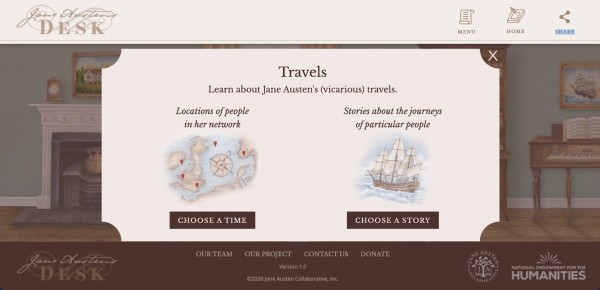
In creating the “vicarious travels” sections of JAD, we discovered that Austen’s worldwide connections were even broader than we had anticipated: in addition to her cousin (and sister-in-law) Eliza’s travels in India and France, her brother Charles spent a good portion of his naval career in North America, while her brother Francis spent time docked in China and negotiated a precarious treaty there. JAD presents much more than just such facts, however: users can discover where other members of Austen’s family were during Francis’s time in China, compare his specific ship with the full list of ships that he captained, or follow links to recollect the relationship between certain family members in the family tree. Visitors can see where her traveling family members were located on the globe in a specific year, such as 1808; follow Charles Austen’s chase and capture of the French frigate La Tribune.
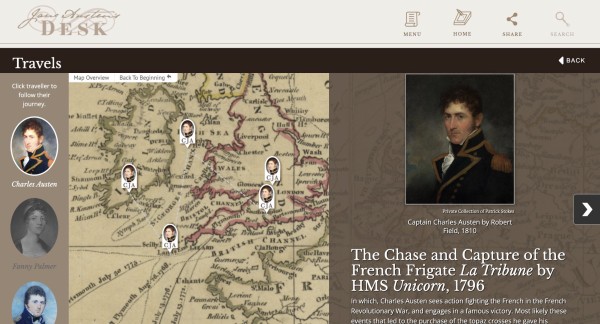
As these examples demonstrate, user interaction with JAD is also highly intertextual and interdisciplinary. Features like the bookshelf, travels, and music invite users to trace connections between texts, places, people, and ideas that are not always visible in traditional scholarly formats. Interactive and illustrated narratives researched and written by Austen family and naval historian Sheila Johnson Kindred enhance this immersion in the adventures of Austen’s family members and give examples of the many untold stories that appear once one begins to draw connections between the various content areas. The hope is that the JAD platform models a kind of reading practice, one that mirrors Austen’s own habits of mind. We hope users will come to see that the scope of Austen’s own global connections is perhaps not as dissimilar as we might think from the reach of her global afterlife in today’s world.
Future developments
We have many ideas for new content areas and pedagogical materials, but another main priority for JAD is to push the limits of what digital texts can do for readers and scholars. To that end, we intend to create scholarly digital editions of the two novels at the center of Version 1.5 (Pride and Prejudice and Mansfield Park), with the hope that these editions will be models for all texts hosted on JAD. Digital editions of Jane Austen’s novels already exist, of course, with some in the eBook form meant for general readers, and a very few intended for scholarship (such as Laura White’s Austen Said project, which explores patterns of diction in the novels). Our editions will be unique in that they will incorporate many interactive and interwoven features, while still having the capacity for continual growth as part of a larger, established digital project. Using clean, correct text embedded in high-resolution scans of Cassandra Austen’s first editions, we will mark up our texts using standard TEI conventions to tag such key elements as characters, locations, and events. We will also create a modern, interactive, and searchable concordance for the Austen novels, giving scholars new means of tracing patterns of language and allusion across Austen’s work. Because our team includes digital humanists who have developed tools and platforms designed for hosting multimedia editions, we will be able to link to both internal JAD content (such as material culture, social networks, and other interdisciplinary connections, as described above) and to external Austen projects such as the above-mentioned Austen Said, Kathryn Sutherland’s Jane Austen’s Fiction Manuscripts, Peter Sabor’s Reading with Austen, and Janine Barchas’s What Jane Saw. (Some of these creators are also collaborators on JAD.) Our hope is that these texts and tools make possible a new mode of reading in which discoveries, arguments, and multimedia sources can be incorporated into the editions themselves rather than published in isolation from them.
The power of play
We think that play is underrated as a means of making such discoveries. JAD is meant to be a playful site, as well as a repository of vast scholarly troves of information. Engagement, play, and community are central to the JAD project. Beyond connecting users to existing content, JAD has goals for expanding what online engagement with Austen can look like, including games, interactive music creation, and other features that invite users to inhabit rather than simply observe her world. In addition, games—particularly nonverbal ones—can be a great way to engage fans from across the globe and of various ages. Eventually we hope to include several learning games that will teach players about various aspects of Austen’s lived experience and that will also be useful to teachers in the classroom.
It seems likely that the future of Jane Austen studies, like the future of JAD, will be increasingly global and more complexly networked. We hope that JAD will help serve as one of the hubs of this international connectivity, as well as demonstrating Austen’s own international, interconnected, and multimedia world of experiences. We hope to develop means of allowing users—both fans and scholars—to work together on annotating special editions of Austen’s novels and find new ways of building community online. As Austen’s worldwide readership continues to grow, our ambition is for this platform to grow alongside and in response to that global community, allowing us all to travel vicariously in Austen’s particular world.
