Jane Austen’s Emma has had a quiet but revealing afterlife in China. Unlike Pride and Prejudice, which has long been Austen’s most visible novel in Chinese translation and scholarship, Emma entered Chinese literary circulation more slowly and has developed through several overlapping channels. This layered circulation makes Emma a useful case for examining how translation history and fan culture meet in contemporary China. We argue that Chinese translations and audiovisual mediations do not merely transmit Austen’s text across linguistic borders; they actively shape the interpretive frameworks through which Chinese readers and platform users engage with the novel. In China, Emma has been repeatedly reframed through a series of interlocking concerns, including ideas of female independence and marriage choice, class consciousness and social critique, ideal masculinity, and visual aesthetics.
These concerns are not incidental. They speak to contemporary Chinese debates that shape how readers encounter Austen. Marriage remains a central social institution in China, but younger women’s increasing education and employment have complicated older expectations that marriage should provide material security. Discussions of “whether to marry,” “when to marry,” and “whether hesitation should mean refusal” make Emma’s insistence on love, fortune, and choice understandable in modern terms. At the same time, class mobility and class vulnerability remain deeply charged issues. Chinese readers recognize in Miss Bates not only Austen’s Highbury but also familiar narratives of family decline and the fragility of social dignity when money and status disappear. Finally, contemporary discussions of masculinity often turn on a difficult balance: many young women value emotional steadiness, responsibility, and guidance, but they are also wary of paternalism and control. Mr. Knightley’s Chinese reception is therefore shaped by the question of whether moral guidance can remain respectful.
Three social media platforms—Douban, Douyin, and Xiaohongshu—anchor the empirical analysis of this study, each occupying a distinct position in the reception landscape. Douban, one of China’s most influential book and film rating and review platforms, provides long-form book reviews in which readers quote and analyze specific translations. Douyin, ByteDance’s short-video platform, which is shaped by algorithmic recommendations and visually compressed storytelling, offers short-video commentary and compressed visual arguments. Xiaohongshu, a lifestyle-oriented platform dominated by young users, especially young women, turns lines, images, costumes, and reading impressions into shareable lifestyle discourse. These platforms provide space for responses that extend translated themes into broader cultural consumption. They show how a nineteenth-century English novel becomes locally meaningful as translators choose words, readers cite and interpret them, and platform users turn them into shareable arguments and images.
Translation and media history of Emma in China
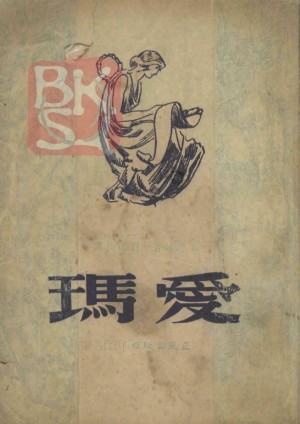
Liu Zhongde’s 1949 Chinese translation of Emma
Liu Zhongde published the first complete Chinese translation of Emma in 1949, the same year as the founding of the People’s Republic of China. The absence of any earlier translation is hardly accidental. Zhang Helong notes that in the first half of the twentieth century, Chinese intellectuals and translators were confronted with foreign invasion and civil upheavals, and thus prioritized novels that could reform society, strengthen the nation, or stir patriotic feeling—qualities not readily associated with Austen’s portrayal of “daily triviality” (105). In the seven decades since, ninety-five publication records of Emma have appeared in the catalogs of five major libraries, including the National Library of China and Shanghai Library, between 1949 and 2025. Among them, seventy-three are complete translations; twenty-one are compiled versions (including abridged, parallel English–Chinese, and rewritten editions); and one is a graphic novel version targeting young adult readers.
These versions do not demonstrate a simple sequence of progress. Different translations serve different reader needs. Liu Zhongde’s 1949 version is predominantly literal, with faithful and somewhat archaic wording. The opening sentence illustrates this approach:
Austen’s text: Emma Woodhouse, handsome, clever, and rich, with a comfortable home and happy disposition, seemed to unite some of the best blessings of existence. (3)
Liu’s translation: 爱玛· 伍德豪斯漂亮,聪明,富裕,家庭舒服,性情快乐,似乎兼而有了生活上的几种最大幸福。 (17)
Back-translation: Emma Woodhouse was beautiful, clever, wealthy, had a comfortable family, and had a happy temperament. She seemed to have some of the greatest blessings in life.
Liu’s translation closely follows the original sentence structure, establishing a textual foundation for later versions. Later translations, however, are far from homogeneous; each emphasizes different textual qualities and thus caters to different reader expectations. The joint translation by Zhu Qingying and Zhu Wenguang (1997) is elegant and fluent; at the micro level, it demonstrates a certain gender awareness in its emphasis on women’s marital rights, sisterly bonds, and the expression of women’s perspectives, thereby expanding women’s space for discourse (Lü 143).1 Sun Zhili’s translation (2001) combines literal rendering with idiomatic readability, while Li Wenjun and Cai Hui’s joint translation (2005) pays particular attention to Austen’s ironic tone and artistic technique (Lü 143). Austen’s fan reception in China has therefore been influenced by how translators collectively shape Emma’s distinctive reader appeal.
Audiovisual translation adds another layer to Emma’s reception history. The 2009 BBC miniseries (starring Romola Garai) is the only version officially imported and was dubbed by CCTV, airing in 2014. The language of the dubbed version balances literary refinement with colloquial accessibility. In Episode 2, Emma encourages Mr. Woodhouse to maintain his walking routine, reflecting the cultural logic of nineteenth-century English villages that regarded walking as a stable social rhythm (Wu 57). The source line is “Of course, we must keep to routine.” The CCTV version renders it as “当然,一定要有始有终” (“Of course, one must maintain consistency from beginning to end”). This translation does not preserve the English wording, but it conveys Emma’s gentle persuasion through a familiar Chinese idiom, “有始有终” (“maintain consistency from beginning to end”). The point is not that dubbing preserves a literal translation of Austen’s novel but that it revoices character dynamics for Chinese television audiences.
Streaming platform subtitles operate differently but also focus on accessibility. Official subtitle teams on platforms such as Tencent Video and iQIYI usually prioritize smoothness and rapid comprehension; these platforms include the 1996 film starring Gwyneth Paltrow and the 2020 film starring Anya Taylor-Joy. In the Tencent Video subtitles for the 1996 Gwyneth Paltrow film, Mr. Woodhouse’s line “It is very difficult to surrender the soul in church when one is worried about one’s throat” is rendered as “一个人在担心自己的喉咙时,很难在教堂里交付出灵魂” (“When someone is concerned about their throat, it becomes difficult for them to surrender the soul in church”). The Chinese version follows a natural conditional–result order, better aligning with Chinese word order and lowering the comprehension barrier for general viewers—but losing the playfulness of the English text.
Amateur subtitle groups, by contrast, often translate less widely available adaptations, including the 1972 BBC miniseries and the 1996 ITV film starring Kate Beckinsale. On Bilibili, a trendy culture and entertainment community popular among young users for its diverse genres such as gaming, lifestyle, and knowledge-sharing, user AntiqueStuff uploaded Chinese subtitles for the 1972 BBC adaptation starring Doran Godwin. When Emma tells Harriet, “Dear Harriet, I only wish I had half your good nature and sweet temper,” the subtitle reads, “亲爱的哈里特,我只希望我能有你一半的好个性跟好脾气” (“Dear Harriet, all I wish for is to possess even half of your good personality and temper”). This highly literal rendering retains much of the original dialogue structure, though it is somewhat rigid and difficult to understand. Such subtitles may appeal to viewers who value textual closeness and the feel of Austen’s phrasing, while official subtitles generally aim for fluency, accessibility, and platform readability. Together, print translation, official dubbing, platform subtitles, and amateur subtitles create a multi-channel reception environment, creating the conditions for the novel’s reception and remediation on social media platforms.
Marriage, women’s autonomy, and the right to refuse
In contemporary China, Emma’s statements about marriage resonate because marriage is still closely tied to economic security, family expectations, and social respectability, even as more women claim the right to delay, refuse, or redefine marriage. Chinese readers often approach Emma not simply as a heroine in a courtship plot but as a woman whose fortune allows her to distinguish love from necessity. Among 194 valid Douban book reviews of Emma from 2005 to 2025, a recurrent theme concerns Emma’s refusal to marry, her declaration of her intent to become “a rich old maid,” and her insistence on a woman’s right to choose. User SpongeRabbit@Present summarized Emma’s revelation through two principles: “A single woman must have money,” and “A single woman must cultivate objects of affection.” The reviewer quotes Emma’s words: “If I draw less, I shall read more; if I give up music, I shall take to carpet-work. As for objects of affection, I have all my sister’s children to care for.” The review matters because it not only identifies Emma’s famous refusal of marriage but turns that refusal into a general rule of female survival for contemporary readers. Economic independence becomes the condition of autonomous choice, while emotional attachment outside marriage becomes the spiritual support of independent life.
SpongeRabbit@Present’s review is based on Sun Zhili’s 2001 Yilin Press translation. The reviewer’s discussion of single life draws on Emma’s famous monologue in volume 1, chapter 10.
Austen’s text: “I have none of the usual inducements of women to marry. . . . Fortune I do not want; employment I do not want; consequence I do not want. . . . A single woman, with a very narrow income, must be a ridiculous, disagreeable, old maid! . . . but a single woman, of good fortune, is always respectable, and may be as sensible and pleasant as anybody else. . . . [A] very narrow income has a tendency to contract the mind, and sour the temper.” (90–91)
Sun’s translation: “我不具备女人常有的结婚动机 . . . 我一不需要财产, 二不愁没事干,三不怕别人看不起. . . 一个收入微薄的单身女人,肯定要变成一个荒唐可笑、令人讨厌的老姑娘! 可是一个有钱的单身女人,却总是十分体面,既聪明又讨人喜欢 . . . 收入微薄往往使人变得心胸狭窄,性情乖僻。” (76–77)
Back-translation: “I do not possess the usual motivations women have for marriage. . . . First, I do not need property; second, I do not have to worry about having nothing to do; third, I am not afraid of being looked down upon by others. . . . A single woman with a meager income must turn into a ridiculous and annoying old maid! But a wealthy single woman is always very decent, smart, and likable. . . . A meager income often leads to narrow-mindedness and eccentric temperament.”
Several features of Sun’s translation strengthen the themes of economic independence and autonomous choice. “Fortune I do not want” is rendered as “一不需要财产” (“First, I do not need property”), the first part of a three-part parallel structure “一不需要 财产,二不愁没事干,三不怕别人看不起” (“First, I do not need property; second, I do not have to worry about having nothing to do; third, I am not afraid of being looked down upon by others”). The parallelism gives Emma’s refusal a declarative force. The contrast between “收入微薄的单身女人” (“[a] single woman with a meager income”) and “有钱的单身女人” (“a wealthy single woman”) is further sharpened by the phrases “荒唐可笑、令人讨厌” (“ridiculous and annoying”) and “十分体面,既聪明又讨人喜欢” (“very decent, smart, and likable”). Although Sun’s “讨人喜欢” gives Austen’s “pleasant” a slightly stronger sense of social likability, the passage as a whole remains centered on respectability, intelligence, and the material conditions that allow a single woman to retain social dignity. These choices help readers transform Emma’s declaration into a contemporary argument that economic independence is the material basis of marital autonomy.
Xiaohongshu users circulate the same theme through memorable quotations. Blogger Lanlan Loves Reading presented Austen as “not only a great writer on par with Shakespeare, but also a woman who transcended her time,” writing that Austen “used the clearest language to tell women that hesitation is itself a reason to refuse.” The user quotes a paraphrased sentence from Emma: “一个女人若犹疑不定,不知是否该接受一个男人,那她当然应该拒绝他。她要是能迟疑地说‘好’,就该果断地说‘不’” (“If a woman hesitates and does not know whether she should accept a man, she should certainly refuse him. If she could hesitate and say ‘yes,’ she should simply say ‘no’”). Although not a verbatim quotation, these sentences closely match the logic of Sun Zhili’s translation:
Austen’s text: “[I]f a woman doubts as to whether she should accept a man or not, she certainly ought to refuse him. If she can hesitate as to ‘Yes,’ she ought to say ‘No’ directly.” (55)
Sun’s translation: “一个女人要是拿不准该不该接受一个男人的求爱,那她当然应该拒绝他。她要是犹犹豫豫地不愿接受,那她就应该当机立断地拒绝他。” (46)
Back-translation: “If a woman is uncertain whether to accept a man’s proposal, she should naturally refuse him. If she hesitates and is reluctant to accept it, she must decisively reject him.”
Both versions emphasize the principle that hesitation should lead to refusal, highlighting women’s rational judgment and autonomous will in marital decisions. This pattern suggests that the phrasing of Sun Zhili’s translation has been internalized through social media as a discursive resource for users to express female independence.
Class consciousness, family decline, and social dignity
Issues of class in Emma are interesting to Chinese readers because they connect Austen’s Highbury to familiar Chinese narratives of family decline, educational striving, and the fragility of dignity when status is lost. In contemporary China, class is often discussed through mobility rather than inherited rank alone. Most relevant to Emma are questions of whether marriage can consolidate social position and whether a family’s decline can turn former respect into pity.
Miss Bates, then, becomes particularly legible to Chinese readers. User Anxi begins with Miss Bates’s vulnerability: “when Miss Bates’s father was alive, her clerical family gave her a degree of social standing, and her kindness to others could be taken as a small honor. After her father’s death, however, the family’s poverty and her unmarried status turned her gratitude into an awkward sign that she had nothing else to offer.” Her situation reveals how precariously dignity depends on social position. Once a person moves from offering kindness to depending on the kindness of others, the same gestures may be reinterpreted as signs of vulnerability rather than generosity. Anxi notes, “I saw in her many hardships that deserve sympathy, witnessed social inequality, and realized how limited women’s choices truly are.” Anxi turns Mr. Knightley’s rebuke of Emma into an inward recognition: “I’ve fallen into the same mistake as Emma; just a couple of days ago, I even compared Miss Bates to another person I truly detest, Mrs. Elton, and mocked her in front of my friends.” This moment of self-recognition is crucial. The reader identifies class cruelty in the novel and converts that recognition into a reflection on her own behavior.
Anxi’s reading is not merely an idiosyncratic response but is grounded in specific translational choices that make Miss Bates’s class position particularly visible to a Chinese readership. Her review relies on the Li Wenjun and Cai Hui translation, published by People’s Literature Publishing House in 2005:
Austen’s text: “How could you be so unfeeling to Miss Bates? How could you be so insolent in your wit to a woman of her character, age, and situation? . . . She is poor; she has sunk from the comforts she was born to; and, if she live to old age, must probably sink more. Her situation should secure your compassion. It was badly done, indeed!” (407–08)
Li and Cai’s translation: “你怎么能对贝茨小姐那样毫无同情之心呢?你说几句俏皮话就罢了,可又怎么能对她那样性格、那样年纪、那样处境的妇女这般蛮横无理呢? . . . 她是个穷人,出娘胎的时候倒还有温饱日子过,可是后来就败落了,以后真要是老了,家里的光景只怕难免还要进一步败落下去。对她的处境你应该同情才是。可是你呀!瞧你干的!” (327–28)
Back-translation: “How could you be so lacking in sympathy toward Miss Bates? You may make a few witty remarks, but how could you be so rude to a woman of her character, age, and situation? . . . She is poor; when she was born, her family still had enough to live on, but later it declined; if she grows old, the family’s circumstances may decline even further. You should have sympathy for her situation. But you! Look what you have done!”
This translation preserves the force of Knightley’s rebuke through repeated rhetorical questions. Yet it also introduces a notable addition absent from the source text: “你说几句俏皮话就罢了,可又怎么能对她那样性格、那样年纪、那样处境的妇女这般蛮横无理呢?” (“You may make a few witty remarks, but how could you be so rude to a woman of her character, age, and situation?”) The concessive phrase “You may make a few witty remarks” acknowledges that Emma’s words might be unintentional, while the following “but” shifts the condemnation to her transgression against a particularly vulnerable target defined by her character, age, and situation. By explicitly listing Miss Bates’s multiple vulnerabilities, the translation amplifies the social dimension of the rebuke, making Knightley’s anger address not just Emma’s words but her disregard for class difference and the dignity of the weak. More importantly, it strengthens the class dimension through “败落” (“decline,” “fall from former status”). Austen’s “sunk” already implies downward movement, but “败落” carries a stronger Chinese association with family decline and loss of social standing. Its repetition in “进一步败落下去” (“decline even further”) makes Miss Bates’s vulnerability feel historical and social, not merely personal. The choice of “败落” evokes the familiar Chinese idiom “ 家道中落” (“one’s family fortunes declined”)—a phrase deeply embedded in the cultural lexicon to describe the loss of inherited status. More broadly, it resonates with the quintessential narrative of “门第衰败” (“decline of one’s social status or family reputation”), a recurring motif in Chinese literary and social discourse. Through this linguistic bridge, Miss Bates’s class decline becomes readily perceptible to Chinese readers.
This translation-mediated perception of class vulnerability finds an extension on the platform Xiaohongshu, where user Yoki moves from the fate of individual characters to a broader structural critique. She proposes the framework of “top-level repair.” According to this framework, Emma’s growth is a story not of a flawed girl rising from the bottom, but of a privileged young woman learning to restrain her power. In this reading, Emma and Knightley’s union is a “strong alliance” within the elite and a “moral purification of the upper class.” Yoki further argues that Highbury’s class structure never truly changes: “Harriet’s return to Robert Martin is not the triumph of love, but a return to social discipline.” This reading echoes Anxi’s Douban discussion. Both readers recognize that Emma’s moral education does not abolish class hierarchy; it only teaches a powerful person to behave with more compassion. The hierarchy remains intact; what changes is the attitude of the character who occupies its top level. In this sense, Austen’s novel offers not a blueprint for social revolution, but a tempered, ironic acknowledgment that the powerful can be taught to be less cruel, and that achievement, perhaps, is the most that the novel’s world will allow.
Masculinity, moral guidance, and respectful partnership
Mr. Knightley’s reception in China is shaped by contemporary debates about what kind of masculinity can be trusted. With women’s economic independence significantly enhanced, the older survival-oriented view of marriage, often summarized by the phrase “嫁汉嫁汉,穿衣吃饭” (“women marry to secure basic needs such as food and clothing”), has been challenged (Guo 460). Women’s expectations of partners have shifted from material security to emotional value and personal respect, and their emphasis on gender equality has expanded beyond cultivating gender awareness during the dating phase to encompassing various aspects of marriage, including interaction patterns, division of household and parenting responsibilities, and family decision-making (Ji 23). The concept of the “爹系男友” (“daddy-oriented boyfriend”), popular since 2019, is a typical manifestation of this shift. The term refers to a male partner who takes on a quasi-paternal role—providing guidance, protection, and practical support. This image evolved from the recurring archetype of the “霸道总裁” (“domineering CEO”), the male protagonist who is wealthy, devoted, and strong-willed, in Chinese “idol dramas”—romantic television series featuring young, attractive casts and focused on love stories. In online discourse, the newer concept is often used approvingly to describe mature, reliable partners, but it has also drawn criticism for normalizing unequal power dynamics or potential paternalistic implications. In this context, Knightley’s appeal lies precisely in his ability to balance moral guidance with respect for autonomy—a combination that resonates with contemporary Chinese women’s expectations of a partner who is steady, respectful, and reliable without being controlling.
Douban reviewers have shown great interest in discussions about ideal masculinity. The long Douban review “Perfect Mr. Knightley” by user Sabrina has received the highest number of likes among the collected book reviews, suggesting that Knightley’s appeal resonates deeply with Chinese readers. Sabrina describes Knightley’s charm from several angles. “He is more decent than Darcy,” she argues, “not simply because he helps others through material assistance but through genuine spiritual equality.” “His assistance to the vulnerable,” she contends, “does not arise from surplus wealth but from a belief that care for the weak is basic decency.” This moral logic reframes generosity as ethical obligation rather than noblesse oblige. Similarly, Knightley’s invitation to Harriet to dance rescues her from humiliation without making him appear self-congratulatory, a detail Sabrina reads as evidence of unshowy empathy. What makes Sabrina’s reading particularly compelling is her emphasis on Knightley’s capacity for honest criticism. She praises his ability to criticize Emma, noting that “he loves her, but he does not allow affection to blind his judgment. He points out her faults because such correction can genuinely help a proud and self-satisfied young woman.” This point is crucial: Knightley’s love does not manifest as indulgence or possessiveness but as a commitment to Emma’s moral growth. Finally, Sabrina admires his honesty about Jane Fairfax—not the courage to confess love but the ability to admit, plainly and without drama, that he does not love the woman others assume he admires. She reads Knightley’s emotional clarity and boundary-setting as integrity rather than coldness.
In support of these observations, Sabrina does not merely recount plot points: she extracts small gestures—his sending apples, arranging carriage rides, clarifying emotional boundaries—and weaves them into a coherent portrait of unobtrusive care rather than dramatic rescue. For contemporary Chinese readers, this portrait resonates with evolving expectations of a partner who respects women’s autonomy, acts responsibly, remains emotionally steady, and guides without controlling.
Translation also contributes to this reception of Knightley, although more subtly than in the discussions of Emma’s marriage autonomy or Miss Bates’s class vulnerability. Zhu Qingying and Zhu Wenguang translate the scene in which Knightley warns Emma not to encourage Harriet’s hopes for Mr. Elton in a way that shows him as observant and plain-speaking:
Austen’s text: “Depend upon it, Elton will not do. . . . He knows the value of a good income as well as anybody. . . . I am convinced that he does not mean to throw himself away.” (70)
Zhu’s translation: “毫无疑问,埃尔顿不会干的。. . . 他跟任何人一样,懂得有一笔可观的收入是多么重要。 . . . 我相信他决不会不顾自己的利益。” (53)
Back-translation: “There is no doubt that Elton would not do that. . . . He knows as well as anyone how important a good income is. . . . I believe he would never disregard his own interests.”
Zhu and Zhu's translation makes Knightley’s judgments sound direct and morally comprehensible. When Knightley warns Emma that “‘Elton will not do,’” Zhu Qingying and Zhu Wenguang render the phrase as “埃尔顿不会干的” (“Elton would not do that”). The translation subtly shifts the emphasis: whereas Austen’s phrasing suggests that Elton does not serve Emma’s purposes as a match for Harriet, Zhu and Zhu’s version focuses more squarely on Elton’s own intentions and calculations. This choice does not distort the scene, but it does present Knightley as someone who sees through the economic logic of courtship with unusual clarity. His speech sounds less like aristocratic authority and more like plain ethical perception. Such phrasing does not by itself create the contemporary image of Knightley as an ideal partner. It does, however, provide a linguistic basis on which later readers and platform users can recognize his mixture of judgment, restraint, and care. In this sense, the reception of Knightley’s masculinity emerges through the interaction between translated wording and contemporary expectations of emotionally responsible partnership.
Ideas about masculinity become even more vivid on short-video platforms. Douyin user Taishou offers a full plot explanation of the 2020 film—at forty-six minutes, the longest video in the search results—receiving 217,000 likes. Taishou analyzes Emma’s class arrogance, her growth through self-reflection, and Knightley’s function as an ideal guiding partner.
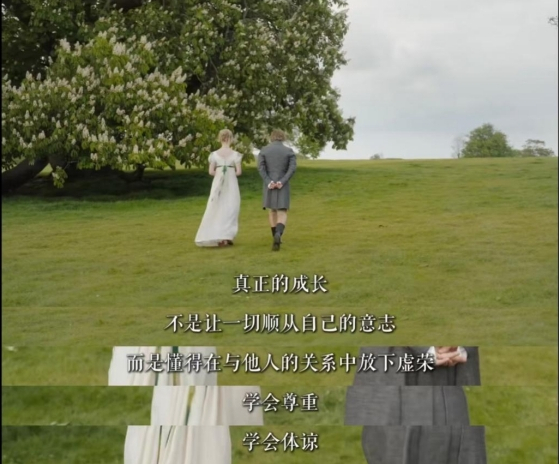
Taishou’s Douyin commentary video.
Taishou’s subtitle reads, “True growth does not mean making everything conform to one’s will, but rather learning to let go of vanity in relationships with others, and to cultivate respect and empathy.” This ending frames Emma not simply as romance, but as a story about self-knowledge, responsibility, and tolerance.
In the comment section of this video, user Latiao Gouyin describes Knightley as a “引导型恋人” (“guiding lover”)—a popular internet term referring to someone who plays the role of a facilitator in a romantic relationship. The guiding lover typically possesses strong communication skills, emotional management abilities, and goal-oriented qualities, enabling his or her partner to grow emotionally and even find direction in life. Latiao Gouyin notes, “It is hard to believe such a kind, empathetic, responsible guy exists in the world, so perfect he seems unreal. Emma is much more vivid, like watching a little sister gradually grow up under his guidance.” Another user, Yi, wrote that Knightley is “super rich, empathetic, responsible, gentlemanly, and pure-hearted—a guiding lover in love. I have nothing to say, pick up.” The repeated phrase “guiding lover” precisely captures the temperament of the character shaped by Austen. The slang phrase “pick up” (接) means, “I hope to meet someone like that too”—expressing .Yi.’s longing and showing that Knightley has become a projective symbol of the ideal partner.
Knightley’s masculinity is interesting in understanding the Chinese reception of Emma because he can be read alongside newer models of mature and responsible masculinity in contemporary China, including the popular but contested idea of the “爹系男友” (“daddy-oriented boyfriend”). Yet Knightley differs from that model because his guidance depends on restraint. He corrects Emma, but he does not force her; he helps Miss Bates and Jane, but he avoids making them feel indebted; he marries Emma, but he is willing to move into Hartfield to accommodate her father. In this sense, Chinese readers respond to him as a figure who promises moral steadiness without domination.
Visual aesthetics and platform-based reception
In addition to discussing Emma through long-form reviews, Chinese readers create and circulate shorter, more visual, and more easily shareable responses on other image, text, and video platforms, including Douyin and Xiaohongshu. As can be seen from the examples above, these platforms do more than repeat the themes identified in translated editions and their Douban reviews. They also introduce visual aesthetics as a new point of entry for fans.
We collected 143 videos related to Emma, from 2018 to 2025, on Douyin. Popular creators include Lancheng Film Collection. Short videos under five minutes account for more than sixty percent of the sample, fitting Douyin users’ fragmented viewing habits. The top title keywords include “奥斯汀” (“Austen”), “电影” (“film”), “女性” (“female”), “推荐” (“recommendation”), and “ 爱情” (“love”). On Xiaohongshu, 204 related posts from 2021 to 2025 were collected. The most frequently used keywords include “女性” (“female”), “电影” (“film”), “小说” (“novel”), “爱情” (“love”), and “婚姻” (“marriage”), closely echoing the Douyin pattern. These data suggest that Emma’s social media circulation is organized mainly around gender issues, romantic topics, and film adaptations. Below are the word clouds we created using Weiciyun, an online tool for Chinese text analysis and word cloud generation.
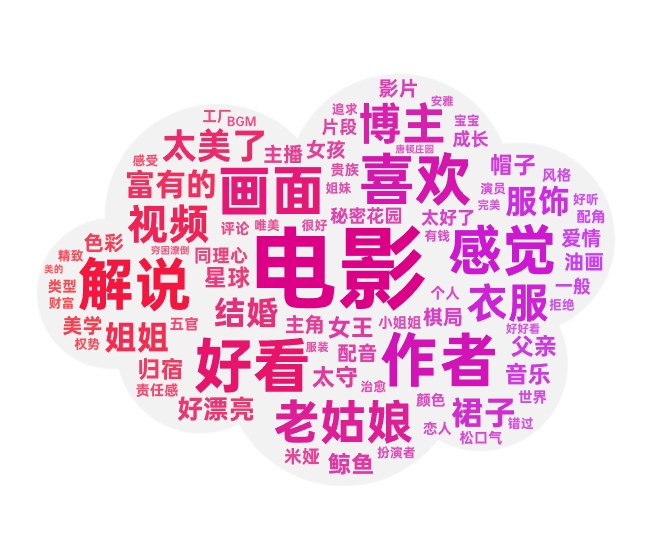 |
 |
| Word Clouds of High-frequency Words on Douyin (left) and Xiaohongshu (right). (Click on each image to see a larger version.) |
|
Visual aesthetics form the most distinctive extension of social media reception because they reach users who may not begin with the novel or with translation at all. Xiaohongshu user Sour Yogurt describes the 2020 Emma. as “a carnival of candy-colored British classical aesthetics,” analyzing its color, costume, and composition and comparing the viewing experience to placing a classical oil painting in a honey jar. User Chun writes that every frame pushes British style to the extreme and gives the impression of a princess stepping out of an oil painting. User Tingdu summarizes the film’s style as consisting of “rich ink tones” and “classical British charm.”
On Douyin, user Lancheng Film Collection concentrates almost entirely on visual aesthetics and costume detail in the 2020 film adaptation. The video received 318,000 likes. Unlike videos focused on plot or theme, Lancheng Film Collection praises the film’s oil-painting texture, Regency-style empire-waist dresses, lace and feather hats, and soft macaron-like color palette, also noting that such retro clothing is difficult to reproduce in daily life.
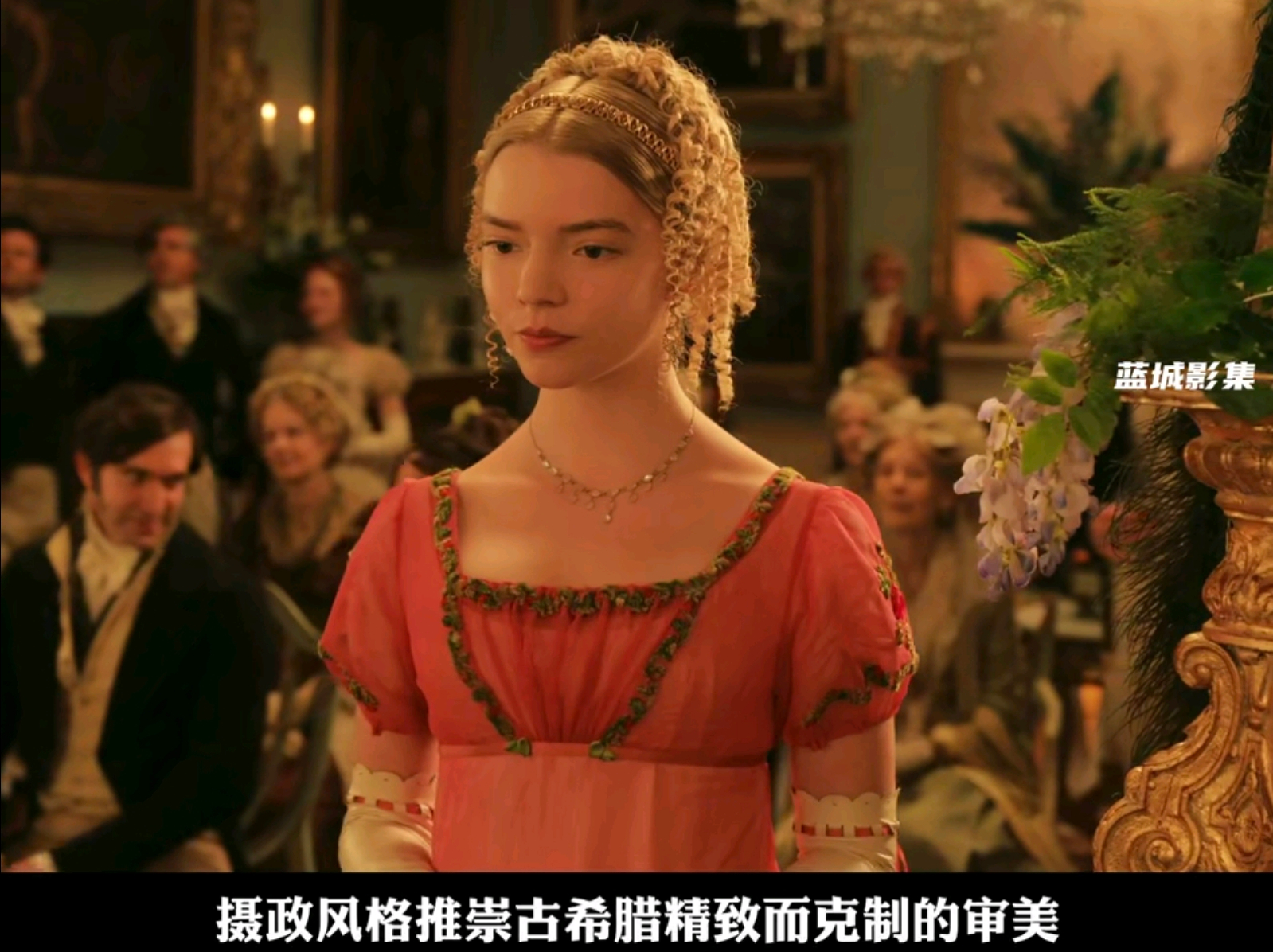
“The Regency-style embodies the refined and restrained aesthetic principles of ancient Greece.”
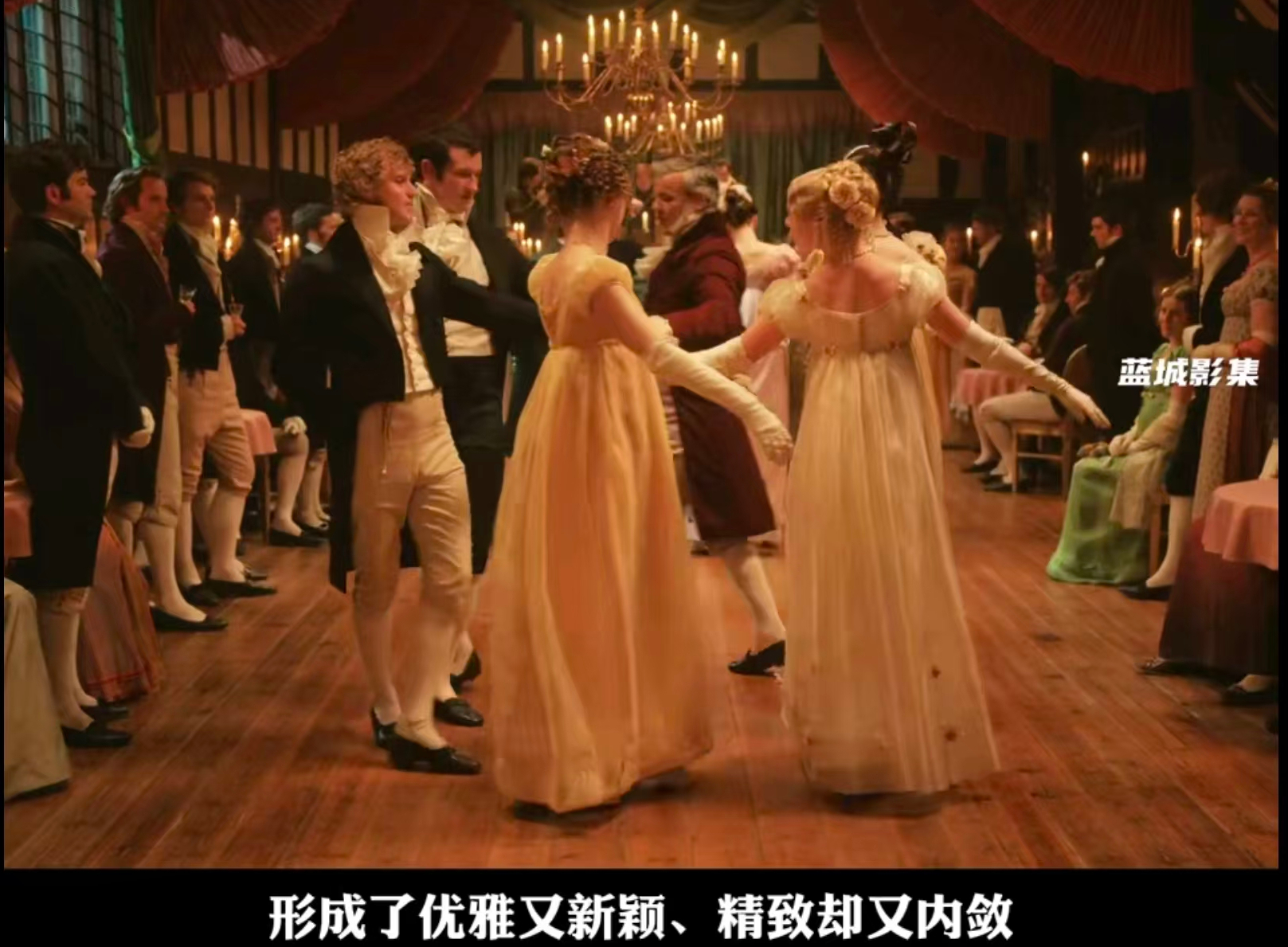 |
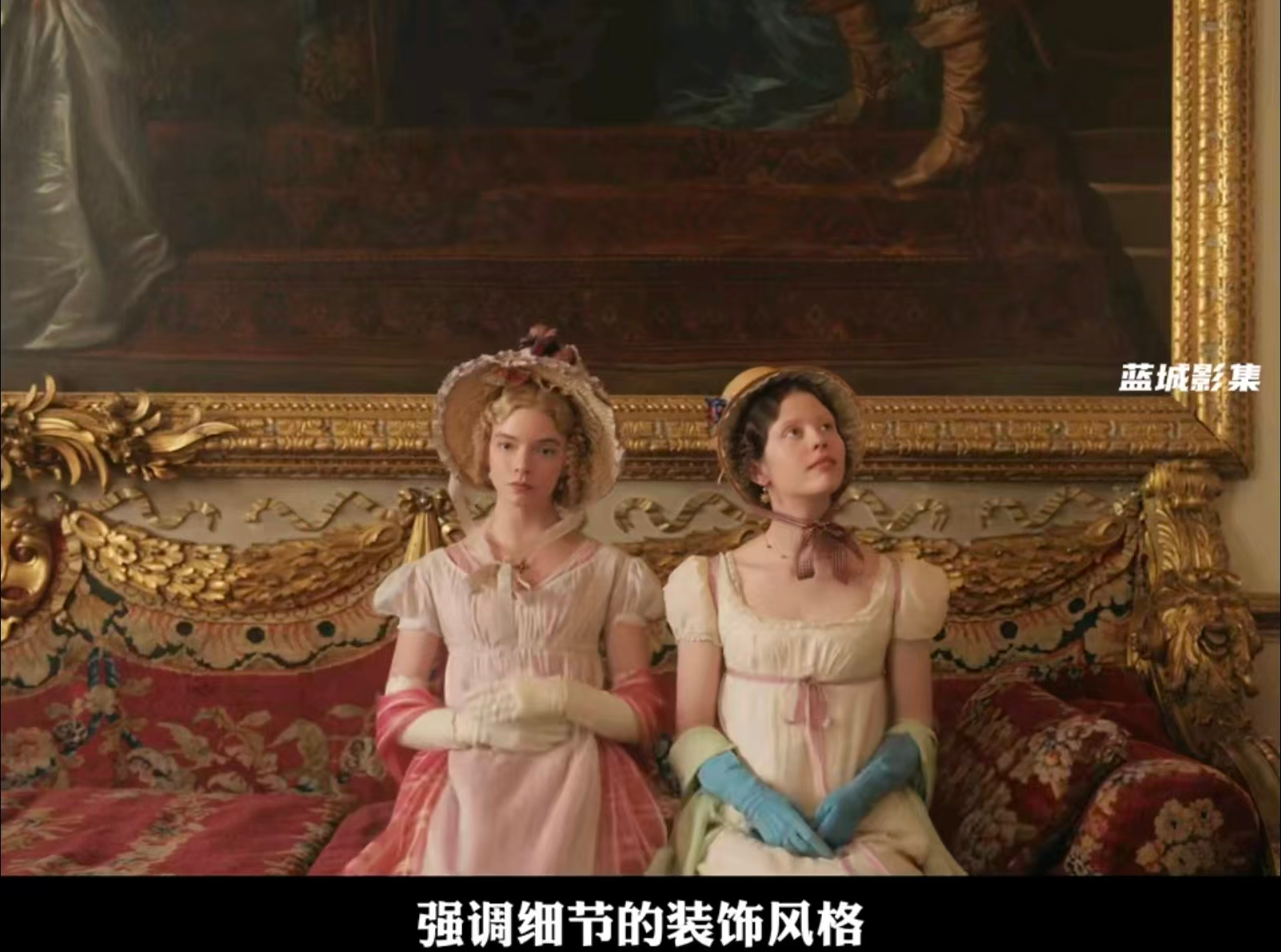 |
| “It embodies a decorative style that is both elegant and innovative, refined yet understated, with a strong emphasis on details.” | |
(Click on each image to see a larger version.)
In the comment section, users made similar observations: “This film directly made me love empire-waist dresses” (Positive and Uplifting Egg Yolk); “The dresses are truly beautiful” (Middle Demeanor); “Every frame can be used as a desktop wallpaper” (Lush and Green Leaves); and “It looks like an oil painting” (Brother Kang). These comments move from viewing to imitation and consumption. Fans not only admire the image but want similar clothing, wallpapers, and atmospheres. User Fossi Mum observes a revealing contradiction, arguing, “It is not that such dresses and hats no longer exist, but that ordinary people would look strange wearing them; they seem to belong only in beautiful films.” The film’s pastel colors, manor settings, lawns, and ballrooms fit young Chinese women’s romanticized imagination of English pastoral life and classical aesthetics. In Chinese internet culture, such aesthetics are often associated with “healing” and “slow living,” serving as a spiritual refuge from the fast-paced urban lifestyle (Ding 66).

Literary translations, audiovisual adaptations, and platform-based discussions on Douban, Douyin, and Xiaohongshu do not operate in isolation but feed into and amplify one another within a mutually constitutive ecosystem. The Chinese Emma corpus shows that different translations coexist not as rivals but as resources for different interpretive needs. The Douban, Douyin, and Xiaohongshu data suggest that platform discussions remain closely tethered to the lexical and tonal choices made by translators, even as they extend those choices into visual, affective, and aspirational registers.
A prominent feature of the Chinese reception of Emma is the convergence of translation history and platform-mediated fan engagement, which bring together several historically specific conditions: late and uneven translation history, the authority of classic literature series, the cultural force of book review platforms, and the rapid circulation of short-video and lifestyle media. A Chinese reader may first encounter Emma through a canonical literary translation, encounter it again through a dubbed television episode, and encounter it yet again through a Xiaohongshu post that quotes a single line to illustrate a modern romantic dilemma. These encounters are not sequential in any strict sense, nor are they interchangeable; each channel offers a different entry point and shapes the novel differently for its audience.
Ultimately, the Chinese reception of Emma reveals how a nineteenth-century English novel continues to generate meaning across media and generations. It survives because successive mediators—translators, subtitle groups, reviewers, and short-video creators—have made it speak to locally urgent questions. Translation is not merely the first gateway through which Emma enters China. It is an ongoing condition of reception. It shapes what readers can quote, what reviewers can analyze, what commentators can explain, and what platform users can transform into contemporary cultural language. Emma continues to matter in China because its translated and mediated forms allow readers to ask enduring questions in local terms: what enables a woman to refuse marriage, how class determines dignity, how guidance can remain respectful rather than controlling, and how visual beauty can draw new audiences back toward a difficult and rewarding novel.
ACKNOWLEDGMENTS
This work was supported by the Humanities and Social Sciences Fund of the Ministry of Education of the People’s Republic of China [grant number 24YJC740020] and the Fundamental Research Funds for the Central Universities [grant number 2026HQZZSK06].
NOTE
1All Chinese journal articles cited in this paper are sourced from either CSSCI (Chinese Social Sciences Citation Index) or the Peking University Core Journal List (commonly known as Chinese Core Journals). CSSCI, established with funding from Nanjing University and developed by the Institute for Chinese Social Sciences Research and Assessment, was first released in 1998. It is the most authoritative citation database in the humanities and social sciences in China, covering over 25 disciplines and indexing more than 500 high-quality academic journals. It has become the highest-level academic evaluation system in the domestic humanities and social sciences, playing a central role in university faculty title evaluations, discipline assessments, research project approvals, and achievement recognition. The Peking University Core Journal List, compiled by the Library of Peking University and the Research Group on Periodicals in Beijing University Libraries, is another widely recognized core journal evaluation system in China. Updated every four years, it identifies a select group of periodicals across various disciplines that are deemed to have significant academic impact and are routinely used as a benchmark for research quality assessment in Chinese academia. All Chinese journal articles cited in this paper are drawn from these two reputable indexing systems to ensure the authority, reliability, and academic rigor of the sources used.
