Recent adaptations of Jane Austen’s novels for the stage have found both critical and fan acclaim by queering the characters they adapt. In the last ten years, fans have been treated to a number of plays that queer their novel counterparts: Isobel McArthur’s Pride and Prejudice* (*sort of) (2018) portrays Charlotte Lucas as a lesbian; Zoe Cooper’s Northanger Abbey (2024) explores Catherine and Isabella’s friendship as a romance and reimagines Henry Tilney as a gay man; and the improvised show Austentatious (2011–present) has developed a spin-off, Crosstentatious, in aid of the LGBTQ+ charity Waverley Care. Austen’s six novels—and even her unfinished works—have thus sustained their relevance for twenty-first-century theatre audiences beyond textually faithful adaptations. Scholars have long noted film adaptations as a marker of Austen’s queer legacy (e.g., the queering of Frank Churchill in Amy Heckerling’s 1995 film Clueless), but researchers have neglected to consider queer theatre adaptations in longer studies. This article undertakes a close reading of Kate Hamill’s play Pride and Prejudice (2017) to argue that queer theatre adaptations, rather than simply modernizing or politicizing Austen’s work, reflect themes regarding gender and sexuality that are genuinely present in her six novels while using stage conventions such as crossdressing, sound effects, and stage design to make these themes more apparent for contemporary audiences.
Annamarie Jagose argues that queerness “focuses on mismatches between sex, gender and desire” and thus “locates and exploits the incoherencies in those three terms which stabilise heterosexuality” (3). Pamela Demory, in theorizing the genre of queer adaptation, suggests that to “queer something may be to reveal the queerness of something apparently ‘straight,’ or to make something available to a queer point of view” (147). In line with this argument, queer Austen adaptations for the stage, such as those listed above, broaden fan engagement most obviously by making her novels more accessible to a modern point of view. Queer adaptations, however, have not always been viewed positively by fans: in a review of Patricia Rozema’s Mansfield Park (1999), Nora Foster Stovel suggests that the “lesbian scenes” between Fanny Price and Mary Crawford “would make Jane Austen blush, as Regency decorum precluded such blatant sexuality in fiction.” Analyzing transgender novel adaptations, Sari Edelstein jokes that it “is a truth universally acknowledged that writers often use LGBT characters to make well-worn storylines feel contemporary.” Queer adaptations such as Hamill’s Pride and Prejudice, however, explore queer subtexts that are genuinely present in Austen’s six novels.
The past thirty years have seen the development of queer Austen studies, with theorists such as Eve Kofosky Sedgwick and Terry Castle attracting controversy during the 1990s for identifying homoerotic themes in Austen’s novels. Today, Austen’s criticism of marriage and gender roles is commonly viewed as central to her writing, in which intimate homosocial female friendships are the “most immediately gratifying human connections in Austen’s imaginative universe” (Castle). For example, inheriting an interest in Emma Woodhouse’s sexuality from Edmund Wilson and Marvin Mudrick, Susan M. Korba has analyzed Emma’s potential homosexuality through the lens of erotic domination in her relationships with Harriet Smith and Jane Fairfax. More recently, Sarah Eason has posited Henry Tilney as the “Queer Hero of Northanger Abbey,” arguing that there is a tension within Henry’s gender identity that is exposed by his unsuccessful attempts at performing masculinity for other male characters, such as his father. While Emma Clery has suggested that Austen’s interest in “the performative nature of social roles” is only “microscopic,” she concedes that the novels echo “Judith Butler’s influential analysis of gender as intrinsically troubled and unstable; as a ‘stylized repetition of acts’ rather than an expression of inner essence or a monolithic construct” (161). These are just some examples of queer readings of Austen’s novels that consider sexuality and gender, in which Austen takes a critical (and even queer) standpoint, as key themes or concerns of her work. Evidently, Austen’s novels contain queer elements and subtexts for queer theorists, adapters, and fans to interrogate.
As adaptations of Austen’s novels have long been symbols of “chick-flick” heterosexual romances, queer adaptations may challenge the view of Austen as socially conservative—and, indeed, the assumption that her novels promote the heteronormative marriage plot. On the other hand, Austen’s novels all end in a traditional heterosexual marriage between heroine and hero, leaving little scope for truly queer adaptations without radical changes to the inherited plot. Demory explores the possibility that “queer perspective[s] on adaptation can thus be a way of resisting normative ideologies and of revealing the fissures, absences, or silences of canonical texts” (148). Exemplifying this argument, Laura Wade’s 2018 play The Watsons adapts Austen’s unfinished novel, radically changing its proposed ending: as the characters revolt against their author on stage, one subplot unravels so that Lady Osborne elopes in a lesbian affair with Nanny, one of the family’s servants.
Queer theatre adaptations ultimately bring Austen’s texts to thousands of fans—theatre-goers, professional actors, and amateur performers among them—offering a unique space for the investigation of links among fan culture, queer theory, and performance. Although the theatre, as a site of gender transgression, camp, and sexual fluidity, is inherently queer, Torsten Graff has lamented that “queer theory is characterized by a profound neglect of drama” (11). In what follows, I present an analysis of both professional and amateur productions of Kate Hamill’s Pride and Prejudice to demonstrate how theatre studies constitute an enlightening yet undervalued field for investigating Austen’s ties to fan culture.
Indeed, neither amateur performances of Austen’s texts nor queer adaptations are modern phenomena. Devoney Looser identifies a Victorian woman as one of the first actors to play Mr. Darcy on stage, during an 1897 production of Pride and Prejudice at Royal Holloway College (164). Knowingly or not, therefore, performers today inherit and build on a queer heritage of performing Austen for the stage. Marina Cano’s Theatrical Afterlives: Nineteenth-Century Women’s Novels on the Stage (2026) argues that the field of theatre studies is crucial to both reception history and knowledge of the adapted texts themselves: “In short, the theatrical afterlives matter not only because of what they tell us about the novels’ reception history, but also because of how they simultaneously expose and reshape unexpected meanings in the source texts” (2). Studying contemporary adaptations is also important in understanding fan culture, as fans embody the text through acting and participate as audience members at the theatre, connecting to Austen’s novels beyond reading.
Kate Hamill’s staged adaptations of Sense and Sensibility (2014), Pride and Prejudice (2017), and Emma (2022) have been hugely successful. According to Hamill’s website, she was named the most produced playwright in the U.S. for the 2024–25 season. Her work has global reach—with, for example, Emma playing at the Abbey Theatre in Dublin in 2025, Pride and Prejudice performed by the Tokyo International Players in 2023, and the same play premiering at the Old Fitz Theatre in Australia in 2025. Hamill’s adaptations have garnered attention for her unique way of retelling classical texts in a non-traditional, comedic manner that incorporates modern pop music, sexual innuendos, and crossdressing to update the stories for a modern audience, whose members are invited to participate in the reshaping of Austen’s text.
For Chris Nagle, the ephemerality of theatre permits an intimacy between Austen and her readers beyond the page:
[W]hat live performance of Austen shows us is the active desire to have closer, more immediate, emotionally charged engagement with her life and work. . . . Live Austen continues to proliferate because so many of us want something more—not to replace or to improve upon what exists, but to add what theatre and live performance alone can offer: Austen narratives alive and embodied in real time, with affective intensity and elements of unpredictability, yet still experienced as ephemeral (this time limit, and the unique quality of each performance, is crucial). Fittingly, for many of the same reasons that Austen loved the experience of theatre in her own day, Janeites want Austen onstage at the theatre today as well. (785)
Informal social media posts reviewing productions of Hamill’s play confirm Nagle’s argument about the intimacy of the experience. In a 2017 Twitter/X post, one audience member (@ArabellaTrefoil) tells her followers:
I saw [Kate Hamill’s] “Pride and Prejudice” today. It’s smashing! I’m a fan of both Kate Hamill and Jane Austen. I got a little too involved with this production. I was yelling advice . . . (“Do, it! Kiss Mr. Darcy!”) Great stuff!
This fan’s direct participation in the action exemplifies the “emotionally charged engagement” with Austen’s work that Nagle identifies as a uniquely Janeite desire. In 2019, another audience member posts a “shout out to [Kansas City Repertory Theatre] for bringing Kate Hamill’s awesome adaption of “pride and prejudice” to KC. Clever writing and perfect for Austen fans or newbies” (@ChristinaMHager). Hamill herself is a self-proclaimed Janeite, explaining in an interview with Theatre by the Lake that she “got interested in her work in a couple of different ways. I just love the novels and have read them many times. I spent a semester in London when I was at university, and I went to Bath and went to her house and the whole bit” (“Kate Hamill”). Queer stage adaptations of Jane Austen’s works thus encourage all manner of Austen fans—Janeite/newbie, queer/straight—to reflect on the treatment of gender and sexuality in her original novels.
The use of crossdressing is the most obviously queer dimension of Hamill’s Pride and Prejudice, and her Dramatis Personae list immediately queers the boundaries of gender among Austen’s cast of characters. Under the subheading “Male or Female,” we find Mr. Bennet, Mary, and Miss Bingley, indicating that productions of the play are free to experiment with gender in their casting (7).
Of these three characters, Mary’s description is the most comedic: “Violent and dark undertones; prone to pendanticism [sic] and sulking. A dark goth Brontë character trapped in an Austen world” (7). While in the novel it is Kitty who “‘has no discretion in her coughs’” (PP 6), Hamill reassigns this habit to Mary, who “[c]oughs to get attention, or to make a point” and “may fancy that she is dying” (7). Hamill draws inspiration here from Mary’s association with the stereotype of the female pedant common in eighteenth-century literature, a trope that Lona Manning has analyzed in relation to the character. Hamill satirizes this figure for the audience, immediately portraying Mary as an outsider to the Bennet family, and especially to her light, bright, and sparkling feminine sisters. Camilla Nelson analyzes Curtis Sittenfeld’s Eligible (2016) through this lens, as the Bennet family think that Mary is a lesbian because she is content with single womanhood, does not “diet, shave her legs, pluck her eyebrows, or wear makeup,” and would never “disgrace herself in pursuit of a man” (127). Nelson writes that in Austen’s novel, Mary “haunts the pages of Pride and Prejudice, a lone female figure rendered all the more poignant by her social invisibility” (128), reflecting her position as a queer outsider in queer readings of the novel. The Unlikely Pursuit of Mary Bennet (2025), a recent novel adaptation, highlights the queer identification with Mary’s character in contrast to continuations such as Janice Hadlow’s The Other Bennet Sister (2020), recently adapted by the BBC, in which Mary marries a man.
Extending this trope of Mary as the socially isolated other from the Bennet girls’ foray into heterosexuality during the events of Pride and Prejudice, Hamill’s choice to cast a male actor as Mary highlights this otherness as a visual gag for the audience. The script is littered with references to Mary and her own family’s dislike of her: “Every time someone sees Mary without warning, they get a little shock. It’s as if she’s Nosferatu, and you turn around and OH GOD SHE’S RIGHT BEHIND YOU. She is Captain Bad Vibes” (8). Her repeated throat clearing is a running joke through stage directions such as “Mary coughs in a revolting manner” (11), underscoring her disgustingness. In a negative review of the play, Colin Thomas writes:
In Hamill’s retelling, the fourth sister, Mary, is a coarse joke of unmarriageability. Played in drag by Rem Murray—because what’s funnier than a man in woman’s clothing?—she’s too big, too sickly, too creepy. There’s no compassion here, no feeling for Mary, and it feels mean.
Thomas’s review is interesting, not in the least because it emphasizes homophobic tropes that Hamill’s play directly challenges. For Thomas, Mary is “creepy” because she is played by a man. In her preface to the playscript, however, Hamill instructs crossdressed actors that “if playing another gender identity, please do not play ‘at’ being a man or woman. Play the character, not the gender” (8). This difference in perception lies within the instability of the theatre adaptation as a fluid, ever-changing text. Each live performance—and each audience member—interprets the production from a unique point of view.
Hamill has explained the use of gender-bent casting as a method of exploring the marginalized role of women in Regency society:
Austen is writing a lot about people, especially women, who are really confined by the expectation of their class in a very rigid class system and their gender roles in a really rigid gender role system. I think we are dealing with a time where people are really struggling with that currently. There’s so much economic disparity and so much pressure to conform to gender roles. But now we realize those roles are confining for people and there are a lot of sacrifices you make to fit into those roles. Then when you step outside of those roles, society makes you pay a cost. I’m explicitly a feminist playwright, and I’m interested in gender roles. I wrote a lot of the roles [in Pride and Prejudice] to be gender neutral. In other productions going up in 2018, those people will not necessarily be the gender they are in the original production. Austen’s work is also a lot about hypocrisy and hypocrisy is evergreen—that thing will never go out of style. (Ferri)
For Hamill, crossdressing functions not as a transphobic or homophobic trope but as a method of subversion that emphasizes Austen’s feminist interests in the novel, exploring how women are negatively affected by patriarchy and heteronormativity. If, as Judith Butler contends, gender happens through “exclusionary means,” Mary’s crossdressing and characterization as the black sheep of the family signal her failure to adhere to nineteenth-century gender norms (Bodies 8).
In a similar manner, Charlotte Lucas is played by a man to highlight her undesirability in a society centered on heterosexuality. For example, in the first scene, Mrs. Bennet identifies Charlotte as Elizabeth’s competition in the marriage market:
LIZZY. It is a truth universally acknowledged that a single man in possession of a good fortune must be in want of a wife, Pappa.
MRS. BENNET. —exactly, THANK you, Lizzy, and I’m sure that [Mr. Bingley will] settle for one of them! But you must get there before horse-faced Charlotte Lucas!
JANE. Mamma! Charlotte is our friend.
MRS. BENNET. Well, your horse-faced friend Charlotte’s MOTHER is a shameless fortune-hunter, Jane, and shall snap him up in a trice if you do not go gogoGO. (11)
These repeated jabs at Charlotte as “ugly” and “horse-faced” demonstrate her disadvantaged position in the marriage market. It would be easy to associate this use of crossdressing as sexist or homophobic comedy; however, I suggest that Hamill visualizes ideas from Austen’s novel in ways that modern audiences find amusing: if woman “constitutes the position of object, a position of other in relation to a socially-dominant male subject,” in the words of theatre scholar Jeanie Forte (218), the masculinized portrayals of Mary and Charlotte shows how such “undesirable” women were further othered in Regency society.
Moreover, despite the running joke around Charlotte’s appearance, in Hamill’s Pride and Prejudice the character is played seriously, being for Elizabeth the sensible mentor that Mrs. Bennet fails to be. For example, during the scene at the Netherfield Ball, Charlotte reveals a clearer understanding of the “game” of marriage than the characters played by female actresses seem to have:
CHARLOTTE. [Jane will] catch him if she just breaks the rules a bit.
LIZZY. Must it always be “catching” and gaming and strategy? Perhaps she wishes to know him before she makes a—a—display of her affection!
CHARLOTTE. How much can we ever know of anybody? She should hurry up and get him to the altar—she has the rest of her life to fall in love!
LIZZY. Charlotte, you never would act that way yourself!
CHARLOTTE. It is my experience that one invariably finds oneself doing the very things one swore “never” to do. (44–45)
Charlotte’s reference to marriage as a game and Lizzy’s use of the word act underscore how these characters inauthentically perform their gender according to the heterosexual system in lieu of being, or knowing, their true selves. In contrast with Mary, Charlotte’s character is played seriously.
The seriousness of Charlotte’s decision to marry Mr. Collins embodies her commitment to operating within the heterosexual social system that Austen explores in her novel, despite Charlotte’s being played by a man. Melina Moe writes that in the source text, “Charlotte detaches marriage from a timeline of improvement” and therefore from the concept of heterosexual love:
She has no easy hopefulness about marriage and progress, couples adapting together, happiness augmenting in time, or self-growth and marriage working in tandem. . . . She severs the moral and conceptual bonds linking marriage to progress, conjugal harmony to personal growth, and future happiness to the judgment of character, all of which Elizabeth teaches herself throughout the novel to see as natural and necessary. (1091)
Hamill’s Charlotte subverts the audience’s expectations of the social and political transgression implied by crossdressing, thus making her decision to marry Mr. Collins and her adherence to the sex-gender system even more striking. Crossdressing in this adaptation is therefore not just a comedic theatrical convention—although that is one of its intended effects. It is used with purpose, implemented not only to subvert audience expectations but to make overt Austen’s subtle critiques of marriage and the position of women. Queer adaptation in this instance—at first glance, simply a comedic spin on Austen’s Pride and Prejudice—is used “to reveal the queerness of something apparently ‘straight’” in the novel’s exploration of the marriage market (Demory 147).
Like her novel counterpart, Caroline Bingley is overly interested in the accomplishments (and, therefore, the femininity) of other women. As in the novel, Caroline mocks Elizabeth’s nonconformity to gender roles as she enters a one-sided competition for the hand of Mr. Darcy. Hamill’s Caroline is a caricature of the internalized misogyny displayed by the novel’s Caroline—an element of her character emphasized in her casting as a man. When she exclaims to Darcy, “Six inches of mud on her! And did you see her hair. . . . To walk fifteen miles, or whatever it is, unchaperoned?! She is really—too much” (29–30), these criticisms of Elizabeth’s gender take on an ironic tone as they come from a male actor.
Internalized misogyny is satirized most apparently in the scene in which the three characters discuss female improvement:
MISS BINGLEY. NO woman can be called “accomplished” who doesn’t possess a mastery of music, needlework, and the languages—
LIZZY. —All of the languages?—
MISS BINGLEY. —And EVEN THAT is nothing, if she does not know when to speak . . . and when to hold her peace! The Accomplished Woman is—irreproachable.
She holds up the glass demonstratively.
An elegant ornament in any room, a sparkling delight to any eye, a flawless vessel into which the confidences of the greatest men may be safely poured!
She strikes a pose, then, unfortunately—burps loudly. (31)
Hamill’s Caroline’s exaggerated expectations of womanhood and “The Accomplished Woman” are unachievable and ridiculous coming from a crossdressed actor, and the punchline comes when she herself cannot even adhere to the guidelines she sets (41). In an interview with The Interval, Hamill explains that this casting was intended for ironic effect:
The way that we cast it now, the men who play women are also the women who enforce patriarchal standards on the other women. They’re the women who say, “This is what a perfect woman is. This is what you should do,” and some of them are more sympathetic, like Charlotte, and some of them are less sympathetic, like Mary. (Rebell)
For contemporary audiences, then, crossdressing therefore emphasizes that those excessive accomplishments, markers of gender identity in Regency England, are, in Butler’s words, “a set of repeated acts within a highly rigid regulatory frame that congeal over time to produce the appearance of substance, of a natural sort of being” (Gender Trouble 45). This subversion of expectation demonstrates Elaine Aston’s argument that
[c]rossdressing, cross-gendering techniques represent a theatrically exciting way of demonstrating and de-automatising our perception of “naturalized” gender sign-systems. Crossing the gender divide may expose the way in which gender is organised as an arbitrary, artificial sign-system, which, like all such systems, it is possible to disturb and to deconstruct. (74)
In other words, “The Accomplished Woman” is a performative construct, and casting Caroline as a man highlights this constructed nature to the audience, helping them to both understand early-nineteenth-century gender norms and reflect on twenty-first-century attitudes towards gender.
Just as gender performance and the constructed nature of femininity are explored through crossdressing, recurring references to game-playing in the script emphasize elements of fakery and performance associated with marriage in Austen’s novels. Lizzy describes marriage as a game:
JANE. Stop filling her head with foolishness. It’s not a game, Lydia.
LIZZY. Isn’t it? There are rules, strategies, wins, losses—and it is, theoretically, done for pleasure. . . . You probably decide he’s your Perfect Match just after your Mamma has finished counting his rich, sickly relatives and your papa has called on his bankers. These things are all arranged above one’s head, Lydia. (14)
Courtship is not simply a social game wherein women are the players and heterosexual marriage the prize but rather more like a competitive sport.
Mr. Collins’s understanding of courtship also figures romance in these competitive, or patriarchal, terms:
COLLINS. –Ladies always reject a gentleman’s first advances! One must woo—court—WIN over and over before attaining blushing surrender! I shall Play This Game—and confess that your humility is indeed most captivating—charming—AROUSING! (52)
Hamill parodies masculinity through the game metaphor, as women are seen as players to conquer and win as prizes when they “surrender.” Reflecting this motif from the script, the stage, lighting, and sound design of various productions emphasize game-playing visually and sonically. The script itself marks sound effects like buzzers, bells, and the cheesy 1960s song “The Game of Love,” by Wayne Fontana and the Mindbenders, while female characters play blind man’s bluff in search of their potential husbands. Chris Nagle writes that “‘The Game of Love’ would work as a fitting subtitle for [Hamill’s] Pride and Prejudice. . . . And yet as light-hearted and often farcical as much of this action is, we also see how clearly serious the consequences of the love-game are for everyone, especially for women in Austen’s age” (761).
Games and coded language are of course present in all six of Austen’s novels, as the heroines struggle or thrive in the gamification of the marriage market. In Emma “the world of games and play is so integral to the structure and so fundamental to our understanding of the meaning that the novel itself could well be described as one extended word game,” David Selwyn argues (275). Vladimir Nabokov writes that Mansfield Park “is the work of a lady and the game of a child. From that workbasket comes exquisite needlework art, and there is a streak of marvelous genius in that child” (10). Several productions of Hamill’s Pride and Prejudice have also chosen to incorporate elements of gaming and sports into their stage design: one reviewer describes the stage design of a 2023 production directed by Tatyana-Marie Carlo as “a large open playing space—making a drawing room or garden or ballroom very much a playground” (Brown). In the premiere production at the WaterTower Theatre in 2017, in which Hamill herself played Lizzy, the stage floor was painted as a Persian rug featuring basketball court markings.

Stage Model by Chelsea M. Warren
( https://www.chelseamwarren.com/pride-prejudice-watertower-theatre)
Jerome Weeks explains in his review that Austen fans were incorporated into the production, “divided into two sections, each seated on opposite sides of the playing area, like high school fans at a basketball game. The set [was] also armed with basketball hoops and there are referee whistles going off and penalty buzzers and a timekeeper’s bell” (qtd. in “Pride & Prejudice—Watertower Theatre”). This set design by Chelsea M. Warren complements Hamill’s parody of Mrs. Bennet as a sort of cheerleading coach, leading a chant before each ball: “Chest and bum and eyes and smiles. Catch that man with female wiles!” (97).
Another production visualized the game of love as a violent boxing ring wherein men and women were each other’s opponents: “The stage floor is painted black and in the center is the white outline of a large rectangle, which—with the help of lighting (by Karin Olsen) and bells (sound design by Dan Dukich)—creates the effect of a boxing ring where the ends of scenes are akin to the end of a round between fiery romantic Lizzy Bennet and staid but punchy Mr. Darcy” (Dorman). One student production also made stage design choices outside the script to highlight Hamill’s emphasis on games: “When some of the main characters [were] having a discussion, other side characters step[ped] off to the side and perform[ed] their own ‘side gig,’ by either talking or tossing a ball around.” The Bennet house featured “an ‘Us’ vs. ‘Them’ scoreboard” that worked as “a great visual representation of the family’s struggles and challenges” (Sims).
Games and game-playing therefore function not just as a metaphor for heterosexual courtship and gender performance but as a method for theatre audiences to connect with the novel in the ephemeral setting of the theatre. Game playing as a motif in a wider sense, beyond the play or novel, invites broader fan engagement with Austen’s work and the performance of heterosexuality—for example, in the Austen video games, board games, and card games that have become huge parts of Austen’s afterlives. In these games, Janeites embody Austen’s heroines and navigate marriage, as Janine Fron discusses:
Noteworthy courtship games like Erika Svanoe’s Marrying Mr. Darcy strategy card game engages players to build skills to attract suitors. In Jane Austen’s Matchmaker game (Sabrewolf Games), players plot advantageous marriages to play out their own story. The board game Pride and Prejudice—The Game (Ashgrove Press) is another tabletop experience where players are challenged to wed their chosen couple through a board race and answer P&P trivia [questions] along the way. (476)
Games and gamification of Austen’s storylines are intrinsic to the manifestation of fan culture and her work. Hamill’s adaptation of Pride and Prejudice, by developing the plot of the novel as a game, both exposes the nature of courtship as performance and encourages the audience to question the seriousness of gender and courtship expectations in both Regency England and their own contemporary context. It also promotes the audience to participate as players or spectators of “the game of love” themselves, encouraging reflection on Austen’s themes of marriage and sexuality in a new, participatory light and visualization of the consequences for the losers of said game. Stage designs also reflect the participatory nature of Jane Austen fan culture itself, demonstrating Chris Nagle’s argument that the ephemeral nature of the theatre encourages fan participation with the novels.
Several high schools and colleges across America have performed Hamill’s Pride and Prejudice as school plays: Christopher Newport University in Virginia, the Frederick Gunn School in Connecticut (a private boarding school), and Mount Baker High School in Washington. Amateur performance is a developing area of Austen studies within the last ten years or so. Looser’s The Making of Jane Austen (2017) was the first to consider amateur performance history and Austen fan culture, and she uncovers Victorian productions of Pride and Prejudice at single-sex colleges and schools, which notably used crossdressing. Such crossdressing suggests that queer adaptations of her novels are not simply markers of modernity but natural results of the theatre’s inherently queer dimensions, such as metatheatricality, performativity, and the ability to transgress social norms. Queer Austen adaptations and amateur performance therefore have a longer history that has yet to be discovered. Highlighting the importance of amateur theatre studies, Cano argues that “[e]xamining what happens onstage when profit is not the main driving factor offers us the chance to unravel how the ‘ordinary’ reader-actor engages with the author and source text, while bringing an often neglected group of practitioners and theatre practices to the foreground” (4).
Amateur performances of Hamill’s Pride and Prejudice can therefore be seen as both indications of Austen’s continued relevance and confirmation of Nagle’s argument that fans have an “active desire to have closer, more immediate, emotionally charged engagement with her life and work” (785). As a field for analysis, amateur productions demonstrate Austen’s afterlife beyond a static playscript or professional stage design choices; rather, the paratextual evidence surrounding school performances can reveal insights into the relationship between Jane Austen, performance, and “everyday” fans. Take, for example, the University of Minnesota’s call for auditions for Hamill’s Pride and Prejudice in 2023. Under the heading “THIS IS NOT YOUR GRANDMOTHER’S JANE AUSTEN!” the director outlines Hamill’s versions of Pride and Prejudice for students:
This contemporary version of the story of Mr. Darcy and Lizzy Bennet is bursting out all over with brilliant jokes, quick changes, and above all LOVE that cannot be contained. This production seeks to cast actors from a wide variety of cultural backgrounds, nationalities, and identities, regardless of their level of familiarity with Jane Austen’s work. We encourage everyone to apply. (“Calling ALL UMN students!”)
This casting call is interesting in two ways: it encourages identity-blind casting, and it invites students who are not Austen fans to participate in the production. To encourage actors from a “wide variety of cultural backgrounds,” the call includes a photograph from the Park Square Theater 2019 production of Pride and Prejudice, directed by Lisa Channer, showing Kiara Jackson, a Black actress, playing Lydia Bennet. Lin-Manuel Miranda’s musical Hamilton (2016) and Netflix’s Bridgerton (2020–present) are recent examples of the increasing popularity of color-blind casting in adaptations set in the long eighteenth century. As the UMN casting call invites those who are not fans of Austen’s novel to participate, it shows how amateur theatrical performances can encourage engagement with Austen’s texts beyond her usual reach, widening fan engagement across cultures and identities. A student reviewer for another production of the play, at the University of Detroit Mercy, highlights how the adaptation foregrounds the audience’s connection to the text in an accessible manner:
Pride and Prejudice can be seen as stuffy or, at its worst, a museum piece. . . . [T]his adaptation takes a fresh spin on the characters and their stories, showing them in a light that is bound to connect with contemporary audiences today. (Wild)
After the show there was a “discussion on the secret language of hand-held fans . . . led by costume historian Katherine Stefl” (Wild), demonstrating that amateur productions can improve knowledge of Austen’s texts and their historical contexts, serving as an educational opportunity.
Given the quirky nature of Hamill’s adaptation, her Pride and Prejudice offers amateurs a chance to interpret Austen’s novel in unexpected ways—particularly through the inclusion of crossdressing or gender-blind casting. Some productions have exploited the fluid nature of the script by cross-casting parts not specified in the original production, changing the impact of certain scenes. For example, in productions casting a female Mr. Bennet, like that at the University of Detroit Mercy in 2023, the fact that he is considerably more enraged by Lydia’s elopement with Wickham than his novel counterpart takes on a different dimension. Hamill’s Mr. Bennet recognizes the genuine danger that Wickham poses to women. But the comedy can also be heightened. In productions where Mr. Bennet is played by a woman, the exaggerated show of masculinity that ensues when he comedically tries to fight Wickham—“HOW DARE YOU COME UNDER MY ROOF, SIR! ELIZABETH! FETCH ME MY PISTOLS!” (84)—takes on a different meaning for the audience. Jack Halberstam has argued that “female masculinity actually affords us a glimpse of how masculinity is constructed as masculinity” by satirizing stereotypical traits like violence, sexism, and “macho man” personas (1). Cross-casting Mr. Bennet and other male characters, therefore, satirizes the dominant masculinities and patriarchal systems of nineteenth-century England for Pride and Prejudice’s modern audience.
How amateur productions choose to cast and stage Hamill’s play can provide further insights into the function of queer adaptation within the Austen fan community and demonstrate how both new and old fans of her novels interpret their contemporary resonances. In 2022, the Beaumont Community Players in Texas performed Pride and Prejudice. This amateur theatre group is known in the local community for LGBT+ activism and is led by Executive Director John Manfredi, whom Pride and Prejudice director Julia Rodriguez describes as “a champion of LGBT+ community (an achievement in a small US southern town).” In line with their ethos of LGBT+ inclusion, Bryan Buzbee performed as Mrs. Bennet, styled in full drag, rather than in a Regency-style dress and bonnet as in other productions. Photographs of the Beaumont production show the actor in a tall ginger wig, with drag makeup, flashy costume jewelry, and a padded chest.
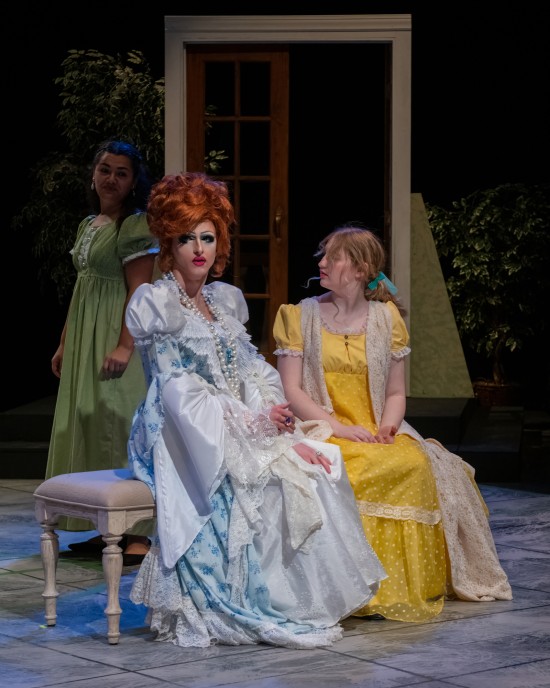
Bryan Buzbee as Mrs. Bennet, photographed by Tim Sudela and reproduced with permission from the Beaumont Community Players/Southeast Texas Stages
One reviewer of the show writes that “Buzbee plays a ‘drag queen’ rendition of Mrs. Bennet and steals the show. Throughout the first act, Mrs. Bennet’s physical comedy, and body language carries the show with incredible charm” (Sims). The irony here is that Buzbee’s Mrs. Bennet identifies and dictates to her daughters what “female wiles” should be, and who has them (there is the running joke that she finds Charlotte hideous because she is played by a man). Judith Butler argues that:
As much as drag creates a unified picture of a “woman” . . . , it also reveals the distinctness of those aspects of gendered experience which are falsely naturalized as a unity through the regulatory fiction of heterosexual coherence. In imitating gender, drag implicitly reveals the imitative structure of gender itself—as well as its contingency. (Gender Trouble 187)
The choice to style Mrs. Bennet as a drag queen again highlights the performative nature of courtship and gender in Austen’s text. Theatre conventions such as crossdressing and drag performance can thus satirize and make more obvious the subtle critiques of compulsory heterosexuality present in Austen’s novels.
I have considered how amateurs, including students, perform Pride and Prejudice from varying levels of familiarity with the original text. Queer adaptation thus encourages fans to learn about Regency life and Austen’s work through a creative, collaborative process that encourages performers, production teams, and technical crews to reflect on themes in both Hamill’s and Austen’s work that they most want to highlight for their audience. In her analysis of using adaptation as a creative assignment with undergraduate students, Misty Kreuger writes positively about the power of adaptation as a pedagogical tool:
In creating adaptations, students established a firsthand connection between works of literature and their own creative practices. Because they were required to think about the relationships between texts—others’ and their own—they were able to appreciate intertextuality.
In similar ways, amateur performances—and in particular Beaumont Community Players’s decision to depart from the script in styling Mrs. Bennet as a drag queen—demonstrate how queer adaptations can facilitate fan engagement for new readers and explore queer themes in her work in a new light through embodiment and performance.
Kate Hamill’s Pride and Prejudice exemplifies how live theatre adaptations of Austen’s work can increase fan engagement with her novels. Elements such as crossdressing and gaming motifs highlight the constructed nature of gender, make her novels available to a queer point of view, and emphasize queer themes inherent in the original text. Casting male actors in the roles of Caroline, Mary, and Charlotte highlights Austen’s satire of the female pedant, internalized misogyny, and the economic pragmatism involved in courtship. Rather than promoting homophobic or misogynist caricatures, this choice draws attention to deeper issues around patriarchy and sexism. Amateur performance is important to adaptation scholars beyond carrying out close readings of playscripts. Attending to such productions of Pride and Prejudice can improve our understanding of Austen’s global reach and how fans engage with adaptations of canonical texts/authors. “Playing” in this context can enhance new fans’ understandings of the original text and attach new meanings to twenty-first-century values of Austen’s work.
