In August 1867, the poet and early Austen tourist Alfred Lord Tennyson visited Lyme Regis with a friend, William Allingham. At this site, they reconnected with one of the most pivotal moments in Austen’s fiction: Allingham recorded that “while we [sat] on the wall I read to him, out of Persuasion, the passage where Louisa Musgrave hurts her ankle” (158). Aside from misspelling Louisa’s surname and understating the famous Cobb scene, this account points to a long history of Austen fandom—now a prominent subfield in Austen scholarship—that has become increasingly centered on literary tourism as an important area of research into Austen’s works and her legacy.
Modern tourists form a diverse community of fans whose motivations for and responses to visiting Austen-related sites vary widely. Yet a persistent popular image lingers around Austen fans: at best they can be seen as escapist and nostalgic, and at worst as unhealthily obsessive and mildly deluded, the latter being popularly reflected in screen productions such as Austenland (2013), Lost in Austen (2008), and Bridget Jones’s Diary (2001). In this stereotype, fans are besotted with Austen’s characters and with the many screen adaptations, often wishing that fiction were reality. The film Austenland clearly illustrates this infatuation, describing Austen aficionados as having a “consuming love for Mr. Darcy.” The enthusiastic heroine is labeled by her friend as “an addict” whose devotion to Austen is “really weird.” Indeed, scholarship suggests that Austen’s novels “evoke nostalgic escapist fantasies in the ordinary lives of modern readers and spectators” (Gündüz 470). Similarly, Sarah Glosson explains how Austen fans view the past “as a simpler time, replete with . . . manners that magnify niceties and obscure less pleasant aspects of life” and how this rose-tinted nostalgia encourages a longing to inhabit Austen’s fictional worlds (7). Glosson goes on to describe how literary tourism allows fans to “experience the pleasures of momentary displacement from everyday life” (200). The tourism itself then reinforces the desire, as “the actual visit invokes . . . a sense of nostalgia or of longing for the particular kind of world they associate with the writer” (Herbert 327). Deidre Lynch argues that Austen tourists are principally driven by a desire for “time-travel” and summarizes their main motivation by concluding: “the prime mover in Austenian tourism is often a nostalgic, Anglophilic notion of ‘heritage’” (116).
Popular media portrayals of Austen superfans combine with scholarship to create an image of Austen literary tourists as individuals driven by a nostalgic desire to live in an idealized past or within a fictional novel. To test the current validity of this view, I took an interdisciplinary approach, applying methods from tourism studies, media studies, and cultural studies, and conducted an anonymous online survey (see Appendix) and in-depth virtual interviews with Austen fans from across the world. Participants were recruited through Austen societies, clubs, and social media fan groups between February and June 2025. They were asked to provide demographic data, including age, gender, educational background, what type of tourism they preferred, and whether they saw themselves as more Janeite or Austenite (with Janeite defined as an enthusiastic admirer of Austen’s novels and characters, and Austenite as someone with a more academic or scholarly interest in Austen). They selected from a list the types of Austen sites and events they had visited, such as immersive experiences or film locations, and they shared which sources they had consumed in advance—for example, Austen-related nonfiction or screen adaptations. Participants then selected their three main reasons for visiting Austen sites from a list and described why those motives were important to them. Reasons were aligned with established tourism models and included options such as “I enjoy connecting with other Austen fans and feeling a sense of belonging,” and “I enjoy attending Austen themed events to immerse myself in Jane’s Regency world.” Lastly, participants were asked what Austen meant to them personally and how they felt when visiting these sites. Through the data, I sought to test the popular assumptions about Austen tourists and to understand why fans trek to Lyme Regis to read Persuasion on the Cobb, as Tennyson once did. What really draws Austen tourists to these places, and what do they gain from their literary pilgrimages?
The typical Austen tourist
As in David Herbert’s study of Chawton visitors in the 1990s and Jeanne Kiefer’s findings on Janeites in 2008, the majority of respondents were female, affluent, and middle-aged, with a median age of fifty-seven. The vast majority were from the U.K. and North America (both at 43% each), while 11% resided in continental Europe, and a further 3% were from Australasia and the Middle East. These tourists were knowledgeable, dedicated fans: 88% had read Austen’s novels, and 83% had read nonfiction about Austen’s life or writing; 86% had also watched screen adaptations of the novels. Respondents were highly educated, with 60% holding a postgraduate-level qualification, compared with just 13–14% of the U.K. and U.S. general populations. These fans mirror those of Herbert’s study, being “a well-read and knowledgeable group” (322). Such findings challenge the popular stereotype of Austen fans as naïve individuals seeking simply “to escape to a prettier and more genteel past” (Thompson).
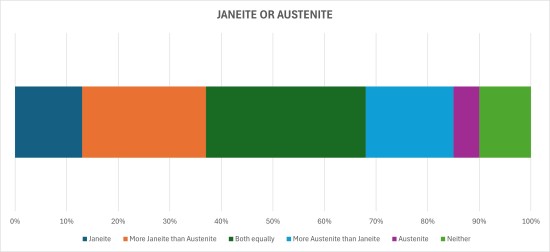
Over a third of respondents described themselves as “mostly Janeite” (i.e., identifying as Janeite or more Janeite than Austenite), while 22% identified as “mostly Austenite”; 10% identified as neither; the remaining third described themselves as both equally. These responses strongly suggest that the binary distinction between Janeite and Austenite is often too simplistic for studying Austen admirers. Furthermore, several respondents described their identities as shifting over time. One American fan explained, “I would consider myself a Janeite, but I’ve shifted again I think as I’ve developed appreciation . . . [for] the scholarly.”
Like all tourists, Austen fans are drawn to sites through a combination of push and pull factors. Push factors are the internal motivations that drive tourists to sites, such as the desire to immerse oneself in the writer’s world, or to feel a connection with Austen and her work. Pull factors, by contrast, are the attractions of particular places and events that induce fans to visit. One example is Winchester Cathedral’s 250th-anniversary ball, advertised as “[t]he only Regency Ball in the world where you can dance in the same room as Jane Austen” (“Regency Ball.”)
The most common reason respondents gave for visiting Austen sites was a push factor: the desire to increase their knowledge and learn something new about Austen and her world, with over a third selecting this educational desire as their primary motivation. This emphasis on learning aligns closely with the respondents’ high levels of educational attainment and suggests that many Austen tourists are curious and keen learners. The next most common motivation was the pull factor of visiting interesting cultural, historic, and literary sites. Visiting Austen locations and events therefore often forms part of a wider interest in heritage and cultural tourism. Contrary to the popular image of Austen fans drawn to sites by a nostalgic longing to inhabit the past, then, responses suggest a well-educated group often motivated by intellectual and cultural curiosity. In fact, several respondents expressed this preference directly, including an American fan who shared, “I do NOT seek out Regency events for ‘immersion’—I am happy to live in a time with antibiotics and washing machines.”
The location of Austenland: Where do fans go?
According to Stanley Plog’s research, tourists can be “psychocentric” (seeking comfort, ease, and convenience) or “allocentric” (seeking adventure, authenticity, and novelty), with only around 4% of the population estimated to fall into the latter category (Stainton). Yet when asked in my survey which they related most to, a surprising 73% of respondents identified as allocentric, suggesting an unusually high prevalence of this behavior among Austen tourists. Naturally, almost all fans had visited well-known locations such as Jane Austen’s House in Chawton or the city of Bath, but the majority (56%) had also visited less prominent Austen sites that were harder to access, lacked tourist facilities and interpretation, or had minimal marketing as Austen locations. Such sites include St. Mary Magdalene Church in Adlestrop, Gloucestershire; the locations of Henry Austen’s London homes; and Goodnestone Park in Kent. In traveling to these sites, respondents demonstrated a tendency towards the allocentric traits of perseverance, adventurousness, and a willingness to travel beyond established tourist routes. This tendency was particularly evident among self-identified Austenites, three-quarters of whom reported visiting less well-known sites, compared with 40% of Janeite respondents. Several fans also described their tourism preferences evolving over time: they began as psychocentric tourists, visiting only well-known, heavily marketed sites, and progressively became allocentric as their knowledge and interest grew. This reinforcing cycle of learning and tourism is highlighted by an American Austenite who explained how she started her fan tourism with visits to the Jane Austen Centre in Bath and Jane Austen’s House in Chawton before gradually seeking out more unusual sites, such as the Twinings tea shop in London. She described this process as cumulative, explaining that “every time I go to one of these places and I learn more, it’s just one of these things that kind of feeds itself. It’s like, ‘Oh, now I want to do even more.’”
Nationality also played a role in tourism patterns. British respondents were much more likely than their international counterparts to visit less well-known sites, which may be explained by their easier access to remote or hard-to-reach locations. This difference may in turn help explain why immersive and themed events account for a greater proportion of international fans’ Austen tourism.
Around half of all respondents, across both Janeite and Austenite groups, had attended Austen-related productions, such as outdoor cinema or theatre performances; a similar proportion had visited film locations; and just over 40% had visited places mentioned in Austen’s novels. These findings raise the significant and thorny issue of authenticity in tourism and what exactly fans experience when they choose to visit, for example, a film location. A very small number of respondents reported visiting film locations specifically to embody and extend their filmic experience. For example, one Czech tourist explained that “visiting a movie location is more connected to the movie and to the emotions I have connected to the movie.” This response highlights how, for some fans, film locations become anchors for the emotions they felt when first viewing the screen adaptations. A similar occurrence is at play when tourists such as Tennyson visit locations from Austen’s novels, particularly if they seek to intensify those feelings by reading or recreating scenes. One British Austenite shared how “one thing I do is reenact bits from the books. If I was wearing a bonnet and stuff, it would be pretending, but because it’s me and my poor husband, for example, in Lyme Regis jumping off the Cobb . . . it makes it real. . . . I’ve linked my life to the books when I do that.” For this fan, there is an authenticity and truthfulness in embodying the text and emotionally engaging with it, which she places in stark contrast to dressing up in period costume. These comments align with Herbert’s conclusion that “places acquire meanings from imaginative worlds, but these meanings and the emotions they engender are real to the beholder” (318).
Challenges of authenticity can also be applied to other types of Austen locations, such as Jane Austen’s House in Chawton or the field in Steventon where the rectory in which Austen grew up was located. When asked what historical authenticity meant for them, many respondents mentioned minimal signage, the absence of intrusive modernity such as video displays, and no crowds. One British tourist shared that “visiting lesser-known or under-marketed sites allows me to engage more closely with the authentic landscapes and contexts that shaped Austen’s life and works,” illustrating how allocentric tourism and authenticity are inextricably connected for some fans.
Another important factor that makes a place feel authentic for many Austen tourists is the material culture, particularly period objects that have a connection with the Austens or the era. One American Austenite noted how she had visited many Austen sites but had deliberately avoided Steventon “because the house isn’t there anymore.” For her, Steventon offered little value because it awards tourists no glimpse of the old rectory, no garden, no dairy, no gravel sweep, no rural poor, no muddy lanes. Authenticity is there in the map coordinates but in little else when viewed literally. Yet it is still a place of pilgrimage for many fans, perhaps because of what Lizzie Dunford, Director of Jane Austen’s House, calls an “authenticity of experience.” This personal encounter is naturally shaped by a fan’s education, history, culture, and memory, because at its heart, “authenticity is personal” (Roberts). It is, of course, impossible to authentically experience the eighteenth century today, but tourists bring their own unique understanding of the past and Austen with them, and they use Austen-related places as enablers for taking imaginative leaps into the past.
“It's pure escapism for me”: Nostalgia and “Englishness” in Austen tourism
Fans’ rich free-text reflections on what it meant to them to visit Austen sites reveal several clear patterns when grouped into themes. For one, almost all fans gained multiple positive benefits from their visits; from these, we can discern a broad network of connected and personal benefits for individuals.
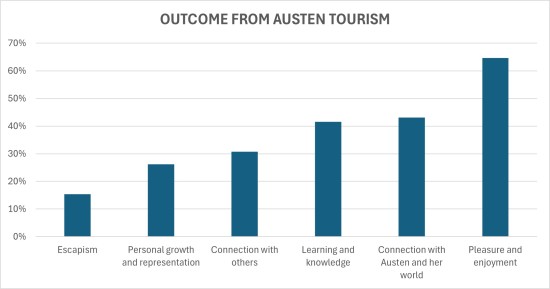
Another striking result is that the popular image of Austen fans as primarily driven by nostalgia and a longing for an idealized English past is not strongly supported by the data. Just ten respondents noted escapism as an important part of their visits. For example, a Czech Janeite said, “I love to be immersed in her world—it’s pure escapism for me, away from my family life and duties.” Similarly, a British Janeite shared that visiting Austen sites “gives me a sense of escapism from the modern world.”
Only four respondents from North America and Europe, and none from Britain, connected their Austen tourism to a love of all things English. Statements included: “I’m a huge Anglophile . . . , [and] she’s somebody I can kind of latch onto and she brings the English history,” and “I also like the English culture and feel very much at home in England (and I am French Canadian!).” These results match patterns identified by Lizzie Dunford, Director of Jane Austen’s House, who estimates that just 2% to 3% of all visitors to Jane Austen’s House in Chawton come from a nostalgic desire to inhabit the past, and that “there is very definitely that connection between Austen and Anglophile . . . for overseas visitors. It is there, but not for English visitors.”
The data therefore suggest that a desire to escape from modern life to a nostalgic, idealized “English” past is not a significant outcome for most Austen fans. The connection between Austen tourism and an experience of “Englishness” (in whatever form that may mean to an individual) also appears to be inapplicable to the many domestic tourists and is only a noteworthy outcome for a minority of overseas respondents.
“It adds to the mosaic of my story”: Tourism for personal growth and representation
Personal growth and representation are important to Austen tourists: 26% of respondents identified these as significant benefits. Fans described using Austen and her characters in a variety of ways to help them understand their place in the world and in broader historical narratives, and to reflect on their own identities. For example, an American Austenite noted not only that “Austen was a huge part of my childhood morality,” but also that the novelist helped her to connect with her European ancestral roots and heritage, because “something inside me wants to feel like I'm a piece of that long chain, and being closer to Austen—the way she lived and worked—helps me understand myself as well as my own cultural upbringing.”
It is fascinating to see how many respondents reported using Austen and her characters as role models to support their personal development and direction. One Austenite raised in South America said, “I grew up in a very agnostic household, and I thought ‘What would Jane Austen do’ in many points in my life when looking for a guide.” Similarly, a Canadian Janeite shared that “in some ways [Austen] feels like an older sister . . . who is so clever, . . .who’s able to observe accurately society, people’s motivations, people’s behaviors. . . . I learn from that. . . . She feels like a sisterly guide.” This use of Austen and her characters as role models can continue throughout a fan’s lifetime, with one seventy-year-old American Austenite sharing that “JA has been a guiding light for me since I first picked up a copy of P&P at age 16.”
The admirable qualities that fans described in Austen frequently related to her perspicacity in reading social behavior but also included a wide range of personal and subjective traits. When asked what Austen represents to them personally, fans described a fascinating breadth of attributes ranging from independence, determination, and feminism to witty humor, intelligence, and, importantly, relatability. Perceptions of an icon’s positive traits and relatability form an important part of their appeal and use as a role model. Indeed, Aron and Aron’s Self-Expansion Model demonstrates that “individuals seek to expand themselves by incorporating aspects of another into the self” (27), including skills, behaviors, and attitudes perceived in others with whom individuals feel close, such as friends or admired icons. Such traits are subsequently integrated into their own identities. Many fans, then, identify qualities in Austen that relate to their own personal narratives or that they want to develop in themselves. One tourist said, “I appreciate the challenges she must have faced to become a published author. As a lupus sufferer, I appreciate this resilience and courage.” Many Austen tourists fuse Austen’s perceived traits and their own identity and values.
Sociologist Robert Stebbins argues that the dedicated pursuit of an interest, such as literary tourism, leads participants to experience a “regeneration or renewal of self . . . [and] self-fulfillment—realizing, or the fact of having realized, to the fullest one’s gifts and character, one’s potential” (20–21). Identifying shared values with Austen can therefore be a deeply enriching experience. One British fan described how Austen “was a really strong advocate for the independence of women, the need and the right for women to plough their own furrow,” noting that “I really connect with all of that. I am personally, and always have been, really committed to the fact that we still have so many inequalities between men and women. . . . It’s still not all alright.” Others identified with different aspects of Austen’s perceived qualities: for example, one Canadian respondent shared that “I feel attached to her as I too am an independent, celibate woman with no children.” Many Austen fans, like fans of musicians and film stars, use their role models as if they were horoscopes, reading into them the qualities and meanings they most want to see. As Deborah Yaffe has noted, “we make our Austen into a reflection of our own preoccupations, a teller of our own stories. . . . We all find ourselves in her because, in a sense, she contains us all” (225–26).
Austen, then, is an icon who offers her fans representation and the opportunity for personal growth. Fans feel seen and understood by her, and so when they visit an Austen site, they don’t simply encounter a physical building; they re-experience a chapter of their own identity story. This powerful process is summed up by a Canadian Janeite who said, “you are as a . . . consumer of that tourist product, also the creator, and you create a whole new set of narratives and experiences and stories. . . . [For me, they become] part of my identity. . . . It adds to the mosaic of my story.”
“It’s like a big blanket of acceptance”: Building connections
Despite just 3% of respondents saying that their top reason for visiting Austen sites was to connect with other fans, almost a third noted it as an important positive benefit from their tourism. Comment after comment spoke of a sense of community and belonging. One American Janeite said, “I’m with people who love the same things I do. . . . At home people know my love of JA, but don’t really understand or relate to it.” Similarly, a Danish fan said they enjoyed going to Austen places and events “where I can meet with like-minded people that have now become firm friends.” Another spoke of the bond felt through sharing in-depth Austen trivia, concluding that “the kind of nerding out element of it is very satisfying.” This sense of belonging and fellowship founded on shared interest, shared knowledge, and shared language is a core part of feeling accepted, seen, and valued. The fact that it is enabled through visiting Austen sites and events attests to the inherent value of Austen tourism to fans. Indeed, modern research talks of the significant value of building a social identity, with fandom creating “a feeling of belonging and shared culture, a sense of significance and purpose, [and] improved mental well-being” (Bond 11).
Interestingly, most respondents who listed connecting with others as an important benefit from their tourism defined themselves as Janeites, with only a small handful of Austenites noting it. This pattern likely reflects the types of sites and events that fans attended. Almost all the Janeites in this group had visited immersive themed experiences such as balls, festivals, and Regency craft sessions, whereas just one Austenite had. Such events more readily facilitate social interaction than, for example, attending lectures or visiting country houses. Therefore, where fans go influences the benefits they receive from their tourism.
In addition, several tourists noted a related theme of connection with their families. They described how visiting Austen sites helped them feel closer to parents who had introduced them to Austen’s novels, highlighting the important role of intergenerational and familial relationships in Austen tourism. One American Austenite noted how “Austen represents a connection to my childhood, when my mother would read her books to my sister and I, as well as a connection to humanity.” Visiting Austen sites therefore performs an important role for such fans in connecting them with and within their families. Lizzie Dunford shared how in Chawton visitors “there is such an intergenerational link with Austen . . . It is like a gift that is passed on from generation to generation.”
This sense of familial connection was particularly significant for the several fans who had lost those parents. One comment from a British Janeite showcases the role of family and personal identity in tourism and the function of Austen fandom in supporting mental health:
I lost my mum at an early age, she instilled her love of JA into me, we watched adaptations together, she read me the books, we had many conversations about Mr Darcy! I know how much her love for JA got her through some tough times in life, and indeed it has also mine. I always feel closer to her when I am immersed in JA related activity. [Jane Austen] reminds me of home, that feeling of love and warmth.
Yet another British fan shared how “my mum was a big fan and we enjoyed Jane Austen's novels. My mum died a year ago and I think Austen and her writing will always make me feel closer to my mum. So last year I went to Bath and visited some Jane Austen-related places in honour of my mum.” For these fans, Austen tourism enables healing, belonging, and a deeper understanding of who they are and where they fit in, a chance to honor both a writer they admire and a lost parent. Connecting with others—whether new friends or family members—has an important role to play in Austen tourism.
“I just like to be intellectually stimulated”: Serious leisure
The next most common tourism outcome, reported by 42% of respondents, was learning new information and gaining knowledge—an outcome that closely matched respondents’ stated motivations for tourism. Janeites and Austenites alike valued the opportunities tourism provided to learn more about Austen, her world, and the context of her novels. One British respondent shared how “being physically present in these environments deepens my understanding of the social, cultural, and geographical textures that shaped her writing.” Another mentioned “the delight of learning more and more minute and weird facts about the past,” and yet another shared that “I’m interested in literature, and visiting locations helps to develop my knowledge and put the literature into historical context.” For some, their desire to learn reflects a wider interest in history, culture, or literature. For example, one American Janeite’s love for the Regency period inspired an interest in medieval history, and one British tourist said, “I am interested in, and have researched, many authors who wrote in earlier periods, from the sixteenth to [the] early 20th century.”
This pursuit of knowledge makes Austen tourism a strong contender for Robert Stebbins’s term serious leisure. In contrast with casual leisure and project-based leisure, Stebbins defines serious leisure as “the systematic pursuit of an amateur, hobbyist, or volunteer core activity that people find so substantial, interesting, and fulfilling that, in the typical case, they launch themselves on a (leisure) career centered on acquiring and expressing a combination of its special skills, knowledge and experience” (20). He goes on to describe numerous outcomes, or rewards, that people get from this type of leisure activity, including personal enrichment, self-expression, belongingness, self-actualization, and deep fulfillment. These are long-term pursuits with a focus on increasing knowledge or skill and self-development—themes that appear throughout the Austen tourist data.
Stebbins also describes serious tourists as “perseverant,” and as we have seen, many respondents (56%) persevered in their tourism. They frequently traveled off the beaten track and visited less mainstream tourist sites, such as one British fan who shared, “I like visiting the little-known buildings in Bath that we KNOW she used and attended. Like the Reading Room on Milsom Street. It gives me a sense of the pattern of her everyday life.” Here this tourist’s determination and effort paid off and provided the fan with additional knowledge and learning about Austen’s life. The vital role that learning plays in Austen tourism can also be clearly seen in the fact that a remarkable 67% of Austen tourists had visited educational events such as conferences, lectures, and exhibitions.
“I felt like I personally connected”: Feeling closer to Austen and her world
After pleasure and enjoyment, the most common theme mentioned was that of connecting with Austen and her world: 43% of respondents, including equal numbers of Janeites and Austenites, noted connection as a significant outcome of visiting Austen sites, highlighting the personal nature of literary tourism. Stepping into spaces Austen once used creates a bond between fan and writer, and one British Austenite described how literary tourism gave her “a sense of shared experience.” Similarly, another British fan shared how “visiting Austen-related sites and events allows me to step into the world she so vividly evokes, bridging the gap between text and place, and creating a personal, almost intimate connection to her voice and vision.” Tourism therefore provides a unique link between author and reader, adding nuance and deeper meaning to the text and a sense of closeness with the author herself.
Juliette Wells notes that “literary tourism is fundamentally a journey of the imagination” (145). This survey confirms the imaginative, introspective experience many fans associate with visiting Austen sites, not dissimilar to the imaginative journeys Austen herself took when she created her novels. One British fan, who shares Austen’s love of walking, explained that “being at Austen sites and events feels like stepping into the living texture of her world. It brings a sense of closeness to her life and imagination that no amount of reading can fully replicate. Walking through the spaces she inhabited or set her stories in deepens my emotional and intellectual connection to her work—it’s grounding, moving, and often quietly exhilarating.” Many tourists can creatively picture their literary icon sharing a space with them, enabling those fans to feel connected across the distance of time, and several described how this closeness generated feelings of contentment, joy, calmness, awe, and sadness for them. One British Austenite said of Jane Austen’s House in Chawton that “it’s like the breath, the prayers have seeped into the walls. You can’t touch them, but they’re there in a way,” and an American Austenite shared how she felt “reverence, awe, contemplation—the same way I feel at a family cemetery or certain national monuments.” The link to visiting solemn cemeteries speaks to the veneration many fans feel, and their sense of gratitude to the author transmutes their tourist visit into a secular pilgrimage where they can honor someone they admire who has gone.
Indeed, many fans over time develop a parasocial relationship with Austen herself, as regular exposure to her work makes them feel they know her. These types of one-sided relationships are a common phenomenon with pop and film icons (and, indeed, any celebrity), and one study has shown that over half of all Americans have experienced them (Murray). Respondents shared comments such as “she’s been with me since my teenage years,” “I feel I have a certain repartee with her,” “[we’re] kindred spirits,” and “at its core, my attachment to and identification with Jane Austen is very personal . . . and psychological.” These types of remarks attest to the parasocial relationship many fans have created with their icon, and hint at the positive and generative role this relationship plays in their lives. Although one-sided and inherently imaginative, the pseudo-relationship can be deeply beneficial and constructive, because “research finds that parasocial relationships improve an individual’s well-being by providing a sense of companionship and someone with whom they can relate” (“Parasocial Relationships”).
This value is particularly evident in some fans’ use of this relationship to support them in challenging times. One American Janeite shared that “when my husband was deployed . . . to Iraq . . . , it really was like she was a friend that helped me through a difficult time.” Another said, “Jane has been important to me, I have turned to her books time and time again, especially in stressful times such as when my father died when I was fifteen.” Another read to escape a difficult childhood, and yet another shared how Austen’s novels were “my ‘go to’ in times of illness or crisis.” Many fans therefore feel a debt of gratitude to Austen, and literary tourism enables them to pay the homage they feel is due.
Place-attachment theory helps explain how fans can bond to settings and places that they imbue with personal significance. This process turns familiar spaces, such as Austen’s drawing-room at Chawton or St. Nicholas Church in Steventon, into loci of feeling, memory, personal restoration, and imagination. Fans are often emotionally primed before they even enter a site, which can heighten a range of feelings, from “the butterflies in the tummy when looking at the little table where she wrote, where the sentences were formulated” to simply being able to “feel the vibes.” The symbolic meaning of visiting these shared spaces further deepens the relationship and provides a sense of being able to touch greatness.
As in pop culture and music tourism, literary tourism is a way to demonstrate respect and admiration for an exceptional individual’s creative output. This practice can be closely connected to how those outputs make an individual feel. For example, “in music tourism research it has been shown that tourists are lured by the feelings evoked by music . . . and a desire for pilgrimage” (Lundberg and Lexhagen 7). Clearly, then, the individual’s emotional response to Austen’s novels and screen adaptations plays a role in tourism. This desire places Austen tourists alongside Beatles fans visiting Liverpool, Elvis fans visiting Graceland, Lord of the Rings fans visiting Matamata in New Zealand, and even Aretha Franklin fans queuing for hours to view her open casket in 2018.1 Interestingly, however, many of these other fan groups are not typically associated with negative stereotypes; instead, they are more often framed as devoted or enthusiastic fans.
Overall, the most cited outcome from Austen tourism was pleasure and enjoyment, a benefit noted by 65% of respondents. Through visiting sites and attending events relating to their literary icon, Austen fans frequently reported experiencing feelings of contentment, joy, and happiness. One British tourist shared that “it’s really interesting to see where she lived. It makes me feel really good.”
The Austen tourist
Centuries after Tennyson, Austen fans still visit Lyme Regis to wander along the Cobb, read from Persuasion, and jump down the well-worn steps. At these locations, tourists co-create shared spaces that extend beyond the physical sites and that engage them with Austen and her work in an embodied and personal way. Contrary to the stereotype that fans are drawn to a “nostalgic geography of a lost English society” (Crang 111), Austenites and Janeites alike reported that they undertake Austen tourism primarily because they wish to increase their knowledge of Austen and her world, and because it aligns with their broader interest in historic and cultural sites. Similarly, in describing the benefits from their tourism, they listed a closer connection with Austen and her world, increased learning, personal growth, and belonging. Fans don’t want to live in the past, as one articulated when describing the joys of immersing herself in Austen’s cultural world only: “not her material world, I like electricity and modern medicine.”
The prevalence of the popular stereotype perhaps lies in both the public perception and the way Austen events and venues are presented, each reinforcing the other. High-profile idealized screen adaptations have perhaps been conflated with Austen fans’ motivations, with assumptions made that mirror the romanticized visuals portrayed on screen. Similarly, the conspicuousness of costumed fans across the media further embeds these perceptions. Unlike other historical reenactors, who are generally seen as deeply skilled and knowledgeable individuals engaging in living history, Austen fans who dress up are often perceived as nostalgic and escapist.2 It may not be a coincidence that most reenactment groups have a more mixed gender balance in their participants.
Although this popular image continues to be embedded in modern culture, Austen tourism is a rich, multilayered, and personal experience for fans, often closely interwoven with their sense of self and belonging. They gain multiple benefits simultaneously from each visit, which evolve over time and vary at different types of sites. Fans might feel playful at an immersive event, then studious at a lecture—or, indeed, both simultaneously at an interactive and educational site. This combination of outcomes is illustrated by one British respondent, who shared how “these visits offer moments of reflection, inspiration, and a shared sense of community with others who value her legacy, making me feel both anchored in history and part of an ongoing cultural conversation.” Significantly, this respondent defined herself as equally Austenite and Janeite, demonstrating her ability to inhabit both camps comfortably and resist compartmentation.
Austen tourism is, furthermore, not simply a one-off experience. It has an afterlife where the fan continues to visit the site imaginatively through memories and even through rereading of Austen’s novels and letters. One Australian fan shared the impact of visiting locations from the novels long after the trip occurred by saying, “I’m quite visual so I picture it then in my mind when I read it.” She also noted how this visual memory applied to understanding Austen’s world, giving the example of the ha-ha: “I’m sitting here in Australia reading [about] it . . . , but until you see one, it doesn’t really make sense.” The novels, the locations, the maps, the venue websites, the photos, the souvenirs, all combine into a panoply of cultural genres creating the Austen fan’s overall tourist encounter over time—enabling fans to continue an ongoing learning and enriching experience.
Through this research I wanted to find out if Austen tourists were indeed primarily motivated by a sense of nostalgia—a wish to time-travel to a simpler past or even into a film, as the popular perception would have us believe. Instead, I found highly educated, curious, adventurous tourists, with a thirst for knowledge and history, a desire for connection with a role model they admired, and a drive for belonging with like-minded individuals. The “Austen effect” draws fans to specific locations that are imbued with meaning and learning and that offer enormous personal development and self-realization. As Kathryn Sutherland noted when speaking of Austen sites, “Place has a certain kind of magic.” It certainly does.
APPENDIX
Click here to see the Austen Tourism Survey Questions.
NOTES
1Many TripAdvisor posts from Elvis fans who visited Graceland closely echo Austen fans’ comments collected in this survey—e.g., “I was just in awe and could genuinely feel he was still there”; “It was nice, to walk, in Elvis’s footsteps. The house, where he laughed, and cried. The house, where everything happened”; “Elvis is a personal staple from my childhood [whom] both my parents idolized and brought them both together. I planned to visit out of respect for my parents, but since realized it was as much for me and my offspring. Cried like a baby when we got to the grave sites”; “If you love Elvis you will feel close to him and his family here in the mansion he loved.”
2One academic paper testifies to the educational value of reenacting by stating that “reenactors can access dimensions of sensory and embodied knowledge that traditional sources and methods cannot reach” (Moilanen and Sahramaa 107). This attitude was mirrored by at least one Austen fan in the survey, who said, “I am interested in history, and especially enjoy the everyday aspects of history, including Regency clothing. The events give me a chance to make and wear it (as a sort of personal living history experience).” Making and wearing period costume therefore often provide opportunities to understand the past further; yet this motivation is frequently underplayed for Austen fans and is often replaced with an attributed desire for escapism. Dressing in period costume is also imagined to be ubiquitous among fans, as Lizzie Dunford attests: “We get journalists coming to us saying, ‘When can we come and see dressed up events?’ And we have to go, ‘Well, we do this once [a year].’”
