Jane Austen’s Pride and Prejudice (1813) has inspired a vast online fanfiction community. Much existing research on this fandom has emphasized the fans’ love for the characters—admiration for Elizabeth Bennet, desire for Mr. Darcy, or a fondly amused appreciation for characters like Mr. Collins and Lady Catherine. Because of these positive affects, the fandom has often been described as a happy, pleasurable, and celebratory fan space primarily for women. This essay shifts attention from such joyful expressions of emotion to the negative affects that circulate within the same community, particularly in response to the character Caroline Bingley. I argue that a shared hate and disgust for Caroline connects the community as much as a shared love for Darcy and Elizabeth does. The intensity of the fandom’s dislike for Caroline and their continued emphasis on punishing her in imaginative continuations of the novel suggest that for the community she is not a marginal figure but a central locus of fan engagement.
In Austen’s novel, Caroline Bingley is a minor antagonist who provides an obstacle to the main courtship plot, voices the class prejudices that Darcy must overcome, and serves as a foil to Elizabeth. With her family fortune stemming from trade, Caroline occupies an uneasy position in Regency society: rich but not aristocratic, and therefore anxious to ascend in society. Her persistent condescension towards the Bennets is part of this attempt to improve her family’s standing, which Austen renders with her characteristic irony and psychological insight. Because of Caroline’s snobbery, the character has been received negatively by fans and scholars alike: she is referred to by Jodi Wyett as the “ever-pretentious, mewling Caroline Bingley,” by Elise Barker as a “notoriously mean-spirited snob,” and by Christopher Stampone as “one of Austen’s least likeable characters.”1
Although Caroline Bingley inspires strong feelings in the readership, the novel’s narrative voice maintains a cool, detached amusement toward her, consistent with its treatment of all self-deceiving characters (including the protagonists). What distinguishes Caroline is a quality that Jayda Coons has identified as unusual in a novel full of misreaders: she is a rather perceptive judge of others’ feelings and intentions, even when she does not like what she sees. She early detects Mr. Darcy’s feelings for Elizabeth, and Mr. Bingley’s for Jane, and although she attempts to interfere with both couples, she is ultimately powerless to stop them.
Austen’s ironic mode permits a quiet, undramatic resolution to Caroline’s interference: she does not get what she wants, but neither does she suffer for her efforts to separate the lovers. This restraint is consistent with Austen’s treatment of unsympathetic characters, who are rarely punished for their wrongdoings. In contrast, many fanfiction stories significantly alter Caroline’s trajectory, making her the subject of elaborate narrative punishment.
For example, in one fanfic Caroline marries a wealthy aristocrat, just as she has always wanted—but he turns out to be cruel and abusive, which the author explains in a note is meant as a lesson in humility for Caroline. It will teach her “to stop being ugly” (BingBennet, ch. 28). This “ugliness” refers to Caroline’s social ambition and arrogance, but the fandom often conflates her inner and outer repulsiveness, as we shall soon see. Readers respond that while Caroline’s fate in BingBennet’s story is “ultimately horrible,” they despise her “to such a point that this level of cruelty towards her doesn’t truly phase me,” or declare that “I wanna throw that stupid Caroline . . . down the lake Superior and see her freeze down there” (comments, chs. 28 and 35). This desire for Caroline’s comeuppance reappears consistently in other comment sections. Readers ask for her to be “taken out and shot,” as people like her “serve only to poison the well of society” (comments, VivienneWolf). They ask for her to be sent to “jail,” “a convent,” “Bedlam,” or “the gallows,” or to “live in penury in the stews of east London”; they also speculate that she will “end up booted out if [sic] polite society and probably end up as some man’s bit of fluff on the side, or worst, in an ‘establishment’ that caters to certain tastes” (comments, Pennyngram chs. 10, 12; lizzybennetfan chs. 23, 27, 30).
Although it is hardly a surprise that fans dislike the character, this vehemence is still notable. In Austen’s novel, the threat Caroline poses to the lovers is negligible, and she does no real or lasting harm. Moreover, she shares many of her most unsympathetic traits with Darcy himself—such as pride and snobbery—and yet only one story that I have found follows Caroline’s path to redemption and marital happiness, mirroring Darcy’s own journey (honey_and_smoke). Darcy’s arrogance remains narratively redeemable in fanfic, while Caroline’s becomes grounds for permanent social exclusion: incarcerated, prostituted, or dead.
When fanfic authors add scenes from Caroline’s point of view, they usually do not deepen her psychology or explain her motivations. Instead, stories focalize Caroline to depict her jealousy in the face of Elizabeth’s romantic success: “The image of [Darcy] dancing again and again with Eliza Bennet burned in [Caroline’s] memory” (LissaMU). Such depictions suggest that Elizabeth’s triumph in gaining Darcy’s attention becomes more meaningful to the fans when contrasted with Caroline’s failure. In more farcical scenarios, she ends up losing her mind at their wedding, where servants are forced to restrain “a screeching Caroline Bingley, proffering insults at the bride,” or is depicted as “constantly yelling, howling, abusing, breaking things” (Mencia, “Darcy,” ch. 21; Mencia, “Better,” ch. 3). Far gone is the coldly composed lady of Austen’s novel. Instead of a disdainful socialite, the fan-made (or “fanon”) version of Caroline emerges as a conspicuous and violent threat against the social order, whose class-climbing aspirations warrant either serious correction or total expulsion from society. Readers enthusiastically encourage these narrative exaggerations in the comment section, often praising scenes in which Caroline suffers humiliation, disappointment, or physical and emotional distress.
Accordingly, the normative fan identity in this fanfiction community seems to be shaped around a rejection of Caroline Bingley and everything associated with her. Public declarations of hatred or disgust of the character appear regularly in these fora, creating an atmosphere in which voiced dislike of Caroline becomes a form of social glue. Examining such emotional norms sheds light on the fandom’s gendered and classed politics. What does Caroline Bingley represent that is the cause of such powerful rejection, and what functions does it serve in the community?
In my analysis, I draw on 200 Pride and Prejudice stories published on Archive of Our Own between 2017 and 2023 (at the time, the fandom tag held 2,374 published works in total, many of them imported from Austen-centric fanfic archives like The Republic of Pemberley or The Derbyshire Writers’ Guild). The works were all part of the archive’s top-ranked and most-read stories in the fandom at that time, based on a combined metrics of “kudos” (likes), comments, and page hits. These stories, with their accompanying comment sections and author’s notes, reveal how Austen’s character is narratively reimagined and how readers publicly perform disdain and disgust for her. Cited examples are chosen to illustrate broader discursive tendencies in the community.
On community disgust
Disgust is often understood as instinctual—a bodily reaction to a perceived threat of contamination. In The Cultural Politics of Emotion, however, Sara Ahmed suggests that disgust is profoundly shaped by cultural and moral norms. Socially performed emotions like hatred and disgust mark boundaries between what counts as acceptable, desirable, or clean and what must be rejected from the community. Within this theoretical framework, disgust is a social performance that acquires force through repetition and becomes a key mechanism for distinguishing the self from the other. Indeed, Jennifer Panek notes that we commonly use the same words to describe objects that we find to be morally reprehensible and objects that offer threat of pollution or sickness, just as moral outrage can both arouse and be aroused by involuntary physical reactions like recoiling, retching, and gagging (7 ff.). Disgust is therefore often entangled with moral judgments, as certain bodies, behaviors, or traits are construed as contaminating.
The shared hatred and disgust for Caroline Bingley ties the fandom together emotionally as much as their love of Darcy and Elizabeth does. Demeaning and punishing Caroline in fanfiction (by routinely abusing, mocking, laughing at, or killing her) allow fans to create emotional and moral bonds with each other. Indeed, such hatred is not contentious or divisive but uniting. Just as most fans agree that Darcy and Elizabeth are the fandom’s romantic center or, in fandom terminology, OTP (“one true pairing”), they also agree that Caroline is disgusting and deserving of punishment. When a community collectively identifies something as disgusting in this way, that identification helps define the borders of the community. Public expressions of disgust thus bind together all subjects who publicly share the same response to the disgusting object, generating “a community of the disgusted” (Ahmed 15). Such expressions reinforce the subject’s or group’s own moral and social position—a work that is central to the creation of cohesive digital communities, where users are otherwise pseudonymous and may be both geographically and temporally dispersed.
Ahmed’s notion that disgust “sticks”—attaching itself to certain people, objects, or traits and transferring easily between everything associated with them—is particularly useful for my analysis. Pride and Prejudice fanfics are full of descriptions of Caroline in which everything associated with her appears to be tainted by the same repulsiveness: her appearance and movements, the color of her dress, and even the tea she brews. These associations have little to do with Caroline’s original characterization in the novel; rather, they emerge from fannish elaboration and repetition—and are often inspired by the screen adaptations.
The orange gown
How should we understand this hatred of Caroline Bingley in particular, rather than the other embodied obstacles to the main love story, like Lady Catherine de Bourgh? Lady Catherine is also vapid and condescending but is typically met with fond amusement by readers. Only Caroline’s downfall is dramatized repeatedly in the fanfics. What primarily distinguishes her from other unsympathetic characters is that she hopes to marry Darcy. Above all, this marital ambition is also what prompts the fandom’s expressions of hatred and disgust. Fanfics often present Caroline as tasteless, socially inept, and comically delusional in her pursuit of Darcy. Her canonical flaws like vanity and ostentation are exaggerated to the point of absurdity, producing a caricature that bears only partial resemblance to Austen’s creation. This transformation of the character reveals how hate and disgust are mobilized to maintain social hierarchies, reflecting the fandom’s norms of feminine respectability.
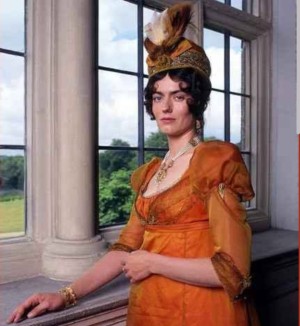
Anna Chancellor as Caroline Bingley (1995).
© BBC.
One striking example is the recurring use of Caroline’s “orange gown” to represent her as disgusting and ridiculous. This memorable costume from the 1995 adaptation has a powerful hold over the fandom’s imaginary and tends to crop up even in fanfics based on the original novel, as Veerle van Steenhuyse has shown (39). In stories where Caroline’s appearance is not overtly described, readers still seem to imagine her wearing orange and adorned by feathers: “can picture her . . . in all her feathered orange glory” (BookWorm_22, ch. 8).
Costume designer Dinah Collin has acknowledged that the Bingley sisters would more accurately have worn the same kind of modest white muslin as the other young women in the novel. To make them visually distinct from the Bennets, however, the Bingleys were dressed in brightly colored silks and more extravagant adornment, such as “feathers and brooches” (“Silk and Sensuality”). For the 2005 film, costumer Jacqueline Durran also dressed Caroline in crimson silk and gave her a more fashionable waistline than the rural Bennet girls, who walk around with muddy skirts and unbound hair. In short, the ostentatious orange gown has become emblematic of Caroline, just as a muddy hemline (attached to virginal white) is of Elizabeth.
In the fanfics, Mr. Darcy’s sexual fantasies of Elizabeth often feature her wearing white, usually on their wedding night, whereas Caroline is associated with her “hideous orange gowns” (LissaMU). Indeed, in the fandom, Caroline’s colorful attire is not construed as striking and fashionable (the way that the costume designers intended) but rather as bizarre. For example, in one story, Caroline’s outlandish sense of style is observed by her maid:
Miss Bingley looked utterly ridiculous. The stupid girl would not listen to her and had insisted on dressing as though she was going to a formal ball in town. Her beautiful gown was made grotesque by the shade of orange and was cut low enough to cause Dorothea to blush. If the color was not jarring enough, it was matched with a green turban and feathers dyed to atch, making the thin Miss Bingley look like a giant walking carrot. (lizzybennetfan)
Caroline’s dress becomes ridiculous because of her failure to grasp social conventions. She has chosen a “jarring” color and matched it with unsuitably ostentatious accessories from the British colonies, like turbans and feathers, to give off the impression of imperial gentility. Caroline has money but no taste, and even servants can see it. n this way, the fandom has spawned a different character than we know from Austen’s novel—one that does not know how to behave in polite society, one with no finesse, class, or tact.
By vocally ejecting this ridiculous figure, the fans reinforce a shared understanding of what constitutes feminine restraint and social propriety in the storyworld that they have come to love. In her reckless pursuit of Mr. Darcy, Caroline fails to embody the sexual modesty, restraint, and good taste that the fandom associates with a proper Regency heroine—exemplified by Elizabeth. By constructing Caroline as Elizabeth’s opposite in all things, the fandom further consolidates an idealized vision of the heroine, who is repeatedly depicted as modest, tasteful, and appropriately receptive to Darcy’s courtship. Caroline’s blunders thus provide opportunities for fans to align themselves with more respectable female characters, affirming their own aesthetic and moral judgments in the process.
Politics of class and sexuality
Importantly, it is not only the too-bright color but also the too-low cut of Caroline’s dress—its overt sexuality—that makes the servant blush. Whether the issue is a revealing décolletage or a brightly colored fabric, fanon Caroline is continually associated with invasive, unwelcome, and therefore disgusting female sexuality. Such depictions are generally appreciated by readers and positively highlighted in the comments:
I am still chuckling. . . . Miss Bingley looking like a giant, walking carrot!!! What a visual . . . I can actually picture what she must look like!!!! Thank you for the detailed description of her and her clothing!!!! Tooooooo funny! Caroline never disappoints . . . a true legend in her own mind!! (lizzybennetfan)
More particularly, many fans appear to appreciate stories in which Darcy is the one repulsed by Caroline’s appearance—creating an ironic effect for the reader, since he is the one she is hoping to seduce: “But my fav thing was how savage Darcy was, repeatedly musing on how revoltingly unsexy Caroline Bingley was???? I laughed so hard omgggg” (LissaMU, ch. 6). Fanfics thus emphasize Caroline’s failure in seducing Darcy, even becoming “revoltingly unsexy” in his eyes, and this failure is enough to humiliate the character, even when she remains unaware of the fact.
The idea that Caroline’s success in dressing herself is dependent on Darcy’s approval adheres closely to contemporary postfeminist values. Antonija Primorac has demonstrated the limits of sexual freedom for women in contemporary neo-Victorian fiction, where women’s sexual agency is often celebrated but represented as dependent on their attractiveness to men. Since erotic appeal empowers women in a postfeminist context, unattractive women are discounted, and all women remain threatened by the loss of male appreciation—for example, by aging or gaining weight. It therefore does not matter if Caroline considers herself “a true legend” and feels pleased with her outfit: Darcy disapproves.
It is not only Caroline’s lack of propriety but also her relatively lower standing that makes her pursuit of Darcy so repulsive to the fandom. As Ahmed argues, disgust is “crucial to power relations” (88). Disgust maintains borders and hierarchizes bodies, and the objects of disgust are always “objects that seem ‘lower’ than or below the subject, or even beneath the subject” (89). Darcy, as landed gentry, is undoubtedly above Caroline, who is trying to rise to his level—so Caroline’s concern with rank arises not because she is located at the top of society, as Darcy is, but rather because she is not. In fanfiction, however, Caroline’s social ambition is construed as repulsive, threatening, and delusional, thereby ensuring a maintenance of the storyworld’s strict class hierarchies.
Fans’ disgust at the orange gown and Caroline’s gaudy attempts at flirtation signify disgust at her unsuitable marital ambition: she strives upwards in becoming Darcy’s wife, but dresses herself without the taste or sense that such a position would require. Meanwhile, Elizabeth’s modest attire in the stories signals that she is both sexually and socially an appropriate match for Darcy, behaving according to the tenets of respectable femininity. The fans’ insistence on Elizabeth’s adherence to such gender norms legitimizes her own class mobility—it proves that she is worthy of the ascent. Conversely, Caroline is represented as clueless and tacky in her orange gown and feathers, unaware of proper etiquette and decorum, and without the aristocrat’s inherited taste (or license to be tasteless). Her attempts at seduction mean that she is trying to bypass the naturalized social order in Regency society, where people marry within their class, and where men have the prerogative to pick a wife. The woman’s choice, as Austen frequently problematizes, is simply to accept or to refuse an offer. The refusal to partake in this gendered courtship system makes the fanon Caroline a bizarre and disgusting figure. Instead of waiting to be courted, she aggressively pursues Mr. Darcy herself, using various sly, promiscuous, and underhanded tactics.
For example, in one story Caroline attempts to drug Darcy with tea containing a powerful aphrodisiac. Another man—a lord who became victim of the same concoction and felt obliged to marry the woman who had drugged him—has told Darcy: “It was witchcraft. Fortune huntresses are sorceresses now. What is to become of us?” (Pennyngram, ch. 6). With the aphrodisiac, witchlike women can ensnare husbands far above their station, sidestepping the social order and stripping even the most powerful men of their prerogative to choose a wife.
As many other fanfics do, the tea story repeatedly links Caroline to the affect of disgust. Her tea tastes bad, as if its evil purpose has seeped into its very flavor. Later, Darcy recalls with gratitude that “Miss Elizabeth had just saved him from drinking Miss Bingley’s disgusting tea blend” (Pennyngram, ch. 3). When he does try it, he finds it to be “the most disgusting thing he had ever tasted,” considering it a “disgusting waste of money,” and at one point he is forced to smell it, “which was even more disgusting” (ch. 6, 9). This emotion soon transfers to Caroline herself, in the way that disgust tends to stick between associated objects. The aphrodisiac is sexually intrusive, just like Caroline, and its taste and smell cause a bodily sense of revulsion in the hero: “Mr Darcy grimaced and coughed, taking a step back” (ch. 14). Likewise, Caroline’s physical proximity causes visceral reactions in him. At one point, Darcy even sprints away from her, despite the lack of decorum of the action: “Miss Bingley tried to follow him, but he put his long legs to good use by outrunning her” (ch. 6).
The tea story, parodic and purposely exaggerated, highlights the trickery of Caroline’s fawning, ingratiating attempts to woo Darcy—a device repeated across the entire fanfic corpus. Caroline tries to win him over through the foreign, “exotic” tea imported from China, another sign of imperialist gentility, much like the brightly colored silk and exotic turbans. Caroline disgusts because she struggles for upward mobility and because she does so through sexual means. As a sexually aggressive woman, Caroline has no place in the respectable Regency world of the fandom’s collective imaginary. Her lack of feminine respectability explains why she is so often killed off, incarcerated, or otherwise ostracized.
The postfeminist values of our own time, where sexual agency is limited to women whom men find attractive, shapes the punishments that Caroline’s transgressions inspire. She is both “revoltingly unsexy” and hypersexual. As such, many of Caroline’s imagined punishments are sexual in nature: being sent to a convent (with enforced abstinence), being forced into a brothel, or becoming “some man’s bit of fluff on the side.” Caroline’s lack of social power when compared to Darcy—made visible through her vulnerability to such punishments—is tied to both her gender and her lower standing. These sexual humiliations enable fanfic writers and readers to articulate shared norms regarding class and gender, with prescribed limits for acceptable female sexuality and an emphasis on strict class hierarchies.
Although Miss Bingley is banished from the society of her peers within these stories, she remains in the center of the fandom’s collective imaginary—indeed, even when it comes to Darcy and Elizabeth’s sexual relationship. In fact, when fans delve into the hero’s mind, Darcy’s erotic fantasies about the heroine are often augmented by, and emmeshed in, his fantasies about Caroline.
Sexualized disgust
It is a recurring trope in the stories that Darcy actively chooses to fantasize about Caroline to dampen his desire for Elizabeth. Disgust is purposely called on to regulate his sexual arousal. Disgust is thus imagined as an affect that can be used to manage male sexuality, in a context where extramarital sex threatens the virtue of a woman and the honor of a man.
In one story, where Darcy has become sexually aroused by thoughts of Elizabeth, his imagination immediately steers back to Caroline and her orange gown: Nothing like thoughts of Caroline Bingley in orange to calm a man’s amorous impulses! I must remember that trick in the future. Chuckling to himself, he finally arrived at Longbourn” (LissaMU, ch. 1). He thinks with distaste of Caroline’s “sickening laugh,” comparing her to the much more alluring Elizabeth (ch. 2). In this depiction, disgust is construed as both voluntary (as Darcy purposefully thinks about Caroline, precisely because she disgusts him) and involuntary (“he shuddered”). Later, when Darcy finds himself thinking about “a soaking wet Elizabeth,” he becomes aroused and once again must fantasize about Caroline to master himself, in the same simultaneously intentional and compulsory way: “How about a soaking wet Caroline Bingley? He shuddered involuntarily at the thought and had control over himself again” (ch. 4). Only by purposely surrendering his body to the unpleasant feeling of disgust (shuddering “involuntarily”) can Darcy regain “control” of his body.
These depictions point to the close affective entanglement of desire and disgust in our cultural imaginary. Aurel Kolnai has termed this entanglement “the eroticism of disgust,” recognizing that disgust can also hint at “the shadow of a desire for union with the object” (46). Ruth Perry has argued that sexual disgust, evoked by the prospect of having sex with someone undesirable, is linked to attraction through intense bodily interest: “both [disgust and attraction] emphasize the ‘person’ of the other” (226). The fans’ preoccupation with Caroline as a sexually disgusting being emphasizes her “person” in a similar way, from her orange gown to the naked body underneath. This close connection between desire and disgust is also discussed at length by Ahmed, who has noted that “disgust is deeply ambivalent, involving desire for, or an attraction towards, the very objects that are felt to be repellent”(84).
Many of the oppressed groups, persons, or symbols that are construed as disgusting in our culture are, at the same time, made into objects of erotic appeal. We can see this affective ambivalence in pornography, which is rife with misogynist, transphobic, and racist tropes.2 The Austen fandom is far from the only community that uses sexualized disgust to demarcate moral values and denote objects of disgust—but it is more surprising in this context, as the fandom is known for a more feminist ethos. Indeed, I have previously demonstrated that many Austen fans tend to appreciate Darcy’s sexual restraint and gentlemanly propriety (“Yearning Hours” 81–113). To fantasize about a lady naked, even if it is done to quench his desire for another lady, does not seem to be in character for the honorable Mr. Darcy—and yet the idea clearly holds appeal for many fans.
The trope is common enough that, even in stories that do not depict it, the idea of Darcy’s sexualized disgust for Caroline crops up among the comments. For example, when Darcy struggles with his overwhelming desire for Elizabeth in another fanfic, a reader suggests: “Darcy if you want [to] gain control of your nether regions all you have to do is think of Caroline Bingley laying naked in your bed. Of course, that picture may cause you to throw up instead” (Comment, Mencia, “Better Master,” ch. 12). To this statement, the writer responds: “Caroline—ice3—it DOES sound completely nauseating!” Here we see the same entanglement of disgust and desire as previously shown: Darcy’s desire for Elizabeth overpowers him, and to “gain control” of his erotic impulses he must purposely evoke disgust, which may however overpower him physically by causing him to vomit or shudder. In this exchange, both fans agree that Caroline’s nudity is “completely nauseating,” and other readers are encouraged to visualize it, as well as to be disgusted by it, even though she is not actually represented as such in the story. Not only is Darcy’s sexualized disgust for Caroline an established trope in the community, but fans also easily project their emotions of disgust onto Darcy: he is imagined to “throw up” while thinking of Caroline in a sexual context, because the idea is “completely nauseating” to the fans.
In comparison, most fanfics depict Elizabeth as sexually curious, but she often initially resists Darcy’s advances and appropriately waits for him to court her (often twice) before relenting. Caroline’s sexual aggression disgusts, while Elizabeth’s sexual modesty entices him. Even so, the hero keeps entangling fantasies of one with the other. For example, under the influence of Caroline’s aphrodisiac tea, Darcy fantasizes about a meek Elizabeth “laying on her soft bed . . . , languidely [sic] fixing her gaze on the canopy bed’s red curtains, waiting for him to come” (Pennyngram, ch. 6). While Darcy is busy fantasizing about this languid, idealized Elizabeth, passively waiting to be seduced by him, Caroline knocks repeatedly on his door: “His blood froze, all the passion he had been feeling for Elizabeth disappearing instantly.” Darcy’s disgust for Caroline is the only thing powerful enough to counteract the magical effects of her aphrodisiac. She is supernaturally disgusting, even more so than the tea, as Darcy’s disgust for her is transformed into feelings of terror:
Mr Darcy laid perfectly still on his bed, trying to will himself into non-existence. Miss Bingley stopped knocking and he took a breath of relief, but then the doorknob started to turn. He was paralysed in horror. The doorknob turned, ever so slowly, and then stopped. Then it turned again, then it was shaken with force. (ch. 6)
Through her boundless sexual aggression, Caroline becomes monstrous—the image of a doorknob slowly twisting and rattling around is drawn from the gothic tradition, not from Austen’s polite comedy of manners. The feelings in Austen fanfiction are generally heightened as compared to the original text, and this heightening is aptly illustrated in Pennyngram’s parodic fanfic: through the literary device of the aphrodisiac, the love becomes more passionate, and Caroline’s canonical fawning over Darcy turns into terrifying acts of sexual aggression.
In response to the scene, one reader remarks with vindictive glee: “Miss Bingley will be delighted to know that Darcy thought of her during the height of his amorous feelings—as a passion killer unfortunately though” (ch. 6). And yet, the trope of Caroline as a “passion killer” still means that she is irrevocably connected to Darcy’s sexuality, here as in other stories. Physically speaking, Darcy pulls away from Caroline, outrunning her or cowering behind a locked door—but he repeatedly seeks her out in his mind.
Darcy’s intentional evocation of Caroline as a sexual being in these stories, either naked or dressed in an orange gown, creates a complicated sexual fantasy with both Elizabeth and Caroline at the center, constantly entwined: one of them meek and obliging, the other insistent and frightening. We can see the effects of this affective entanglement most dramatically while reading scenes that are intended as intimate, romantic moments between Darcy and Elizabeth. Even when they are united as a couple towards the obligatory happy ending of the stories, and Caroline’s sexual threats have subsided, she is still present in Darcy’s erotic imagination. For example, during their wedding ceremony, one story depicts Darcy as overcome by arousal as he anticipates the wedding night, when he will finally be allowed to sleep with the virginal Elizabeth: “Darcy tried thousands of distractions to keep from imagining what the night would have in store, and often found himself looking at Caroline Bingley repeatedly to cool his passions” (LissaMU, ch. 6). At his wedding he is not blind to the rest of the world, looking at his blushing bride. Instead, he looks at Caroline in the church pews, even while making his marital vows to Elizabeth. Disgust has made Caroline stick in Darcy’s sexual imaginary along with his desire for Elizabeth—and whenever Darcy thinks about Elizabeth he thinks about Caroline, too.
It might even be said that the fandom’s distaste for Caroline mimics Elizabeth’s own distaste for Darcy in the first half of the novel, which is soon transformed to (or even masks) her budding interest in him. Nora Nachumi and Stephanie Oppenheim have argued that, while Elizabeth’s attraction to Wickham is more obvious, she is in fact also sexually drawn to Darcy in the novel’s early chapters, when she still claims to dislike him:
Every time Elizabeth starts thinking about Wickham, she ends up thinking about Darcy instead. In these moments, the narrative associates thoughts of Darcy with Elizabeth’s libido. As a result, Elizabeth seems—in some sense—aroused by Darcy’s attention. Her resistance to knowing it springs from an unwillingness to harbor feelings that her judgment refuses to sanction.
In a similar way, every time Darcy thinks about Elizabeth in these fanfics, he ends up thinking about Caroline—and every time the fans indulge in the fantasy of their favorite fictional couple, that fantasy is entangled with Caroline’s intrusive, threatening sexuality. Fans appear to delight in Caroline’s outrageousness and sexual humiliation as much as they delight in the romance of their “one true pairing.” The community collectively fantasizes about Caroline’s naked body, scandalous gowns, and boundless sexuality, even while performing a shared disgust about these very things.

The Pride and Prejudice fanfiction community, then, often described as centered around positive feelings like love, joy, and appreciation, is also strongly connected by feelings of hate and disgust. More particularly, fan identity in this context is often established through a shared rejection of Caroline Bingley. Together, fans revel in her repulsiveness and sexual humiliation, narratively punishing her for wanting Mr. Darcy. Such repeated public performances of disgust for the character are used to connect a dispersed and ephemeral group into an imagined whole, with shared values and moral judgments. To prove that they are unlike Miss Bingley, fans publicly condemn her transgressive behavior, generating a “community of the disgusted” (Ahmed 15). These insights allow us to understand how a character like Caroline Bingley, whose presence in the original novel and screen adaptations is rather limited, has become disproportionately significant to the fandom: she serves an important function in maintaining a cohesive fan community.
The depictions of Caroline as sexually transgressive indicate the limits of what Beverly Skeggs has famously termed respectability. Caroline’s failure to embody tasteful femininity, and the communal pleasure taken in that failure, illuminate the cultural work performed by fanfiction as it reshapes Austen’s narrative according to contemporary postfeminist norms of respectability. This reshaping suggests how postfeminist pressure to demarcate acceptable and unacceptable forms of femininity through performances of disgust seeps into fan spaces, even fan spaces otherwise known for a feminist ethos. Through collective expressions of hatred and revulsion, Caroline Bingley becomes a site for fans to negotiate much broader contemporary anxieties about femininity and female sexuality. If Caroline is a symbol of all that is undesirable in a woman, fans who vocally reject her effectively demonstrate to their peers that they are unlike her and cannot be contaminated by her disgusting lack of sexiness—and therefore, her lack of postfeminist power. By so frequently representing Caroline Bingley as a sexually repulsive-yet-alluring being, fans continue to negotiate the politics of respectability in their community in fraught and sometimes contradictory ways.
NOTES
1The only scholarly account that, to the best of my knowledge, challenges this reading of the character is Mridula Sharma’s. In her feminist analysis of Pride and Prejudice, Sharma notes that both Lady Catherine and Caroline Bingley are inserted as obstacles to the love story and textually condemned for their behavior, but she argues that their financial independence is what is really threatening to the patriarchal society depicted in the novel.
2See, for example, Tamari Kitossa’s Appealing because He Is Appalling (3–139).
3This word might be a typographical error for “ick,” or it could suggest the chill of disgust.
