In February 2024, the Hampshire Chronicle reported on the divided response to plans to erect a statue of Jane Austen in the grounds of Winchester Cathedral. At the public consultation for a sculpture to commemorate the 250th anniversary of the author’s birth, Martin Jennings’s design was described as risking a place of worship becoming “Disneyland on Itchen” by making it a hotspot for tourists taking selfies. The news report documenting the meeting noted that there were questions about Austen’s appearance, given that “we don't know very much at all about what she looked like,” but that the suitability of the proposed location was raised as a particular cause for concern (Oliver, “Austen Statue”). Elizabeth Proudman, former Chair of the Jane Austen Society, felt that a statue would not be in keeping with its surroundings in the Inner Close, an area historically maintained as a private monastic space. Phil Howe of Hidden Britain Tours agreed with Proudman, adding that with the commodification of Austen’s image—something associated with Bath, but not Winchester—the proposed statue would constitute a “cynical cultural misappropriation” of the Austen brand. Yet Jane Austen spent the final weeks of her life at No. 8 College Street, died there on 18 July 1817, and was buried in Winchester Cathedral. Thus not only is the Cathedral’s Inner Close a location once familiar to Austen, but the statue—unveiled in October 2025 and placed against the backdrop of No. 9, The Close—also marks the route her funeral procession would have taken.
Winchester has long been a site of literary pilgrimage for Austen fans. What can we learn about the significance of place and the ways in which viewers respond to works of art by considering Martin Jennings’s statue of Austen within the discourse of “literary tourism,” which, according to Nicola Watson, records “that otherwise most elusive of things to pin down, how readers experience and live out their reading” (8)? Literary tourism effectively enables readers to extend their relationship with an author and that author’s texts. The desire to be in a place where a favorite public figure once was—and perhaps to encounter that person’s sculpted likeness in the spot—raises the question of whether the experience can ever live up to what has been imagined. This issue brings fan culture into a wider conversation with the representation of women in public sculpture in general, in terms of how gender and achievement are captured in a monument and the nature of the public response, especially via social media.
Public sculpture
As a city rich in history, Winchester contains many public works of art. In 2022, for example, a statue of Licoricia of Winchester (a thirteenth-century businesswoman), by Ian Rank-Broadley, was unveiled on Jewry Street. The same year, a report by Art UK found that just 17% of public sculptures in the country depict named women. The 2022 survey of public sculpture conducted by Art UK found that of around 14,500 public sculptures in the UK, 2,060 depict people: 77.5% are dedicated to men, 17% to women, and 5.5% to men and women together. Statues of twelve named women were unveiled in 2023, including a monument to Agatha Christie—but with no overall percentage change, there is still work to be done to balance gender representation (Goodwin and Jenkins).1
By “public sculpture,” I refer to works of art produced for the benefit of a wide audience and placed in freely accessible locations, without the institutional barriers associated with museums and galleries. These sculptures are intended to enhance spaces for the community at large. While a location chosen and a subject represented can create a sense of collective ownership and pride, a public setting also has the potential to spark debate—as seen with the response to the public consultation for Winchester’s Austen statue. Successful works of public sculpture become sites of engagement, places people want to visit, photograph, or perhaps even lay flowers. Such engagement can be seen as negative, however, if it damages a statue or its surroundings—for example, if the gathering of large crowds brings noise, litter, graffiti, or placards to an area, or if a costume is added to a statue as a political statement. Excessive touching or rubbing of a statue not only can discolor the work, but can be seen as sexualizing the subject.
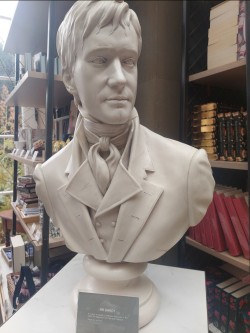
Matthew Macfadyen as Darcy in the Chatsworth giftshop.
Even if motivated by a desire to show their love for a subject, literary tourists can still be criticized for engaging in behavior that damages or sexualizes works of sculpture. The prop portrait bust of Darcy (as portrayed by Matthew Macfadyen) from Joe Wright’s 2005 film Pride & Prejudice can still be found in the gift shop at Chatsworth—with the polite notice “Please do not kiss!” to prevent over-enthusiastic fan engagement. While this notice is a humorous nod to heritage industry signs reading, “Please do not touch,” it raises the question of how we engage with art and what behaviors are acceptable and appropriate.
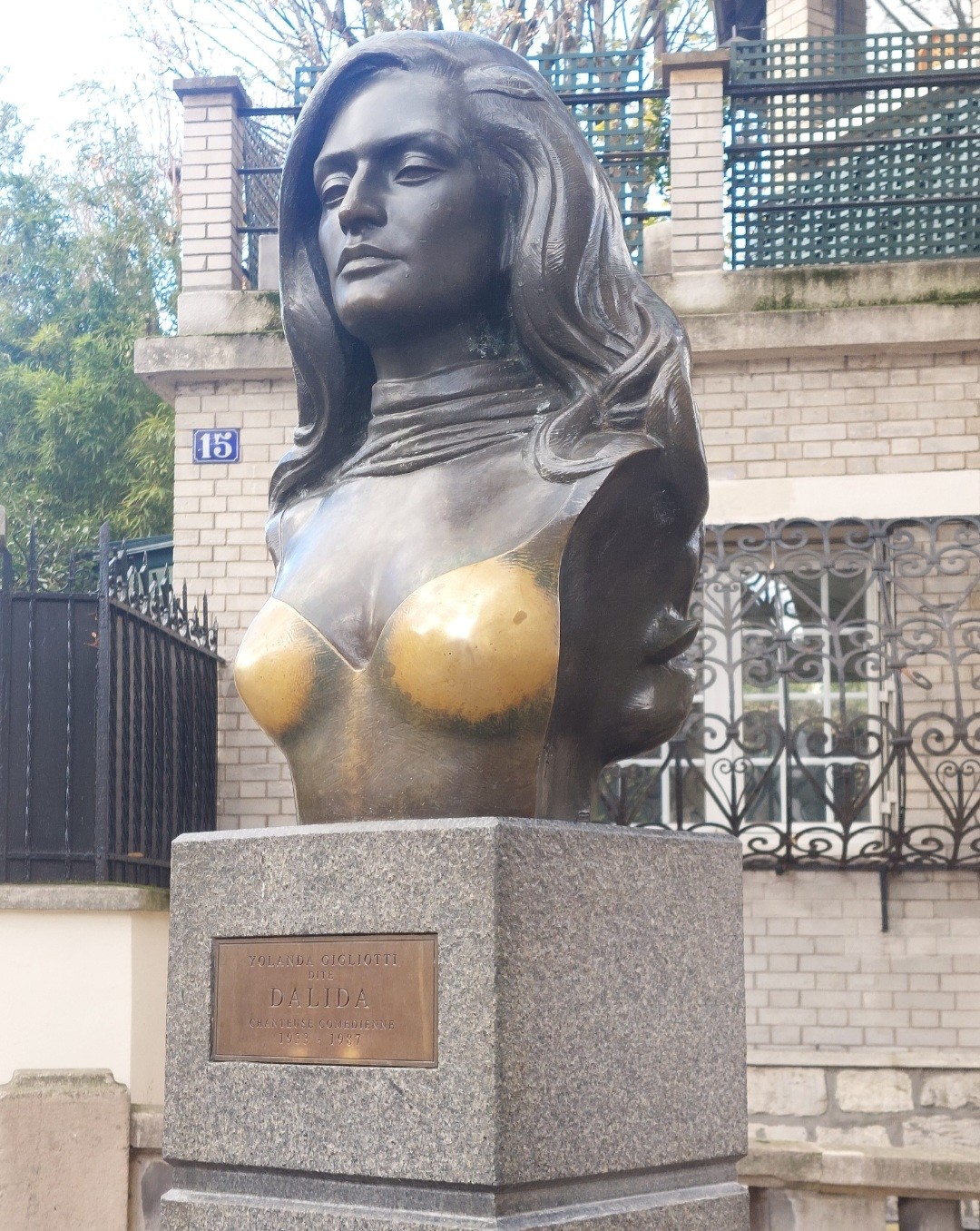
On International Women’s Day 2026, an artistic intervention drew attention to the damaging and misogynistic practice of rubbing the breasts of statues for luck. Artist Lucie Lesterlou Tarride, known as Luz, who believes that the act of touching a statue’s breasts risks normalizing sexual assault, made “armor” to cover the bust of the singer Dalida in Montmartre. The fabric corset covers the nipples with mirrors to encourage a potential perpetrator to reflect on themselves, as does the embroidered message: “Regarde ce que tu fais, Regarde-toi” (“Look at what you are doing, look at yourself”) (Luz).
 |
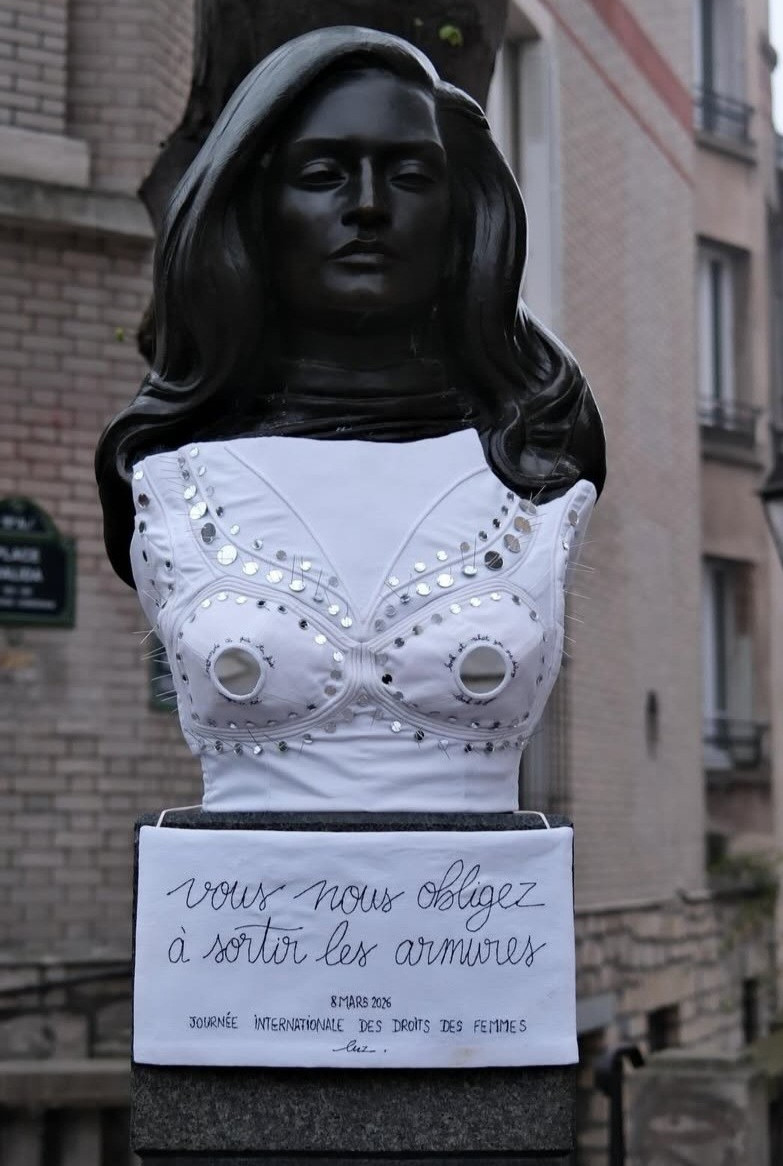 |
| Dalida, by Aslan (1997). Armor by Luz (2026). (Click on each image to see a larger version.) |
|
Artist Rory Macbeth reported being “sickened” by the behavior he witnessed of men groping and kissing his hyper-realistic waxwork of Flora in the city center of Leeds. Though his waxwork replicated a living-statue street performer, the perceived reality of the figure did not prevent inappropriate public interaction. Instead, the figure’s perceived reality was used as an excuse to justify behavior: “When I call them out on [it], their response is always the same, ‘oh sorry, I thought she was real.’ Which is obviously profoundly worse, if you’re groping her” (Blakey and Port).
Since antiquity, public sculpture has been a target of protest, but Martin Jennings, the sculptor of Winchester’s statue of Jane Austen, notes that this cultural moment is a particularly difficult time for the art form: “there’s a considerable degree of uncertainty, even embarrassment about public statues. People don’t quite know what to do with them these days. And it all started with the sculpture of the slave trader Colston being dumped in the harbour in Bristol” (193). The toppling of monuments on both sides of the Atlantic as part of the Black Lives Matter movement has brought public sculpture to the forefront of public consciousness regarding who is commemorated and why. In the UK, the twelve-foot bronze statue of Winston Churchill in Parliament Square became a target for Black Lives Matter and the global environmental movement Extinction Rebellion during 2020 protests, and was more recently defaced by Palestine Action in February 2026. As an image of a political figure, located outside the Houses of Parliament, the statue of Churchill is in a very different context from the new statue of Austen—but as Devoney Looser has described, there is a long history of Jane Austen’s being co-opted for different political points of view (2–3).
What’s more, when a public sculpture is created for a community, it is worth considering who is being celebrated and what the subject stands for. With just 2% of named statues depicting people of color, the stories being told occupy a limited spectrum (Goodwin and Jenkins). The statistics published by Art UK are regularly cited amid calls for more diversity in the people and stories represented. Campaigns for representations of women writers have resulted in statues of Mary Wollstonecraft, Agatha Christie, Aphra Behn, and Virginia Woolf. The monument to Mary Wollstonecraft on Newington Green by Maggi Hambling has attracted backlash, however, for its depiction of a naked “everywoman” rather than Wollstonecraft herself.2 Emma Evelyn Roberts has argued that “the statue opens up some interesting debates about public monument culture and the embrace of more abstract works that are informed by a community rather than the ideas of one artist.” While a more abstract work has the potential to reach beyond the individual, Hambling’s small, naked figure rising from an amorphous base says more about the vision of the artist than about the subject—or indeed the community. For Julia Long, a resident whom The Guardian reported to be disappointed by the work, “the problem is this seems to be about an artist’s ego. The fundraising campaign was called ‘Mary on the Green,’ not ‘Maggi on the Green’” (Thorpe). Although Hambling’s single-minded artistic vision would not be as controversial if it were a private commission, the demands are different within the context of public sculpture, where the community of stakeholders includes local residents as well as literary tourists and fans looking to recognize their own ideas in the figure represented.
Literary tourism and Winchester
Every sculpture gains meaning from its location—and tourism brings money. Basingstoke is proud of its connection to Austen and pleased with the monetary bonus it has brought. The 2017 commemorations of Austen’s death, which included the installation of the bronze statue by Adam Roud in Basingstoke Market Place as well as the “Sitting with Jane” project—a free public art trail of twenty-four Book Benches with unique Austen-themed designs—reportedly generated a £21 million boost to the Hampshire economy (“The Jane Effect”; Krueger). Because the parsonage at Steventon was demolished in the 1820s, perhaps Basingstoke is the next best place for a statue of Austen, but debate about the suitability of a location raises the question of what makes a site significant. What constitutes a meaningful enough connection for fans to make a pilgrimage? Must Austen have been born there, died there, gone to school there, stayed there, or danced there? Perhaps making a purchase warrants commemoration, given that a blue plaque has been granted for the building where the Reverend George Austen purchased Jane’s writing desk (Crossman). A 2017 episode of the long-running British drama series Midsomer Murders, titled “Murder by Persuasion,” investigates a death at a Regency roleplaying weekend in a village Jane Austen supposedly once visited to take tea in 1801. The tenuous connection is used to gently mock the consumer-led side of fan culture and literary tourism, as well as the fandom’s appetite for “sacred sites” to visit.
While Winchester has not capitalized on Austen tourism to the same extent as Bath, the desire to commemorate her in the city is long-standing. In a journal entry for 1858, eminent politician, essayist, and historian Thomas Babington Macaulay (1800–59) recorded his plans to commemorate Jane Austen: “If I could get materials, I really would write a short life of that wonderful woman, and raise a little money to put up a monument to her in Winchester Cathedral” (Austen-Leigh 249). Macaulay’s death prevented his plans from coming to fruition, with James Edward Austen-Leigh lamenting, “Oh! That such an idea had been realised! . . . A memoir written by him would have been a monument” (112). Austen-Leigh’s own A Memoir of Jane Austen, Claire Harman argues, opened “the floodgates to speculation” that led to Austen’s becoming seen as “public property” (154). Yet an anecdote he included reveals that Winchester was already a site of literary pilgrimage.
In the Memoir, James Edward Austen-Leigh recounts the story of a gentleman visiting Winchester Cathedral during the 1860s and asking the verger to be shown to Austen’s grave—a request that was met with the reply, “Pray, Sir, can you tell me whether there was anything particular about that lady; so many people want to know where she was buried?” (91). The very fact that visitors were inquiring suggests that, even then, Austen had a degree of posthumous fame that was attached to Winchester, even if her significance was unknown to this particular verger.
Austen is buried in the north nave aisle of Winchester Cathedral. In addition to her ledger stone, there is a second memorial nearby, added in 1870, which acknowledges her writings. This brass plaque, designed by James Wyatt, was funded by the royalties from James Edward Austen-Leigh’s Memoir. A stained-glass window dedicated to Austen and paid for by public subscription was installed in 1900—but since there is no imagery relating it to Austen or her work, it can be easily overlooked.
The Cathedral welcomes literary tourists looking to pay their respects, and its website notes, “Visitors often leave letters and flowers next to Jane Austen’s brass memorial plaque, at the side of her grave.” Yet among the complaints regarding the plans for a statue of Austen raised at the public consultation was Elizabeth Proudman’s argument that “Jane Austen was not a Winchester person” (Oliver, “Austen Statue”). Phil Howe agreed, calling Winchester’s plans “disproportionate” when Basingstoke has a stronger connection and a “fine, fitting, elegant and modest statue” already in place.
Plans to erect a statue in the Cathedral grounds have been fraught with setbacks. Sculptor Martin Jennings’s original design was shelved in 2019 after public backlash, but a redesign set in motion plans for a sculpture to be finalized in time for the 250th birthday celebrations.3 As noted, criticism centered on the location, with the proposed site eliciting a flurry of letters published in the Hampshire Chronicle under headlines ranging from “A special and overdue artistic tribute to national treasure” to “Winchester need not hijack the Jane Austen brand” (Volz; Howe). The Inner Close, however, has changed significantly over time, and the Reverend Canon Dr. Roly Riem argued that “it should be seen . . . not only as the former site of two medieval cloisters, but also as a swathe of gardens, some parts of which have recently been opened for the pleasure of the public” (Oliver, “Jane Austen”). The Very Reverend Catherine Ogle added that the artwork will “bring additional meaning to a place,” with the depiction of Austen adding another layer of history to the site (Ashworth). Martin Tod, leader of Winchester City Council, argued, “A sense of place and sense of history are related reasons why people choose to live in and visit Winchester” (Barber).
Jane Austen’s time in Winchester represents one layer of Winchester’s history, just as Alfred the Great’s marks another. The gravesite of an author is a particularly popular site of literary pilgrimage. Paul Westover notes, “The draw of the grave was that literal, material proximity and limit, that sense that the author was, not just had been, there.” He analyzes the literary pilgrimage in terms of “ideal presence”—a term coined by Lord Kames to describe “the powerful sense that remembering and imagining the dead brings them close.” Westover says, “Literary tourism enacts readers’ fantasies of ideal presence: tourists ‘see’ history coming to life before them. Yet tourism also marks the limits of ideal presence. It insists that literary faith must have something material to work on, and it grasps for real presence beyond the ideal” (11). We crave statues to help materialize a sense of presence and satisfy the desire for an encounter with the dead or absent. A life-sized, ground-level sculpture aids the visualization process. This notion recalls Mark S. Phillips’s description of history as “a scene to be revisited” (323).
Statues of Austen
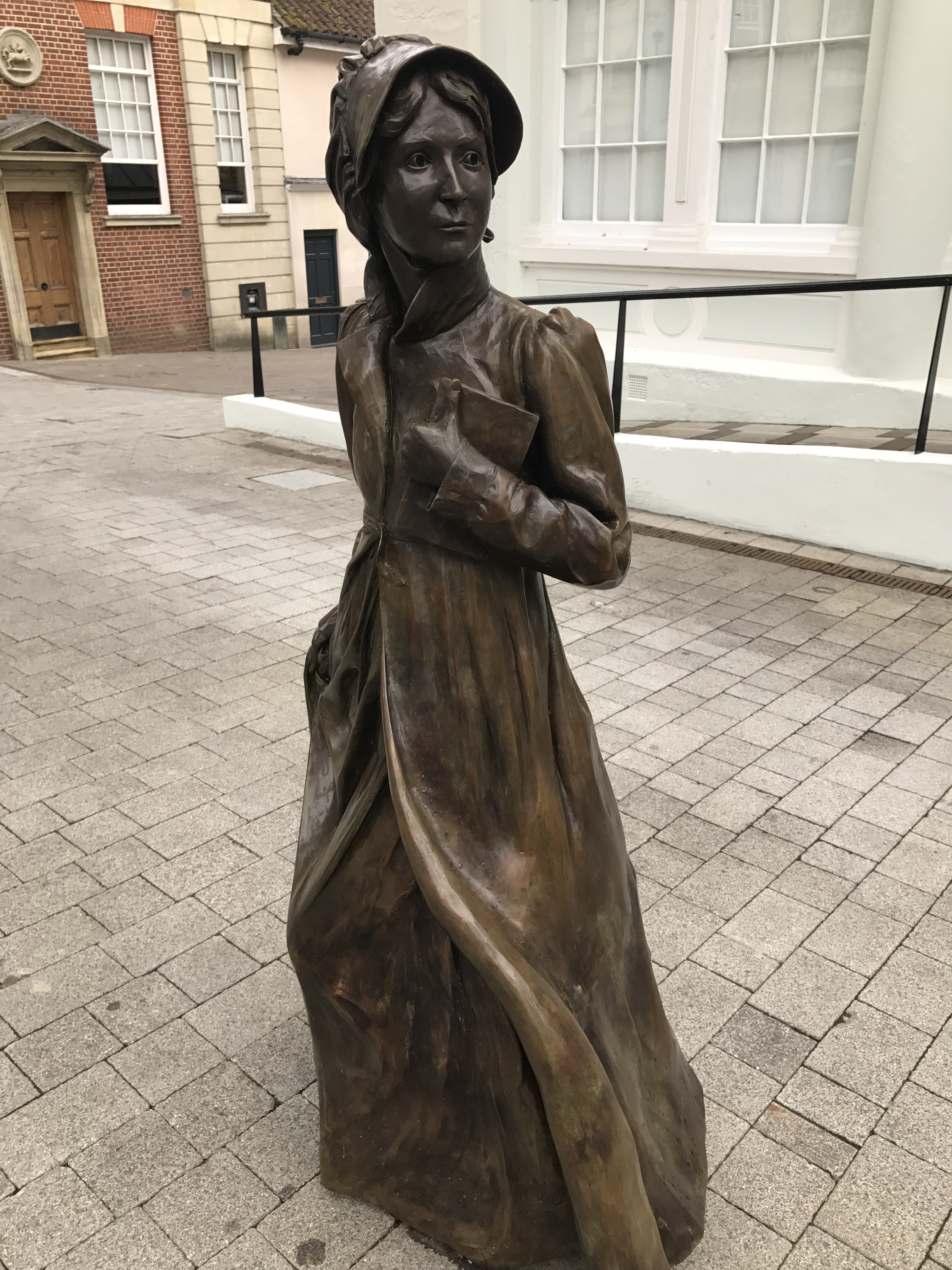
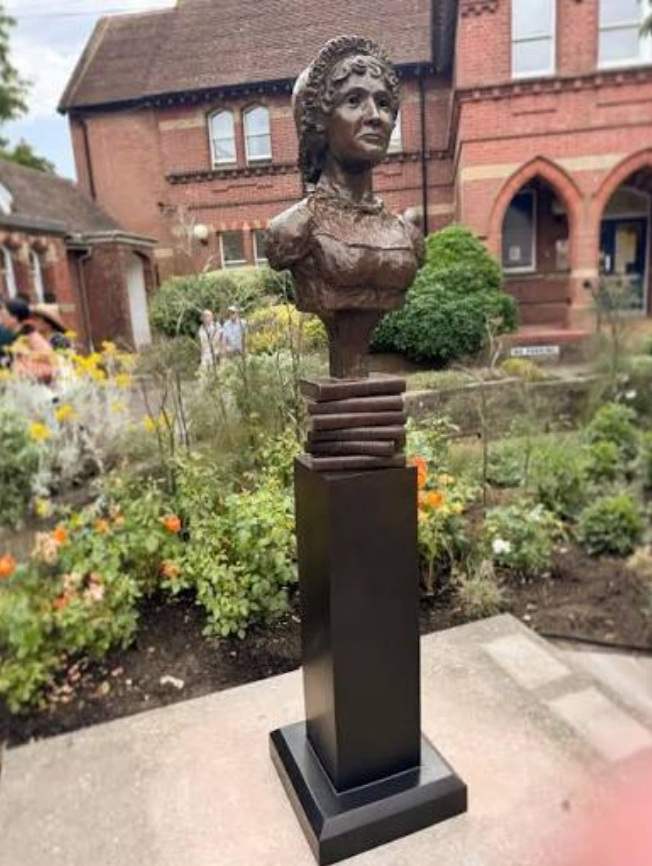
Including Jennings’s statue, there are currently four public sculptures of Jane Austen in England, all located in Austen’s home county of Hampshire.4 Basingstoke lays claim to being home to the first of these sculptures, unveiled on 18 July 2017 as part of the events to commemorate the 200th anniversary of Austen’s death. The ground-level bronze figure, standing just short of life-sized at around 5 feet, was created by Basingstoke sculptor Adam Roud to give the impression of Austen striding through the Market Square, proudly clasping a book to her chest.5 Chawton’s village church is home to a maquette—or quarter-size model—of this work, while the neighboring town of Alton has more recently, to mark JaneAusten250, unveiled Mark Coreth’s bronze bust of Austen perched atop a pile of books, in a garden setting off the High Street.
 |
 |
|
Jane Austen in Basingstoke, by Adam Roud (2017); in Alton, by Mark Coreth (2025). |
|
Robert Truscott’s small-scale piece “Jane Austen at Work” (2017) was temporarily displayed in Winchester Cathedral in 2017 to commemorate the 200th anniversary of Austen’s death. The 38.5-cm-tall piece depicts Austen seated, leaning over her desk, immersed in the act of writing. “Jane Austen at Work” has since been exhibited at Jane Austen’s House in Chawton, and a cast is currently on display at P&G Wells bookshop in College Street, Winchester—where, Truscott’s website notes, Austen is “documented having visited . . . , even taking tea with the proprietor on occasion.” Although these places are significant, they are not permanent installation sites. The small scale of Truscott’s work makes movement between relevant locations possible and means that fans can invest in a casting of their own for £5,500. Truscott’s interest in showing Austen at work means that her face is almost hidden from the viewer. As a consequence, the issue of likeness is avoided.
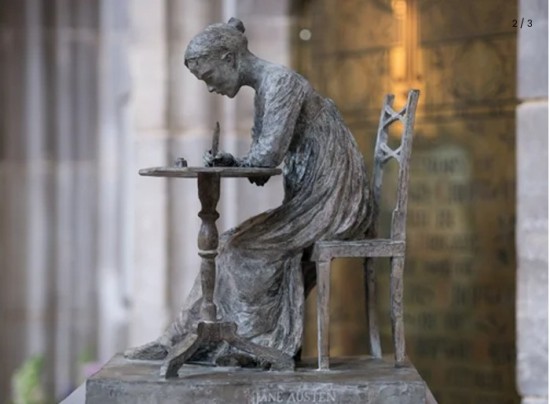
Jane Austen at Work, by Robert Truscott (2017).
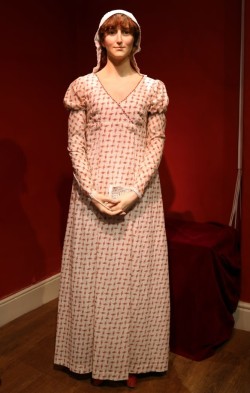
Jane Austen Waxwork, after a portrait by Melissa Dring, by Mark Richards, Andrea Galer, and Nell Clarke (2014). Jane Austen Centre, Bath.
The Jane Austen Centre’s waxwork of Jane Austen is another piece not classed as a public work of sculpture, but it is of interest due to its mode of production—“forensic reconstruction”—and its location at a tourist hotspot for Jane Austen fans visiting Bath. The Jane Austen Waxwork—produced as a collaboration among sculptor Mark Richards, costume designer Andrea Galer, and former Madame Tussaud’s artist Nell Clarke—is based on the 2002 portrait of Austen by forensic artist Melissa Dring.6 Drawing on contemporary eye-witness descriptions of Austen, Dring used her experience working with the police on facial reconstruction to put together an image of Austen with rosy cheeks, long nose, and pointy chin that she believes is as close to a definitive likeness as possible. Nevertheless, the Jane Austen Centre includes the following proviso on its website:
As . . . the modern-day Jane Austen fan (or Janeite) can be very opinionated to the point of over-protectiveness, with some going so far as to see themselves as the self-appointed guardians of her image, this figure is almost certain to provoke controversy. (“Jane Austen Waxwork”)
The Centre acknowledges that while there is a strong desire to know what Austen looked like, an image will never be able to satisfy everyone.
Jennings’s statue of Jane Austen
These depictions of Austen were joined by Martin Jennings’s life-sized bronze statue of Austen, unveiled in the grounds of Winchester Cathedral in October 2025. Jennings (b. 1957) is an award-winning sculptor, particularly known for his depictions of literary figures. His works include John Betjeman at St. Pancras Station (2007), Philip Larkin for Hull’s Larkin25 commemorations (2010), Charles Dickens in Portsmouth (2014), and George Orwell outside the BBC Broadcasting House (2017). Jennings’s works are not limited to illustrious males: he has also sculpted British-Jamaican nurse Mary Seacole (2016) and Sheffield’s Women of Steel (2016). All these sculptures are rooted to the place, whether the city of birth in the case of Dickens, or the building whose future Betjeman worked so hard to secure.
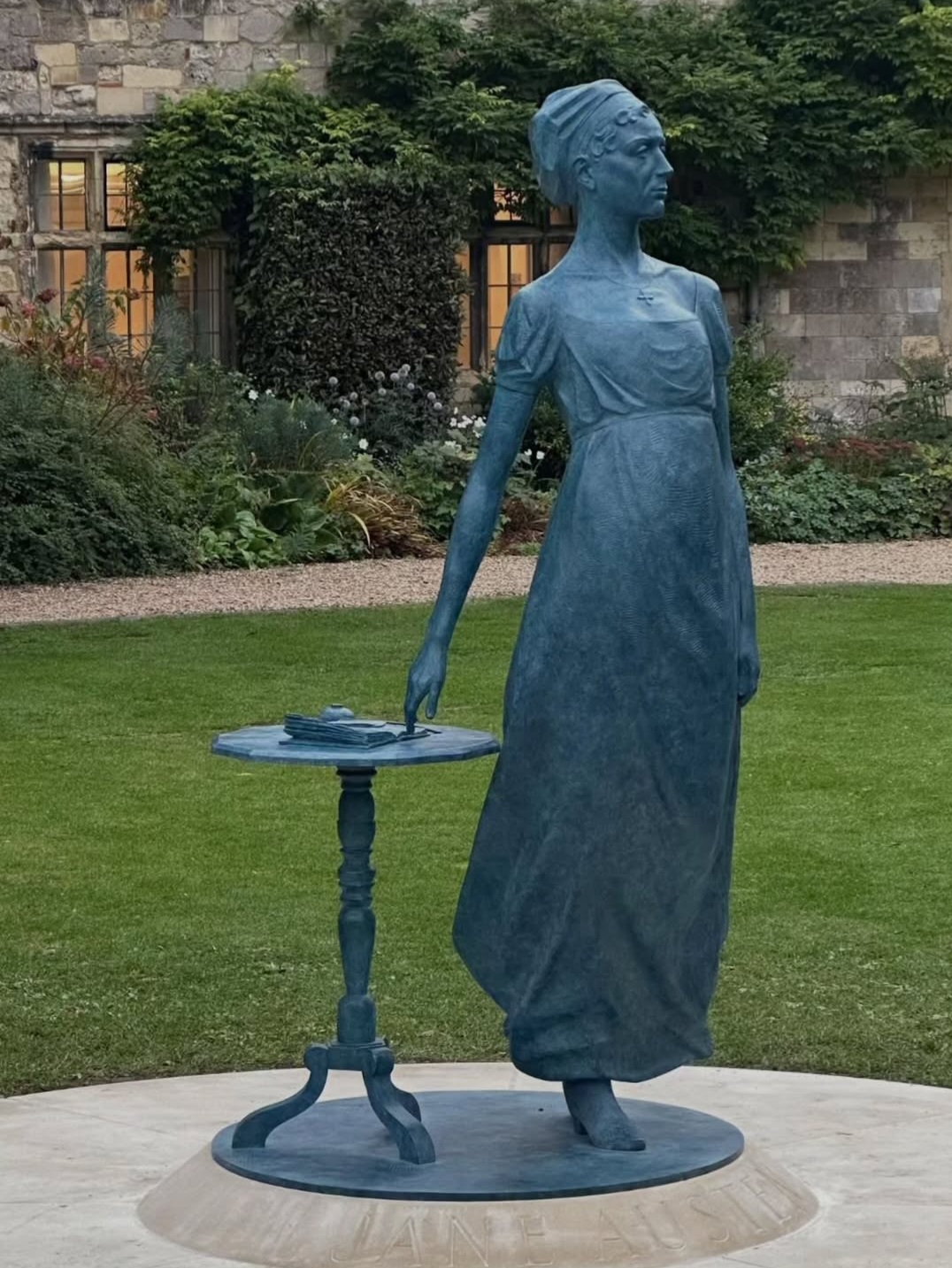
Martin Jennings depicts Jane Austen at ground level, standing with one hand lightly resting on the table beside her, having just risen from her writing. She is thus associated with her writing, without being depicted in the act. She wears a cap and flowing Empire- line dress, which follows the curve of her body as she strides out. Her face is unsmiling and determined.
 |
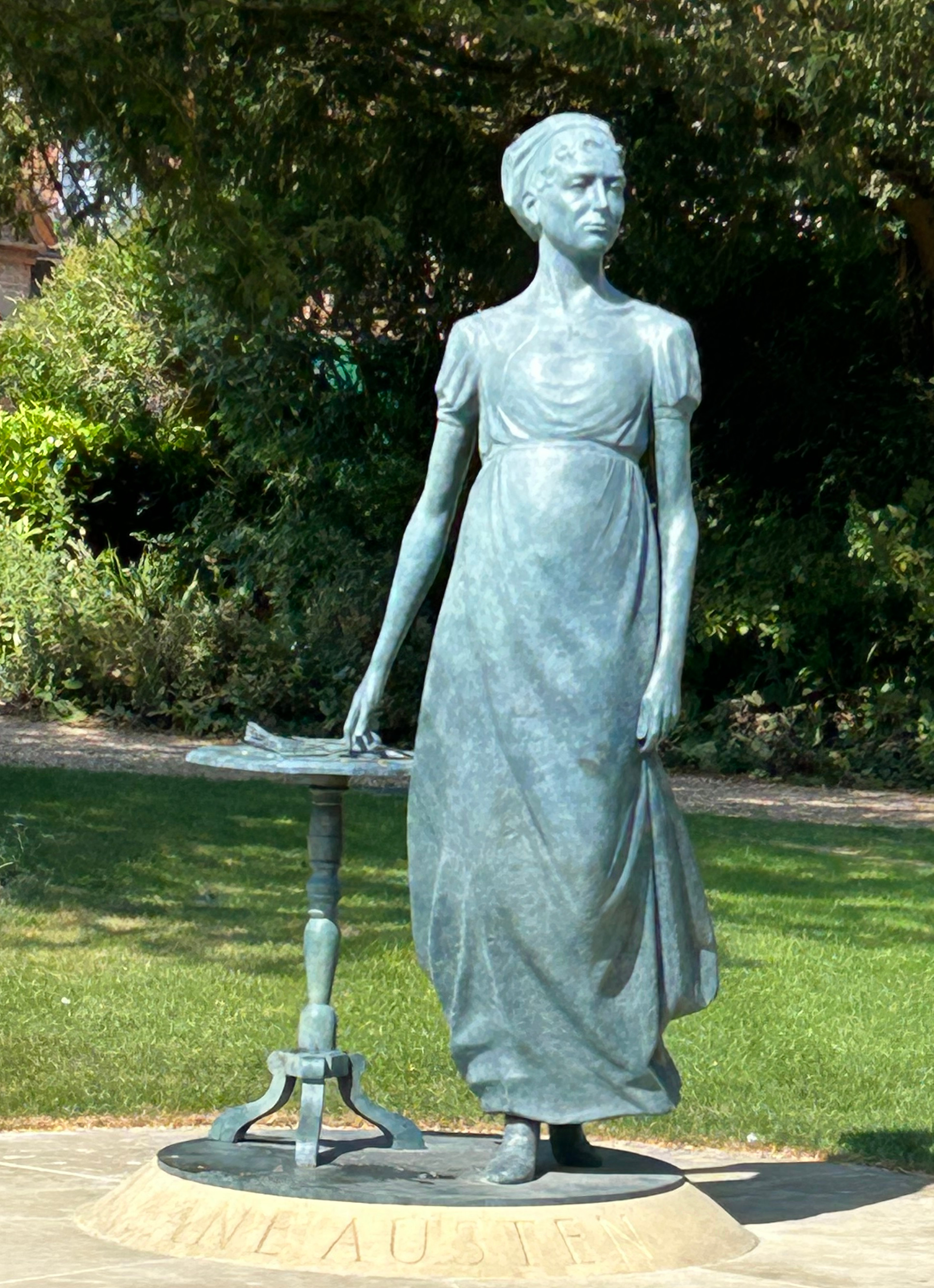 |
| Jane Austen, by Martin Jennings, in the Winchester Cathedral Close (2025). (Click on each image to see a larger version.) |
|
Jennings has spoken openly about how his sculpting of Austen has been different from his other experiences, due to the weight of fan expectation: “People have very strong feelings about how she should be represented. I’ve been surprised at the fervour with which people care about this. I haven’t met it with any of the other authors I’ve represented” (195). This “fervour” illustrates Deidre Lynch’s assertion that “Jane Austen fosters in her readers, as most other literary giants do not, the devotion and fantasies of personal access that are the hallmarks of the fan” (111).
Jennings had not only fan expectations to contend with but a lack of evidence. Jennings’s sculpture—like all the existing statues of Austen—aims for realism, even if we don’t really know what she looked like.7 The two sketches of Austen produced by her sister, Cassandra—one of which views her from behind—are the only extant images that we know were taken from life. Although Cassandra was a skilled artist (Barchas), the small watercolor image (ca. 1810) held by the National Portrait Gallery is a quick sketch of a rather cross-looking Austen. Her niece Anna Lefroy thought this portrait “hideously unlike” her aunt (qtd. in Sutherland xlvi). Jennings describes what he learned from the written record, which “suggests she had quite a long nose, small mouth, large eyes” (196).
The gap in our knowledge effectively leaves space for fans and artists alike to create their own imaginary versions of Austen, pieced together from the images we have seen and our experiences of reading her works.8 Martin Jennings has acknowledged the difficulty these imaginary notions pose for a sculptor:
People do hold her close to their hearts. Her enthusiastic supporters talk of her as if she was their close friend and they will have a strong notion of who that person is. This is my interpretation and I hope I’ve got something of her in there. (196)
As Claire Tomalin notes, “many readers feel strongly that she is their personal property, not to be tampered with or subjected to questions and theories” (285). While Tomalin’s caution focuses on Austen’s biography, the same is true of her portraits and statues, as can be seen in the social media response to Jennings’s statue.
The social media response
Social media provides a point of contact for anyone in the world to voice their opinions, whether they are Hampshire residents, fans of Austen and her works, or casual readers. Winchester Cathedral received a boost in engagement across its social media channels during the unveiling of Jennings’s statue of Austen. The Cathedral’s Instagram account (@winchestercathedral) has 19,300 followers, and over the course of 2025 most posts gained between 10 and 100 likes, with a successful post achieving 200 to 400. A post from 7 February 2025 on conservation projects was the most liked post, with 3,814 likes. A video of the unveiling of the Austen statue from 16 October 2025 gained 1,053 likes, 163 shares, and 24 comments, and the same day another video of the unveiling captured by travel influencer @awinchesterwoman, with @winchestercathedral tagged as a contributor, went viral. As of 1 March 2026, this post has received 459,000 likes, 38,900 shares, and 2,053 comments—a record high for both accounts, revealing the appetite for Austen content and the promotional influence of social media.
A sample of the top 100 comments from @awinchesterwoman’s post shows a debate regarding the “harsh” appearance of the statue in comparison with other images of Austen, largely triggered by the comment, “They could have made her a little more gentle looking. Her face is like a harsh nanny. I always imagined her with a more dreamy facial expression.” The responses to this comment call out the internalized misogyny:
So much misogyny in one comment.
You asking a female to smile is that it.
It’s her face? People with harsh faces aren’t allowed to write beautifully?
Not everyone can be an idealized version of who you expected them to be.
If her sister’s sketch is accurate, then she had a sharper face. I’m not sure why you think she needed to look like an insta filter.
The original commenter responded numerous times in self-defense, arguing for the right to express an opinion and referring to what we know of Austen’s appearance: “It doesn’t resemble any of the portraits. . . . [The few] we have in existence are much softer.”
Our expectations regarding Austen’s appearance can, of course, be traced back to the “softening” of Cassandra’s portrait, initiated when a “Mr. Andrews” was commissioned to produce an improved portrait based on her image. This new portrait was then engraved by Lizars for use as the frontispiece to James Edward Austen-Leigh’s Memoir. As another user comments, “I also learned from an exhibit that there are only two portraits of her existing from her lifetime and credible evidence that one the second one was based on was ‘softened’ because the family was concerned about their reputation.” Many comments on the Instagram thread show the persistent desire for Austen to be an example of ideal femininity, as participants describe their desire to see the “gentle,” “humble,” “dreamy,” “far-away,” or “peaceful” Austen they imagined.
While detractors of Jennings’s work find it too “stern” or “harsh,” arguing that “[t]hey made her look like a petty tyrant,” others find the depiction “determined” and “strong.” Many comments report gaining an internalized impression of Austen from her writings, but even this impression is divided between dreamy and romantic versus witty and sarcastic.
On Instagram, references to filters and appearance are common, so a second sample of 100 comments has been taken from the same unveiling video shared on Winchester Cathedral’s Facebook page. On the Facebook page, this video received 7,500 likes, 706 shares, and 756 comments (as of 1 March 2026). Again, this increase in engagement is significant for an account that more usually obtains 10–100 likes per post. If we take the first 100 comments as a sample, the responses can be divided in terms of the following themes: perceived level of attractiveness; gender; pose; likeness via comparison to other images or celebrity figures; and personal experiences of illness.
Many of the comments left on Facebook—as on Instagram—similarly criticize the appearance of the statue as too “harsh,” describing the face as “severe,” “austere,” “haughty,” “humourless,” “grim,” and even “ugly.” Once again, the idea that Austen should be depicted smiling comes to the fore. What can be seen as a subjective preference descends into misogyny with the reference to sexually motivated touching and physical violence:
[A] smile might be nice
Perhaps at least a smile and less severe eyes.
They’ve given her the sort of face that needs a slap!
[It’s] as if someone pinched her bottom!
While these postings might be characterized as light-hearted banter, the sentiments reflect the findings of artists Rory Macbeth and Luz described earlier, whereby the boundaries of what is deemed acceptable behavior towards art overlap with the actual treatment of real women, normalizing verbal insults and sexual assault.9
The numerous references to Austen’s appearing masculine in the sculpture are part of this disturbing gender politics. While some commenters value the statue’s stereotypically masculine traits of strength and determination, the idea that Jennings’s Austen does not appear feminine enough is a common criticism: “I think she looks like a man”; “[D]id he get a bloke to model for him?” Even without a definitive likeness of Austen, there is an expectation that she will be presented as young, able-bodied, and conventionally pretty.
One thread of this conversation centers on the choice of a male sculptor to complete the commission: “I feel they should have commissioned a female sculptor. . . . [I]t would be fitting that we should look at this great writer as a female artist would imagine her.” The argument that a woman would be better placed to represent Austen based on shared worldview, however, falls apart when the Basingstoke statue by Adam Roud is cited as a prime example of a successful work: “much more in keeping with her character.” Robert Truscott’s statue of Austen seated at her writing desk, displayed in Winchester Cathedral in 2017, is also described as “much preferred” by this commenter. Entering the debate himself, Truscott suggests that we are just not used to seeing statues of strong women: “female strength is more subtle it’s less obvious how to convey compared to proud soldier or statesmen statues we are more accustomed to.” Mark Ryan’s Facebook comment that “we have a haughty violation of Jane Austen’s wit—because she happened to die here” met with a response from Martin Jennings: “I thought it was important to contradict the erroneous impression of Austen as a soft homely figure” (Keay).
The current trend for statues of women to be seated on a bench and/or accompanied by a pet makes the figures approachable, but this style of representation is in direct contrast to the “proud soldier or statemen statues” Truscott refers to, and it can overly feminize a woman’s appearance. As one commenter remarks, “At least there’s no dog. Usually when there’s statues of famous women they put a dog with them.” For Truscott, the solution was to place “emphasis on her writing rather than presenting her in the form of a conventional statue” (Robert Truscott Sculptor). In Jennings’s work, Austen is depicted rising from her writing, one hand touching the table. There are accusations, however, that she looks like a drunk steadying herself or that she appears arrogant:
In postural terms it is very ego driven. Surely Jane’s intellect and wit had no need of such a “pushy” stance?
[B]ut why is she sticking out her belly? Very odd pose.
Looks like the prow of a ship, they bent backwards.
Some defenders of Jennings’s choice of pose draw on their historical subject knowledge, citing the aesthetics of the time to explain the curve:
[I]t’s artistic flow and exaggerates the form of the time as in empire line. Echo to Ingres depiction of the female form from that time.
The pose is lifted directly from the fashion plates of the period.
As seen with the debate around the harsh appearance of the statue versus the softness of the ideal Austen, commenters are keen to justify their position through an assertion of visual literacy, rather than a purely aesthetic judgment dependent on personal taste. They appeal to sources—whether biographies, exhibitions, or other artworks. Still others report similarities between Jennings’s statue of Austen and celebrity figures: “I thought it was Vanessa Redgrave”; “Why does she look like a young Maggie Smith?” There is a desire to find familiarity or a degree of recognition when we look at a face.
Another pattern to the comments is that some commenters want to see themselves, or their experiences, reflected in the work. One person interprets the pose as a consequence of Austen’s illness: “perhaps if you had Addison’s disease u would understand.” When asked to elaborate, the commenter confides that “when kidneys are causing pain I tend to stand like this as I have kidney disease too.” Jennings has not commented on Austen’s illness as an influence on his depiction, but that does not diminish the validity of this type of response to a work of art. This interaction illustrates how a personal response to art combines the viewer’s own life and experiences with their knowledge of the subject—just as Elizabeth Bennet approaches the portrait of Darcy at Pemberley. Viewing art is not so much about critiquing artistic skill as about viewers’ evaluating a piece in relation to their own expectations and experiences.
To deflect accusations of subjectivity, some commentators have turned to consider what Austen would have made of the statue, considering her sense of humor. Speaking at the unveiling, cultural historian Michael Wheeler said, “I think she would also be surprised and amused that we have come together with a memorial statue of her” (Thompson). It is impossible to know exactly what Austen would think of the statue, but she was very aware of—and amused by—fashions in art, joking about the possibility of being painted by Joshua Reynolds “all white & red, with my Head on one Side” (3 November 1813), and she often considered the issues of likeness and location of artworks in her writing. We are told, for instance, that Elizabeth Bennet is no connoisseur of art; yet it is only when faced with Darcy’s portrait that she can take the time to evaluate her prior experiences in comparison to what she sees, hears, and experiences at Pemberley. The gap between Elizabeth’s experience and that of the housekeeper, Mrs. Reynolds, creates an opportunity to re-evaluate her perceptions. For Kazuko Hisamori, the wider context surrounding the painting needs to be taken into consideration, as “Austen enlarges the concept of the portrait itself” by “including both the symbolic landscape view of the estate and the housekeeper’s viewpoint of her master.” The location of the portrait is highly significant; Darcy and Pemberley are effectively one and the same, with one influencing the view of the other.

With issues of class, power, and social dynamics in play, spaces where art is displayed are not neutral. In both public and private spaces, what artworks are chosen and how they are displayed can influence or divide opinion.
Engagement with the statue of Austen in Winchester will be influenced by the negotiation between pre-existing knowledge and other people’s opinions, as well as by the setting. Encountering Austen amid the mud caused by the hustle and bustle of a busy Christmas market will undoubtedly feel different from stopping by a cathedral close to take a selfie, read a novel, or picnic on a sunny summer’s day; and opinion will be divided on the suitability of the setting for each of these activities. Will the sign asking people to stay off the grass while the new seed takes root be obeyed? This new sculpture of Austen in Winchester thus marks the latest iteration of what Deidre Lynch terms the “drive to discriminate between proper and improper Austen enthusiasms” (113).
It remains to be seen how the public will engage with Martin Jennings’s statue of Austen over the long term: perhaps literary pilgrims will touch her hand to have literary genius or a happy marriage bestowed upon them. The social media response generated from the unveiling, however, provides an initial insight that shows how sculpture is both deeply personal and political: viewers desire to find some kind of familiarity, as well as for the sculpture to speak to wider concerns. Their expectations about how Austen is, or should be, represented are shaped by society. Austen is part of a wider conversation about public sculpture and engagement with such sites, and the commentary is ultimately symptomatic of a lack of consensus regarding how a statue of a woman writer should appear.
NOTES
1The statistics for 2024 and 2025 haven’t yet been published.
2Hambling’s proposal was chosen by the selection committee over a more conventional design submitted by Martin Jennings, who went on to sculpt the new Austen statue for the grounds of Winchester Cathedral. For a report on Jennings’s Wollstonecraft design, see https://www.westminsterextra.co.uk/article/visions-of-mary.
3The rejected 2019 design “involved a kind of screen behind her with the branches of a tree running across it” (Jennings 190).
4This number does not include Robert Truscott’s “Jane Austen at Work” (2017), as it was not commissioned for public display in a freely accessible fixed location.
5Austen is believed to have been 5 feet, 7 inches tall.
6 For more on Melissa Dring’s forensic portrait of Jane Austen see https://share.google/hrJWf1iY8S36mnIqy and https://janeausten.co.uk/blogs/from-the-jane-austen-centre/the-jane-austen-portrait?srsltid=AfmBOoon6YP1iPBgH8X2WBwFLty7E3qBYWg2ZGa8yqRO083aRKoNTAcV.
7For more on portraits of Austen, see “Portraits of Jane Austen” on the JASNA website).
8See also Deborah Kaplan’s essay on the subject of the desire to create our own images of Austen, particularly in the context of the controversy over the Byrne portrait.
9See also Camilla Wallin Lämsä’s essay in this issue for more insight into sexual violence and social media response.
